
How will the upcoming “super” El Niño affect Sonoma County?
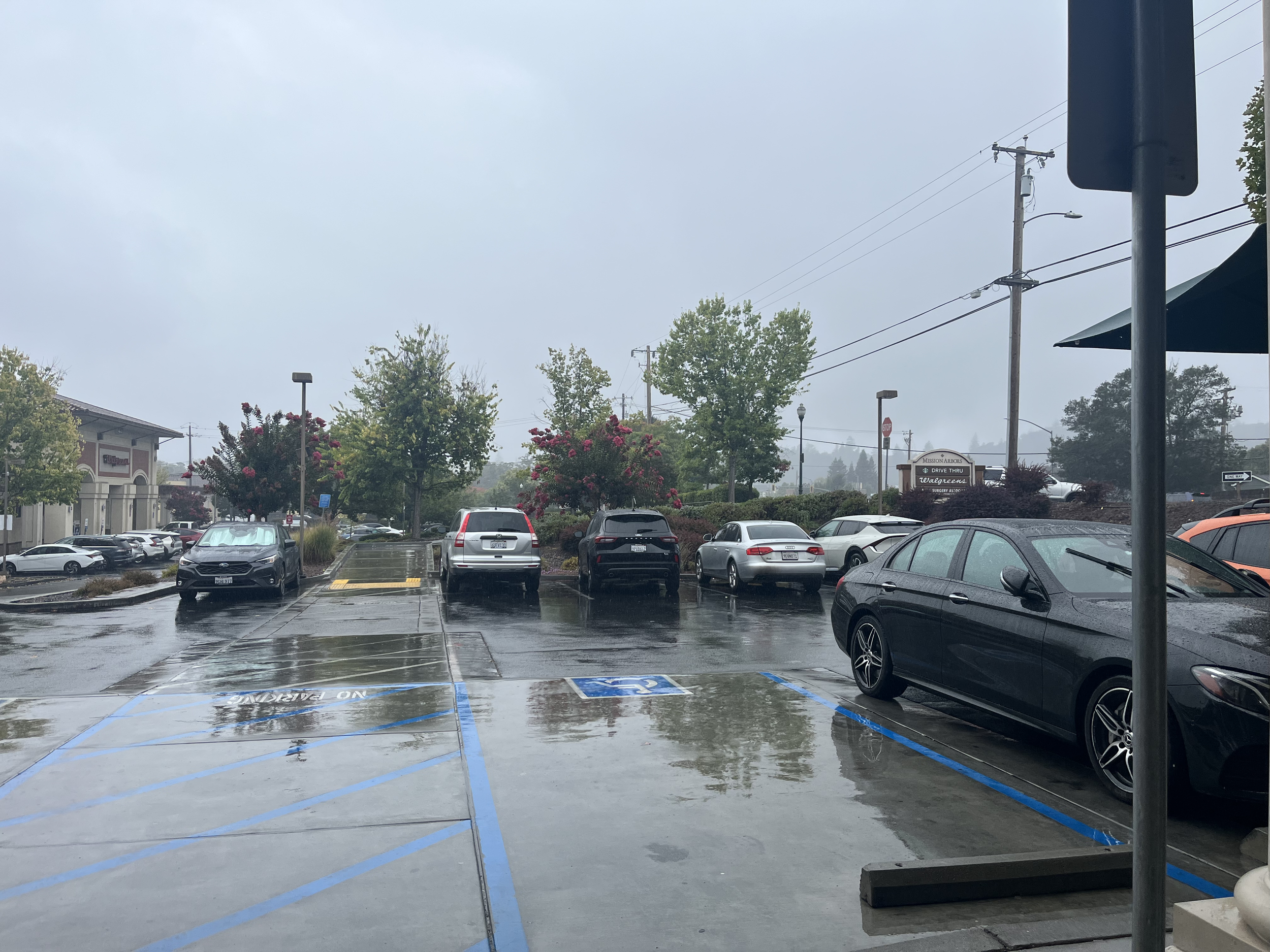
Early rainy weather in a parking lot on September 3, 2026 (Ruby Costa / The Puma Prensa)
By Ruby Costa, Co-Executive Editor
When heavy rain began to fall during the first week of September, it became clear that we would be in for a wet end to our year. This weather trend is not simply local, however — it is actually an indication of an international weather phenomenon that will affect wildlife, the environment, the economy, and the everyday life of citizens all over the world. As such, this phenomenon has been appropriately dubbed an upcoming “super” El Niño.
El Niño and La Niña are phases of the El Niño-Southern Oscillation (ENSO) cycle, which is an irregular naturally occurring climate pattern. El Niño and La Niña years, however, mark extremes of this cycle, and lead to severe weather conditions, natural disasters, and can have devastating impacts on fishing-reliant economies.
The upcoming “super” El Niño is not an entirely uncommon occurrence, though much research has been done to prove that global warming due to human activity certainly intensifies the frequency of this weather event. Even so, just because the ENSO cycle is natural, that does not mean that it cannot have extreme effects on the world, and that it cannot cause extreme harm.
In many areas of the world, hurricanes and tropical storms are a serious concern, as well as extreme droughts—which can disrupt agriculture—in others. Luckily, the effects of this El Niño might be more mild in Sonoma County, but residents should still prepare.
What to expect in Sonoma County
1. Increased rainfall: This is a definite possibility, so it's best to gear up for wet weather with proper clothing and utilities. The humidity could rise due to warm, wet weather, though this can be combatted with a dehumidifier.
2. Warmer weather: Though fall and winter temperatures will likely not exceed 80 degrees, the weather will be warmer than usual. This will be reflected at night, with temperatures not reaching low extremes, and the days being more mild, even in the dead of winter.
3. Coastal flooding: Because of warm weather creating higher sea levels, coastal and low-elevation areas will likely experience increased flooding and coastline erosion.
Aside from the effects on residents, the weather brought about by the “super” El Niño will be a stresser for local wildlife, and the coastal flooding can disrupt ecosystems both on land and in the water. When the water becomes warmer, it can kill marine life or force species to relocate, creating a domino effect on other organisms that rely on these marine animals for food or resources. On the other hand, marine animals that thrive in warmer conditions might relocate to the Bay Area, which could lead to sightings of species that would not normally be living in colder waters.
The effects of this “super” El Niño are unfortunately not yet subject to change by scientists, though there are ongoing conversations on how humans can try to mitigate the damage caused by extreme weather, with many solutions relating to reversing climate change.
In the meantime, it is important to know how exactly this extreme weather will affect Sonoma County, and to be prepared for how to prevent damage due to flooding. Certain areas of Sonoma County are more prone to flooding than others, and this potential risk should be just as discussed as fire safety.
The Federal Emergency Management Agency (FEMA) has released preliminary flood risk maps for the city of Santa Rosa, shown below. Being prepared for potential flood risks, and educated about the effects of the ENSO cycle on local residents and wildlife, are equally as important and crucial for the upcoming fall and winter.