
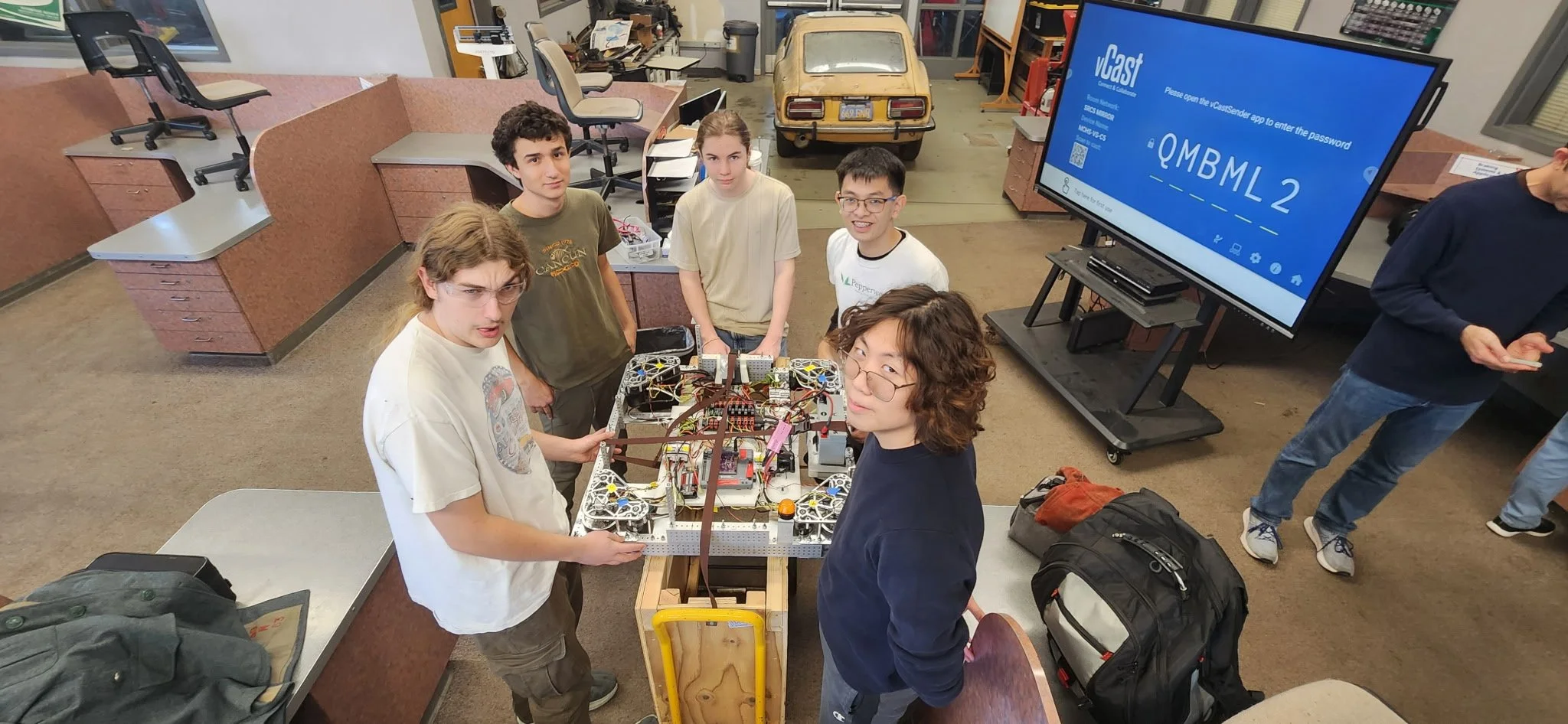
Maria Carrillo High School Robotics Club early season photo (Chase Soylu Chee/The Puma Prensa)
Maria Carrillo Robotics Club & Team MC2 has been on a generational run this year, competing at the FIRST Robotics Competition within California. Here is a highlight of the team’s accomplishments this year.
Maria Carrillo Robotics Club, also known as Maria Carrillo Cybernetics, MC2, or Team 5728, is a STEM and Career Technical Education (CTE) club that allows students to collaborate with mentors and industry professionals.
These professionals help students build independent skills in science, technology, and engineering to better prepare them for higher education and/or for future careers in high-demand STEM and CTE fields.
MCHS Robotics Club is not your typical club. Every year, the club is tasked with understanding the new game or rules regarding the FIRST Robotics Competition. With this, the club works with industry professionals from Medtronic, Keysight, and other organizations to fund, plan, and build a robot to compete for the chance to be nationally recognized robotics champions.
For Inspiration and Recognition of Science and Technology, also known as FIRST is a non-profit to support science, technology, engineering, and mathematics through a“coopertition” –a cooperative competition– building leadership, confidence, and teamwork skills.
Since its rookie year in 2015, Maria Carrillo Cybernetics had played in one distinct qualifier within California until 2026, when the team was able to play in two district qualifiers. This year they got the chance to compete in the playoffs, unlike most years.
During their first qualifying competition at Pleasant Grove High School in Elk Grove, California, with a few of the best teams in California playing against them consistently, MCHS Robotics Club was ranked dead last.
The Robotics Club did not let the score get to them. The club started working hour-long days on spring break, upgrading a whole entire robot drive from a Tank Drive –a drive that moves like a tractor– to a Swerve Drive –allowing driving in any direction and rotating anywhere.
The Robotics Club's second qualifying competition –in Pittsburg, California– at Pittsburg High School ranked #17 but refused to play in the playoffs due to scheduling conflicts in the Drive Team.
Speaking of, the drive team consists of three members, three of whom are permitted on the field during a match. Two of them are drivers who operate the robot directly and communicate with their alliance partners’ drive teams to coordinate strategy during matches. The third field member is the human player, who plays an active scoring role by throwing the ball into their team’s HUD (goal) at the start of the game.
Furthermore, the whole game has matches that begin with a 20-second autonomous period, where robots operate automatically while human players attempt to score by shooting into their HUDs.
After the autonomous period, robots operate automatically while human players attempt to score by shooting into their HUDs.
Following this period, gameplay alternates between teams in timed score shifts.
Second Shift: 25 seconds for the opposing alliance to score into their HUD.
Third Shift: 25 seconds for the other alliance to score into their HUD.
Fourth Shift: 25 seconds for the opposing alliance to score into their HUD.
Fifth Shift: 25 seconds for the other alliance to score into their HUD.
For the final and sixth shift, both teams receive 30 seconds of open scoring, where all robots and human players may score simultaneously. At the end of the match, the alliance with the highest score and the fewest penalty points is declared the winner. Each full match lasts a total of 2 minutes and 40 seconds.
Not only does Robotics need to prepare their robot for the competition, but they also need to follow a 166-page manual that features a lot of FIRST’s Robotics expectations, such as “gracious professionalism,” which encourages students to compete fiercely with empathy and respect. During the game, groups of judges go to pits and interview teams regarding the manual.
An expert in FIRST Robotics Competition is engineer Eron Flory, the prospective Robotics course teacher and mentor for the Robotics Club. Due to current circumstances, Flory could not be hired due to class sizes and restrictions for next year.
When Flory learned about FIRST competitions, he was fascinated, “‘I wish I had [FRC] when I was in high school because they’re learning things.’ I realized then that the students are learning things in high school that I didn’t learn till after college, and they got a huge head start in what they’re doing.”
Looking to get involved, Flory found MCHS Robotics. “I started research on the internet, found contact with the right person, and got put in contact with [the previous president]... I think four years ago at Maria Carrillo, and they’re looking for a mentor.”
Ever since, Flory has been the head coach of the team, observing growth within all the members and the whole team. “It’s just amazing to me how much students can learn in ten weeks during the competition season, and it’s really satisfying to see them go off to college and have a better idea of what their careers are going to be,” said Flory.
“It was at the second competition, near the end, YenKhai (Vice President of the Club) finally had enough driving time to really be driving [the robot] well, and we’re actually contributing quite a bit to our alliances, and that was nice to see,” recalled Flory regarding his favorite moment during the year.
“The best things about the FIRST program in my mind is one is teaching people to cooperate and coordinate and communicate because you have to in the alliances, and that’s something that I’ve seen high school students now that are better at that than some of my co-workers who are Medtronic who were professional engineers,” exclaimed Flory.
Working alongside club advisor and Mathematics teacher Margie BradyLong, both researched CTE and other related courses. They reached out to an educator in Oregon who created a class years ago and drafted a proposal to the District.
The general outline for the club was to start basic robotics education, like VEX Robotics, which has templates that could support learning for FRC. Afterwards, Bradylong fought to get the course approved by the district, but due to the budget cuts, it was uncertain.
Sadly, the course has been taken off next year’s courses. The district has decided to cut almost all of the CTE courses except for Culinary, making the Auto Technical Room dominant for next year.
Almost all of the Robotics roster consists of seniors. This leaves the club with three individuals; without the course, the club would have a hard time recuperating. On this, we get to hear Carter Herrault, lead programmer and one of the few underclassmen on the team.
“I joined the Robotics team because I was interested in electronics, programming, and mechanics since eighth grade…. I wanted to take that hobby a step further, and robotics shows that you’re pretty much halfway to becoming an engineer for colleges,” said Herrault.
Without Herrault, the club was on life support. The lead programmer codes the autonomous, kinematics, and other miscellaneous systems on the robot that feature camera movements, sensor systems, controller input, and shooting. It goes to show how every member is vital for the team.
With a course, instead of a club, the school could support the robotics cause. “Some of the robots are intricately crafted by sometimes more than 100 people, [and] are perfect machines. They perform great. Compared to our robot, which was a very complicated thing. They were leagues above what we could ever hope to produce with our current manpower and resources,” said Herrault.
If the club became a course, Robotics could receive more funding and attention on their competition and goals, setting them up to get higher placements in qualifiers and go off to playoffs with a better robot and a stronger, more motivated team.
Looking back at the competitions, “I would say spring break was definitely impactful. It was the day we went to the first competition, we were testing the robot, and I felt a real sense of camaraderie between me and everyone else on the team,” said Herrault.
With the club looking like a course in the near future, Herrault sees a revitalization within the Robotics scene at school. “The club, you know, was purely voluntary. You could call sick, ‘Hey, I have practice, I got this one class…’ The fact that there are grades and incentives to do well means you can really optimize what people do and time management,” said Herrault.
Robotics is essential to keeping Maria Carrillo High School’s reputation of producing power producers, universal citizens, masterful communicators, and active learners. Having robotics would answer that age old question of “What is it like to be an Engineer?” or “Is Engineering right for me in College?” as many struggle to decide or even think of what major or program is right for them.
Thinking of what could have been, Flory remarked “I think it’ll be good for the club for one because you have more people exposed to how fun Robotics can be. It’s also going to help some students pick their college majors… I think when you get exposed to something like that and get hands-on, you’re either going to like it or you’re not. But it’s going to answer a lot of questions in your mind whether your college plan and after is the right one.”