
“马年到了!”: How the world celebrates the Lunar New Year, and why we don’t
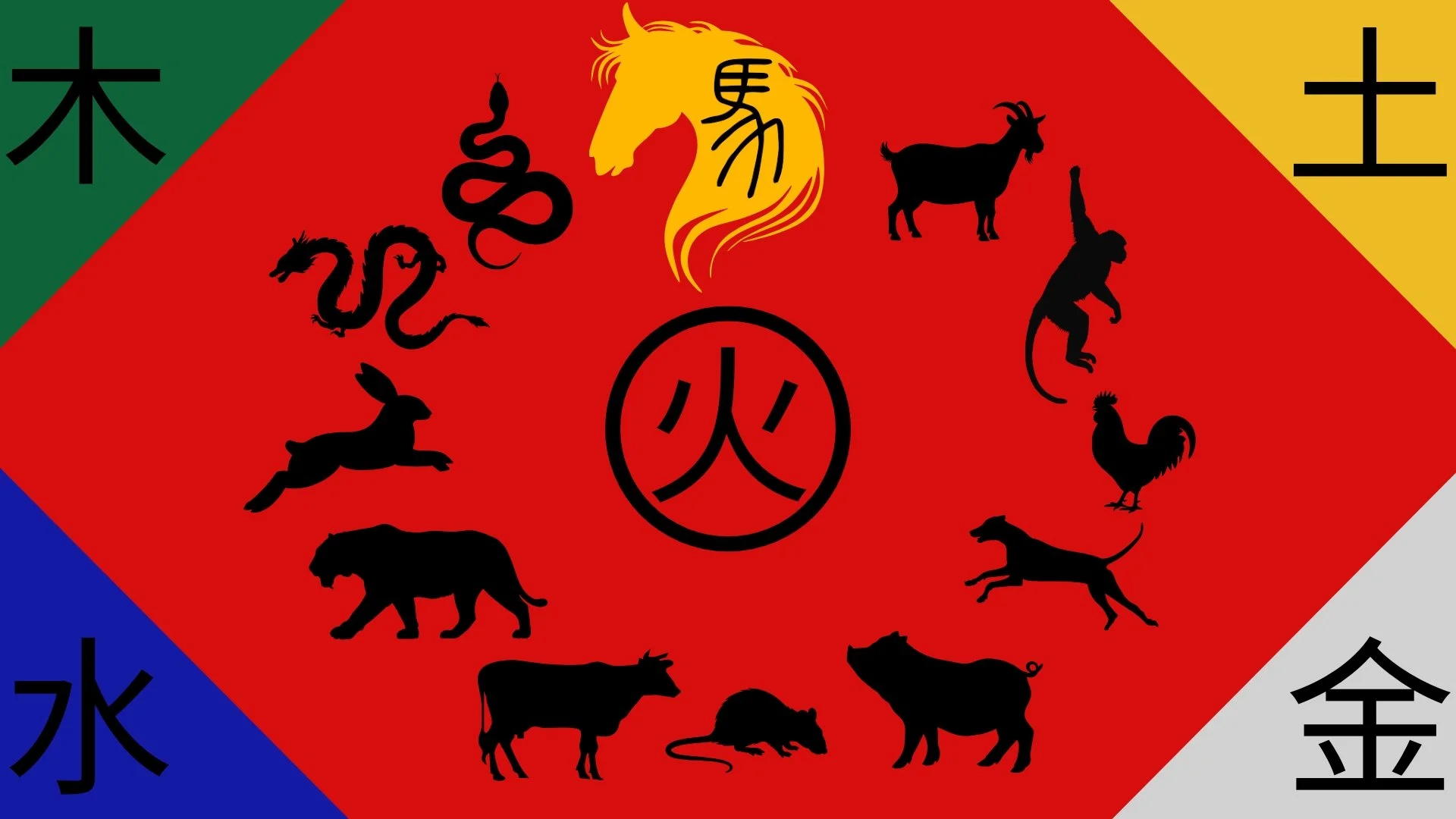
A graphic of the twelve animals and five elements from traditional Chinese folklore (Ryan Win-Ruan / ThePuma Prensa)
By: Ryan Win-Ruan, News Editor & Esmond Hoang, Staff Writer
For over two thousand years, the Lunar New Year has been one of the most prominent and relevant celebrations in East Asia. And every February, the world prepares to celebrate it in various ways.
The Lunar New Year, or Chunjie (lit. “Spring Festival”) has its origins in Shang Dynasty farming festivals (~1500 BCE), where people held festivals for their ancestors at the beginning and end of the year, an event traditionally celebrated in the Spring. Eventually, it solidified into a national festival during the Han Dynasty (~200 BC–200 AD), and later spread across Eastern Asia before finally transforming into the version we know today.
Based on the traditional Chinese Zodiac (as well as later Daoist beliefs), the Chinese New Years occur in a 120 year cycle; twelve animals, five elements, and Yin and Yang versions of each.
In China itself, this year marks the coming of the Year of the Fire Horse, and was celebrated with robotic performances, a marked departure from the traditional modes of celebration, yet a concept fully in line with China’s spirit of innovation and technological advancement.
This year, the festivities are taking hold internationally, as nations like Russia and Argentina host their own Lunar New Year celebrations on a massive scale.
Both in Eastern Asia and the U.S., many members of the Southern Chinese and Vietnamese communities typically celebrate the holiday, since those two regions have historically had some of the deepest ties to the Lunar New Year (called “Tet” in Vietnam) out of all cultures which observe it.
But despite the new scale of celebration, Maria Carrillo High School is noticeably lacking when it comes to Lunar New Years decoration. Although it is so celebrated throughout the world, Carrillo Live has never mentioned it once despite the campus’s Asian population.
According to the school profile from last year, roughly 8% of MCHS students are Asian, not including anyone who claims to be more than one ethnicity. Even though this percentage of students may seem insignificant, every student should feel acknowledged at least on such a major holiday. Santa Rosa is only an hour away from San Francisco, which holds a Lunar New Year celebration throughout Chinatown. San Jose is also known for celebrations because of the large Vietnamese community.
Many MCHS students take the trip to SF for the iconic parade or leave to visit family. Cate Huynh, an Asian-American junior, says that “We often go down to San Jose to meet with all the families." She recalls on that day, “We eat food, we visit graves, and we do the firecrackers, and then set out the offerings.” Although the celebration is not as grand as in other countries, it is still important to the people living in America.
During the month of February, Carrillo Live has been packed with skits, highlighting the spirit week, events, other holidays, and the fact that it is Black History Month. The additional work for Carrillo Live has made it one of the best months; however, why can’t the same love, or at least any love, be given to the Lunar New Year? The school has not even acknowledged the holiday at all.
The perfect chance would have been Feb. 17, right after the long weekend. This is the beginning of the year according to the Lunar calendar for 2026.
Another idea is to tie in a spirit day with it. Leadership could have done so on Friday, Feb. 13; it was a wear red or pink day, and they could have mentioned wearing red is good luck on Lunar New Year. However, Lunar New Year was not the only event overshadowed, as the month-long celebration called Ramadan, which also follows the lunar cycle, was not mentioned either.
MCHS could at least mention the Lunar New Year as a graphic in the beginning or end of the program. According to sophomore class president Yihe Wang, inside the hundred and more students in the leadership classes, there are only a handful of Asian students.
Therefore, leadership should research more so students do not feel misrepresented. Generally as students, we should learn and be educated about the cultural holidays around us.