
To block, or not to block
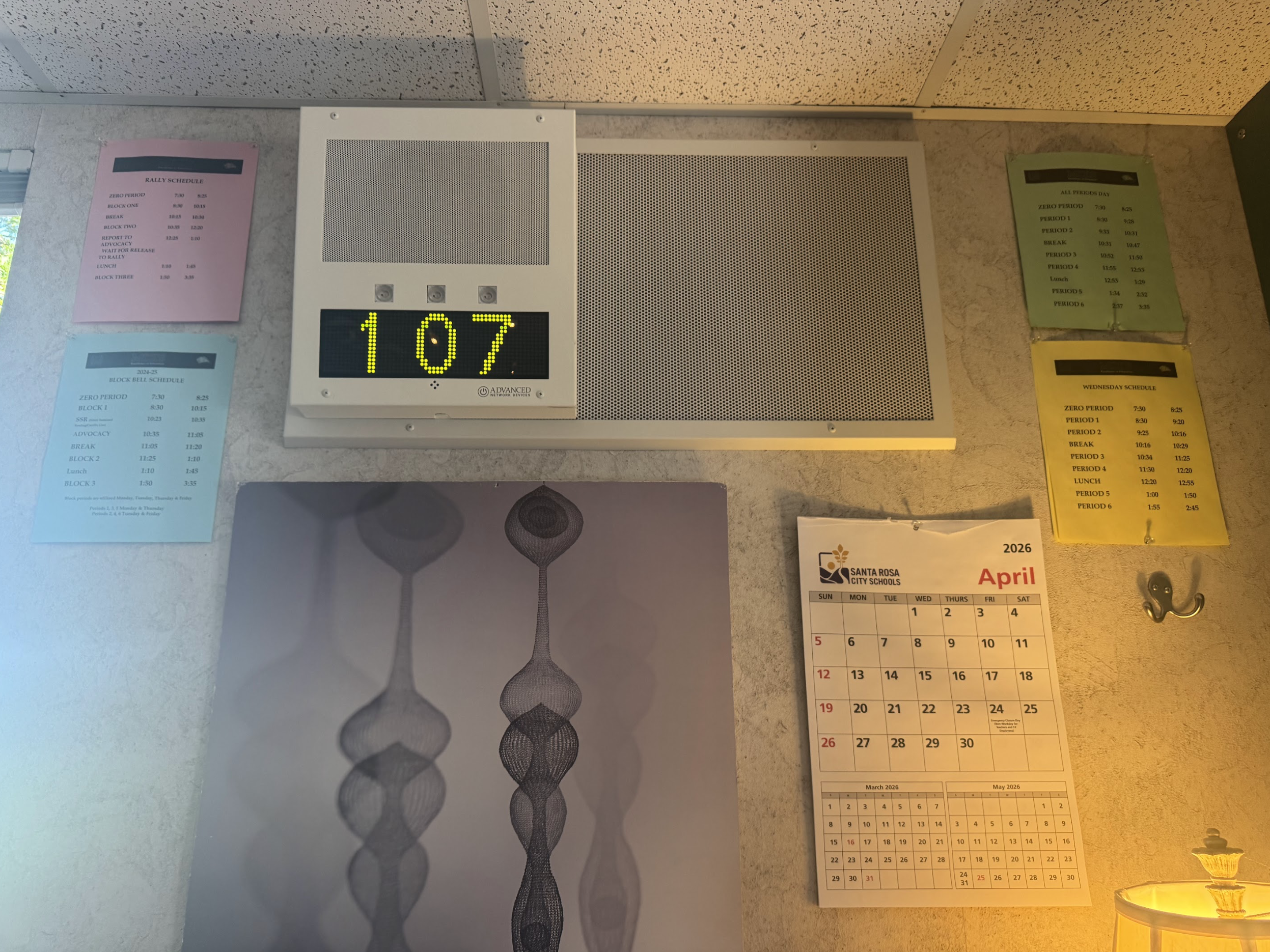
Photo of a clock in a classroom (Isa Dajalos / The Puma Prensa)
By Isa Dajalos, Staff Writer
From 8:30 to 3:35 students roam the halls and fill up the seats in the crowded classrooms of Maria Carrillo High School. Throughout the week, the schedule that students navigate through the day is split into two formats: block schedule and all-periods schedule. Block schedules are further divided into Block-A and Block-B schedules consisting of three classes each, with Block-A schedules consisting of first, third, and fifth periods, while Block-B consists of second, fourth, and sixth periods. These two schedules alternate around Wednesdays, which are the only all-periods day each week, meaning Block-A on Mondays and Thursdays and Block-B on Tuesdays and Fridays. As previously mentioned, Wednesdays are special in that students have all six classes–actually a more traditional schedule, but they also have an earlier release time of 2:45. While the alternating schedules throughout the week keep students on their toes, maybe preventing a midweek lull in motivation, is there science to back up the efficacy of either? And which do students actually find more useful? Let’s find out.
Let’s start with the schedule that takes up most of the week: the block period schedule. Block-schedules are made up of three one hour and 45 minute (85 minute) classes with a 42 minute study period known as Advocacy between the first class of the day and the break, adding up to just over a seven hour school day. These classes are stretched almost twice as long as traditional periods and there are obviously benefits and drawbacks to this. Where block schedules shine is in terms of allowing teachers to lead in-depth discussions or lectures with the extra time. Teachers can get into the nitty-gritty details of subjects and really hammer in important concepts with the students. Additionally, students can use the longer classes to complete meaningful work with the presence of a teacher that can answer any questions. Block classes also encourage working in teams because the longer classes are ideal for group projects. For these reasons, block schedules can provide a similar learning environment to many college classes if utilized correctly. There have been plenty of studies finding improved student performance with block scheduling, including a research paper by Dartmouth College which found that schools that implemented the A/B block schedule performed academically better, earning higher average GPAs.
Classes that especially benefit from block periods include art, lab sciences, and physical education because they address the issue of hands-on courses requiring more sustained periods of engagement that would otherwise be fragmented by a traditional 45 or 60 minute class. MCHS senior Sophia Partovi–who has taken three AP science classes–reinforced this belief, saying that “science classes are well suited to block days because you have time for a lab,” as well as “time for a lab write-up.” Regarding block periods in general, Partovi posited that “if you take advantage of [the time] you don't really have as much homework to do at home.” Because of this lightened homework load, Partovi added that the longer classes are particularly useful on the days she has work after school because she does not have to worry about completing assignments on top of her obligations outside of school.
However, the most glaringly obvious problem that could arise from a block schedule is that there can be too much time. When classes seem to just drag on a little too long, students get bored which can lead to behavioral problems or roaming around campus. Not to insinuate that students are naturally inclined to get into trouble, but it is important to recognize that there is not much for teenagers to be entertained by within a classroom that is likely to be considered productive or appropriate by teachers. And despite the statewide ban on phones in schools, there is always some sort of tech to subvert attention to during hour-long classes.
On the other hand, the traditional all-periods schedule finds its place in the middle of the MCHS school week. Each Wednesday students follow a schedule of six 50-minute classes with no Advocacy period, and end the day off a bit earlier at 2:45 pm. This traditional school day allows students the opportunity to meet with all of their teachers in one day and is a better fit for the ever-shortening attention spans of this technologically advanced age–not that short attention spans should be encouraged, just an acknowledgement of the truth. All-periods schedules enable teachers to break down topics into smaller, more manageable lessons for students.
Now, while students at MCHS have limited experience with all-periods scheduling, ASB President and senior at Santa Rosa High School Alicia Matunga has spent far more time in a traditional schedule, as SRHS operates on an entire week of all-periods days. Matunga described her experience with an all-periods schedule as “consistent and straight-forward” and went on to say that, as far as homework is concerned, she gets most of it done during school but pointed out that homework is something “heavily dependent on the classes you’re taking.” When asked about having sufficient time to complete meaningful work in class, she commented that she feels teachers typically dedicate the “right amount of time” to assignments which allows her to do her best. The sentiment of teachers’ adaptability being the backbone of student success is reflected at Carrillo as well, where Partovi had great things to say about teachers who adjust their routine for Wednesday’s shorter class periods. She stated that “the classes I've liked the most are the ones where you do something different on block days than you do on Wednesdays. So, you might do FRQ practice in an AP class on a Wednesday, and then the other classes might be lecture time or project time… I think it’s probably the best, when [teachers] take advantage of the fact that it's different time frames. If you just try to cram a full lesson in, it just does not work, and everybody is not happy.”
Outside of student reception of either schedule, there is obviously responsibility that falls on teachers to accommodate whichever is present at their school. With both schedules there is a certain weight that falls on teachers in order to best serve their students. Whether that be creating long lesson plans that keep a class full of students engaged for nearly two hours, or having a lesson plan for five days a week that splits the week’s agenda into intuitive chunks, teachers have to find their groove. And that groove is going to look different for each subject and each teacher, so maybe the hybrid block-all-periods scheduling going on at Carrillo is sufficient middle ground.