
“It’s impossible”: the difficulties of teaching a combo class
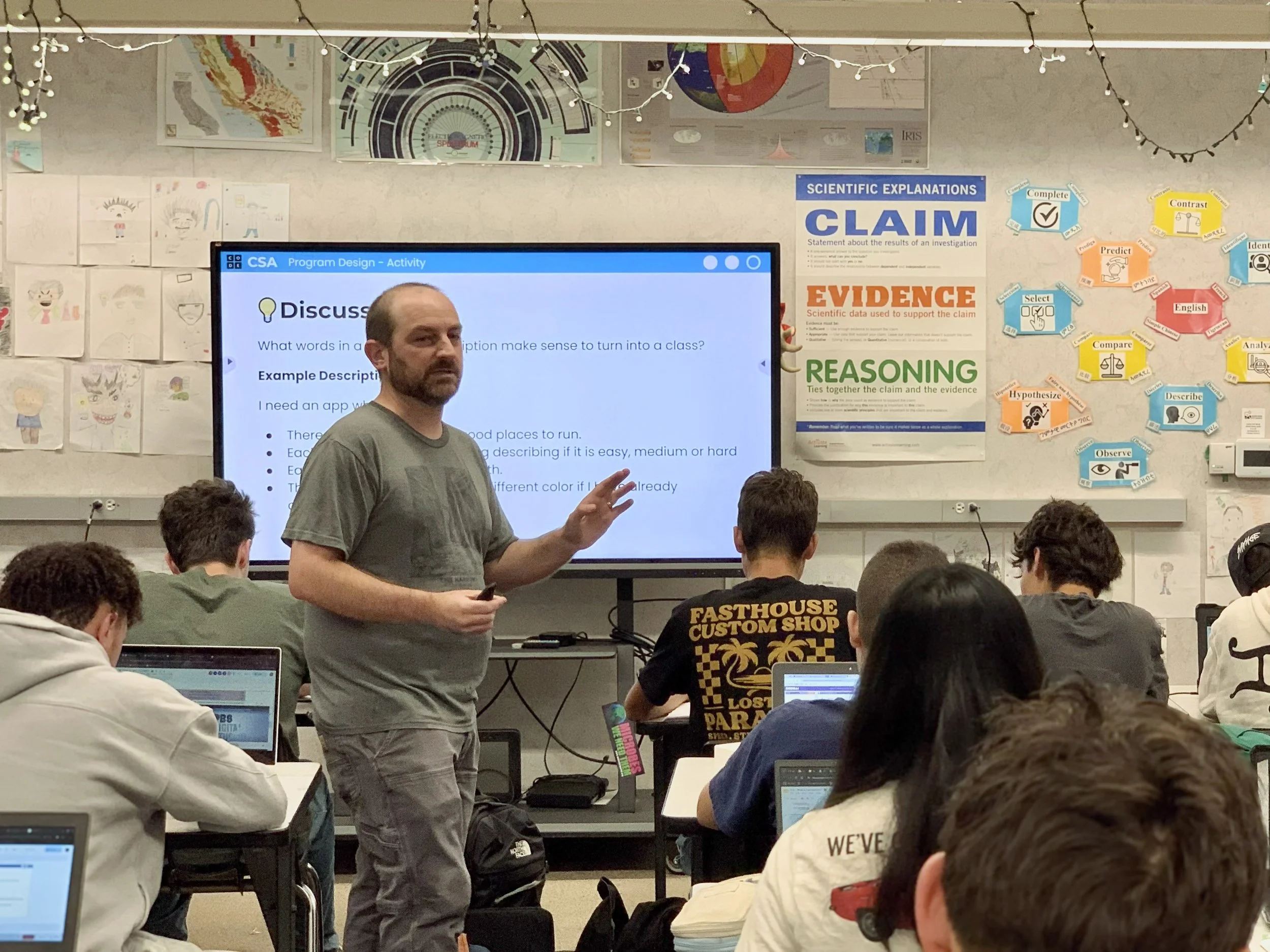
Tyson Ruszler teaching his Computer Science Principles class, while AP Computer Science A students work independently (Christopher Haraszti / The Puma Prensa).
By Christopher Haraszti, Staff Writer
Maria Carrillo High School students are no strangers to combo classes – they have existed in many departments over the years. However, the fiscal crisis and ensuing section reductions have made such classes, where a teacher has to teach two distinct classes at the same time, even more prevalent. This year, beyond impacting every single art program at Carrillo, they have also appeared in more academic subjects like World Language and Science, and pose an immense challenge to the teachers teaching them.
Tyson Ruszler is the department chair for Science and in his tenth year of teaching Earth Science, Computer Science, and now Biology at Carrillo. He has two different computer science classes during second period: Honors CS Principles and AP Computer Science A. He notes, “one is a broad overview of computer science topics and some programming in Javascript, the other is all programming in Java, which are different languages. So it's two totally different curricula that I'm trying to run side by side.”
“I didn't want kids to be forced from one [class] to another, so in order to be able to put together a section at all and to have enough students we had to combine them into one period,” says Ruszler. “So, this is an arrangement I was willing to do and I made that arrangement at the end of last year. I can do some planning ahead and make it work … because I’m a crazy person who can juggle and I'm comfortable with the curriculum, but I would not ask just anyone to do that.”
Maria Harrington has been teaching Spanish for twenty-eight years, and her sixth period is a combination of Academic Spanish 3 and Honors Spanish 3. “I didn't have enough [students] for the honors class, so they combined the class,” she laments, continuing in a tired tone, “the curriculum is completely different, I can’t even — it's so complicated that I am going loca - really.”
“Although I take some of the kids to the other room to work on something and I keep the honors kids to teach them something new and move a little bit faster … it’s really, really difficult and I feel like I can't do whatever I was doing before.”
Stephanie Contreras has taught French at Carrillo since 2012, and now teaches every French class in four periods, three of which are combo classes. She explains, “I have a section of French 2 and 2 honors combined, a section of French 3 and 3 honors combined, and a section of 4th year and AP combined.”
“I just think there aren't many of us high school French teachers, but we're really kind of stuck between a rock and a hard place because we are essentially forced to teach all these combo classes,” Contreras explains intently. She also remarks that despite teaching seven unique classes, likely more than any other academic teacher on campus, she only gets paid as a part time teacher with four classes. “You know, I want to be a French teacher, but I don't want to kill myself doing it.”
Despite the variation in subjects taught, Ruszler, Harrington, and Contreras all mentioned similar complications in teaching a combo class.
Ruszler notes, “with any type of transition you lose some time, so when I'm having to switch between which class I’m teaching, I can hold that in my head and do that just fine, but the transition time has a cost.… It just means we get through less stuff or I'd have to assign more things as homework.” The world language honors classes are meant to prepare students for the AP class and test, and Harrington is clear that her students “won’t be prepared for that class.”
Furthermore, perhaps surprising to some students, teaching such a class requires a lot of extra homework for the teachers. Contreras puts it simply: “And no matter if you have eighteen kids or thirty-eight kids, you still have to prepare a lesson. You know, you've got all these kids staring at you every day. You've got to be prepared.”
She specifies, “I was here for seven hours on Saturday…[It’s] just a lot of extra work. Tons of hours. And work always comes first.” Ruszler continues, “when you’re teaching you do a ton of unpaid labor, but there is definitely more than usual this year. I've been going home late every day all year, and I have to come in on the weekends to get stuff done.”
However, despite the difficulty, thirteen teachers across campus continue to teach such classes, most of them with multiple combo periods.
With a note of finality, Harrington laments: “I don't think it's fair to the kids to be honest, and it's not fair to the teacher either. A teacher can't do that, I mean, it's impossible. I'm doing my best, but I know I am not going to be able to teach as much as I used to.”
However, perhaps Contreras best explained why she continues to teach, despite all her combo classes and the challenge they pose. “My number one motivation is the kids, the students. I love my students. And I feel that they, you know, love me too in a way. The rapport I have with my students has always been a point of joy. I'll use a cliché French expression: un joie de vivre. Joy of life. We laugh every day. I mean, you guys are hilarious, you know?”
She continues, with a note of finality, “I feel like I have my fingers on the pulse of the world. Like I know what's happening out here, you know, on the ground.… Something more meaningful. It's a good feeling.”