
“Its ridiculous" – MCHS’s phone policy is here to stay
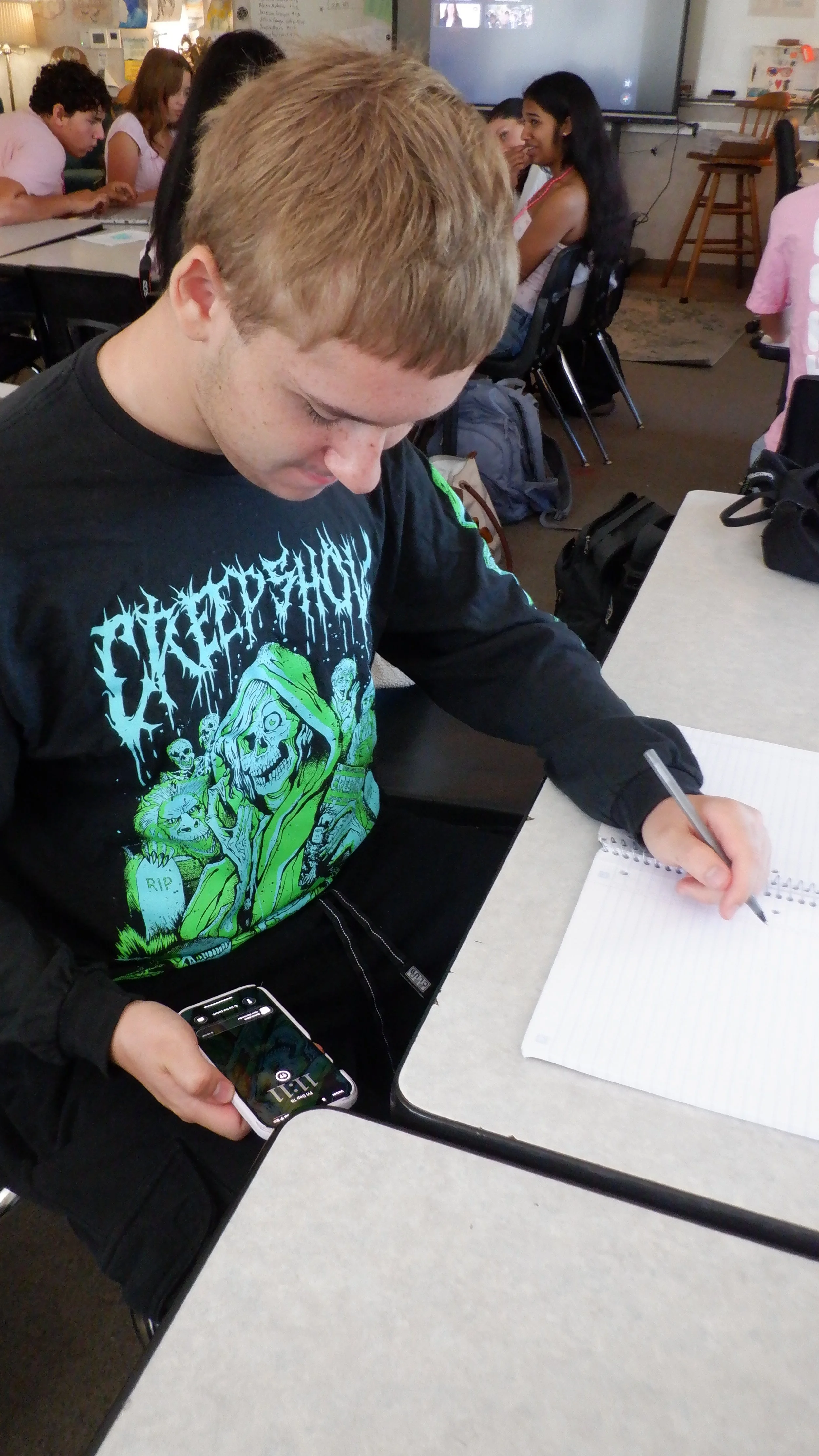
A student using his phone class (Aiden Damasco)
By Aiden Damasco, Features Editor & Web Developer, and Saayan Shah, Staff Writer
The phone policy has indeed lasted. And it’s here to stay.
After the introduction of Maria Carrillo High Schools’ very own phone policy during the 2025-2026 school year to comply with the Phone-Free School Act of 2024 early, mixed reviews were drawn from the school populace, many of whom deemed the early policy unnecessary.
However, now the law is in full enforcement, being backed up entirely by the state government. At Carrillo, the phone policy has experienced an evolution, with phones being banned for the entire day, including at breaks, passing periods, and lunch.
For many students, the updates have been incredibly harsh. “It’s ridiculous,” MCHS senior Jehan Staebell said. “It wasn't the worst last year,” he reflected, “but I’m a senior now, about to be an adult, and I’m being restricted on my phone usage.”
Staebell has also expressed his concerns about how the phone ban is affecting both his and his peers' education. “I can't put reminders on my phone in school, show my teacher something if there's a problem with my grades, etc.” Staebell believes that due to the severity of the policy, there are no changes that actually improve his, or his peers’ education.
While the policy is intended to reduce distractions and encourage students to stay focused in class, the stricter enforcement raises many questions about the removal of the practical uses of devices. Students feel that the removal of tools for organization, communication, and accessing information can create tension between the goals of students and the actual policy.
Brandon Moyles, another MCHS senior, brought up another point: phone usage is not the entire picture of student productivity, as people will still find loopholes. “Last year I saw quite a few students using their phones in class, but I see even more people on their laptop doing anything but schoolwork,” Moyles said.
This raises another question surrounding the policy: if the goal is to improve student productivity, is restricting one source of distraction really going to help when students have access to the other distractions? And what does the policy enforce if students can be exposed to even more distracting activities (such as games) on their laptop?
Moyles also believes that the answer is complicated. While he acknowledges that it’s a good thing that phones can’t be used during instructional periods, he struggles to understand the point of banning it during non-instructional time.
“I think the phone policy is pretty extreme in the way that you can’t use them during breaks and lunch, and even during advocacy. I don’t think it accomplishes anything, and these parts of the day are not instructional time, so I don’t know why allowing students to use their phones would hurt during these times,” Moyles said.
Moyles has also expressed a huge drawback for him due to the new phone policy. “I think a big negative is just the inability to communicate with people on your phone during the school day. All it takes is a singular text, and it’s kind of ridiculous that you can get your phone completely confiscated just for that, even during a break or lunch.”
But Cindy Lui, MCHS AP Precalculus and AP Calculus AB teacher, has been in favor of the changes made in the school’s policy, as well as the enforcement of the phone ban across California. “There is a reason it became a law in California… actual research has shown that it is damaging to mental health of young people.”
Lui has also noticed a positive change since the stricter policy has been implemented. She believes that students are interacting more with each other, especially during break and lunch. Before the policy many students would spend their free time on phones instead of socializing with the people around them. This is important, as socialization is a big part of many people’s high school experiences.
As Lui primarily teaches upperclassmen, she herself has not seen much phone usage amongst her students. However, this has not stopped her from noticing the possible problem that can arise with the implementation. If some teachers choose to not enforce the policy, it can cause friction among the staff. Students question why one teacher abides by the phone policy while the other doesn't, causing students to take sides.
Lui has acknowledged that phones can be used during instructional times, but only if used sensibly. She allows students to use their devices only in special circumstances, such as for taking pictures of their homework to upload to Google Classroom. “I think that routine has kind of reinforced the idea that there's responsible ways to use the phone.”
While students like Staebell and Moyles believe there is impracticability, flaws, and extremes in the phone policy, students and teachers alike will have diverse perspectives on the effect. Either way, students must learn to not utilize their phones, and use technology when it's appropriate.