
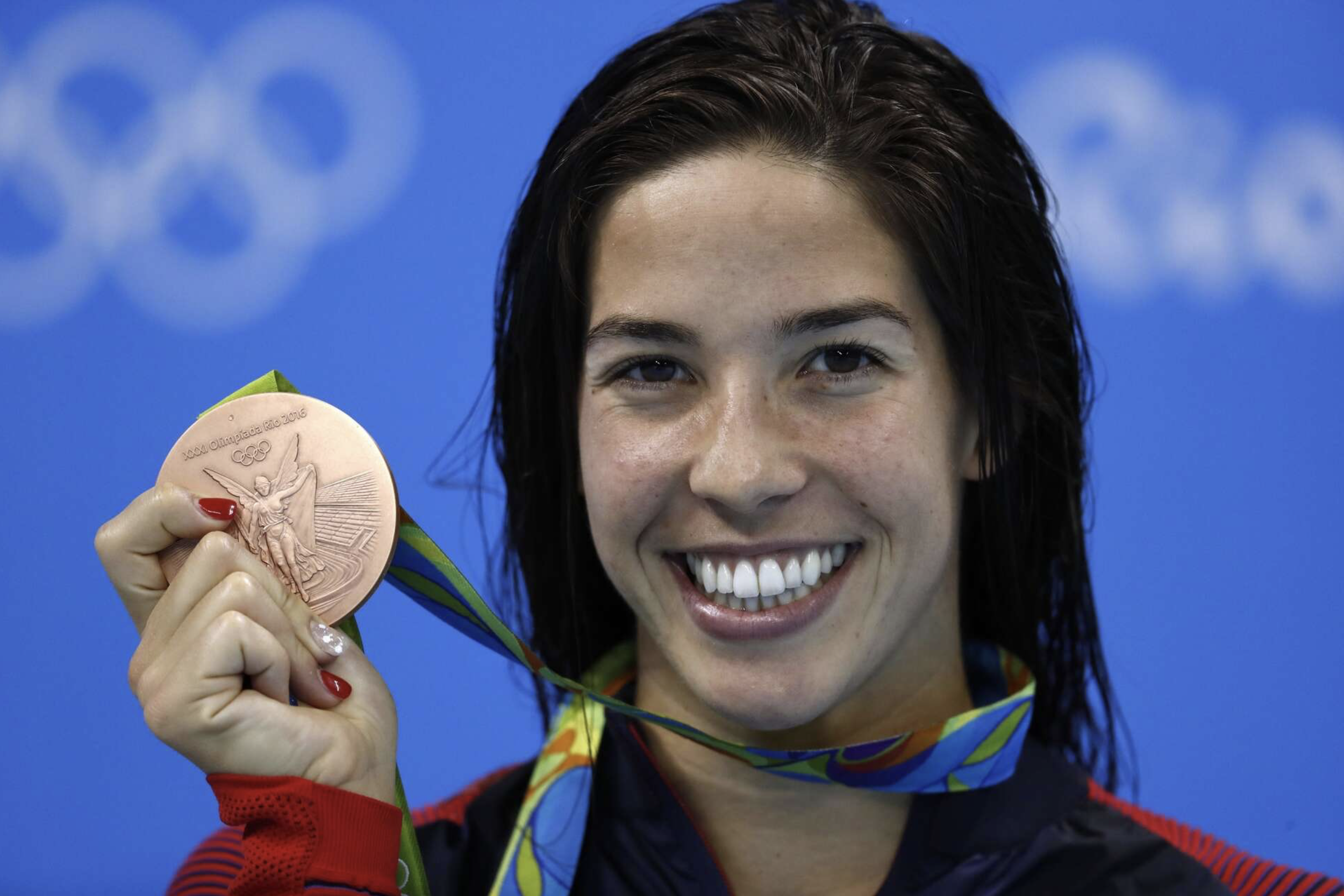
MCHS Alum Maya DiRado and her bronze medal (Courtesy of The San Francisco Chronicle)
By Keira Eicken, Staff Writer
For most people, a timer is just a tool or reminder. But for high school swimmers, a timer can mean everything. One hundredth of a second can decide who wins, who qualifies for championships, or who misses the podium.
California is one of the most competitive states for high school swimming. With hundreds of teams across the state, athletes train year-round to improve their times and rankings. Among these teams is Maria Carrillo High School, whose swim program has built a reputation for dedication and steady success. While the team may be described as hardworking, the details behind their performance show just how much effort goes into each race.
The Basics of Competitive Swimming
Competitive swimming includes four main strokes. Freestyle is the fastest and most common stroke, using a front crawl with quick arm pulls and flutter kicks. Backstroke is swum on the back, similar to freestyle. Breaststroke uses a frog-like kick with both arms moving together in a circular motion. Butterfly is often considered the most difficult stroke because it requires a powerful dolphin kick and both arms moving in a wave-like shape at the same time.
In major events like the Olympic Games, swimmers compete individually or as part of relay teams to finish a set distance in the fastest time possible. High school swimming usually takes place in 25-yard pools, known as Short Course Yards (SCY). Olympic pools are 50 meters long, which makes races feel very different because swimmers have fewer turns. According to USA Swimming rules for short course competitions, the shortest race is the 25-yard sprint, just one lap down the pool. The longest event is the 1,650-yard freestyle, which equals 66 laps. That race requires not only speed but also mental toughness and endurance.
What Makes Carrillo Swimming Unique?
Most high school swim teams practice about five days a week during the season. However, Carrillo swimmers often practice up to 10 times a week, both in and out of the water. Morning practices might focus on endurance sets, while afternoon practices may include sprint work, starts, and turns. Dryland workouts help swimmers build strength, flexibility, and injury prevention. Although some students say there are not many official team bonding events, they still form close friendships. Many swimmers mention that peer coaching—helping each other fix technique or improve turns—is one of their favorite parts of the season. Cheering loudly for teammates during close races also builds team spirit. Even though swimming is technically an individual sport, Carrillo athletes show that success feels shared.
The team’s strongest recent season was 2022–2023, earning 438.77 points on Swimcloud, a website that ranks swim performances. This achievement reflects not just one strong swimmer, but strength across the entire team. Carrillo swimmers compete in major meets such as the California Interscholastic Federation (CIF) championships, which take place from February to May. They also compete at the North Coast Section Championships in Concord each May. These meets determine rankings and can qualify swimmers for higher levels of competition.
Records, Standings, and Standout Athletes
Carrillo’s swim history shows consistent success. According to Carrillo’s data, the women’s team won the NBL championships from 2001 to 2014. The men’s team won titles in 2009, 2010, 2012, 2013, and 2014. These stretches of victories show that the program has remained competitive for over a decade.
Some individual performances also stand out. Lucas Wang dropped an impressive 42 seconds in his 50-yard backstroke over time, eventually finishing in 25.05 seconds May 8-10, 2025. In swimming, even dropping half a second is considered significant, so a 42-second improvement shows major growth and dedication. Fisher Brophy completed the 200 Individual Medley in just over two minutes at the same meet. The 200 IM is especially challenging because swimmers must complete two laps of each stroke—butterfly, backstroke, breaststroke, and freestyle—in one race.
Perhaps Carrillo’s most famous swim alumni is Maya DiRado, who graduated in 2010. DiRado went on to compete in the 2016 Olympics, where she won four medals, including two gold medals. Her success proves that a high school program can be the starting point for international achievement. In 2016, she returned to speak at Carrillo, inspiring the next generation of swimmers.
Her story reminds current athletes that big dreams can start in a 25-yard pool.