
MF DOOM – The Greatest Rapper You Never Heard Of
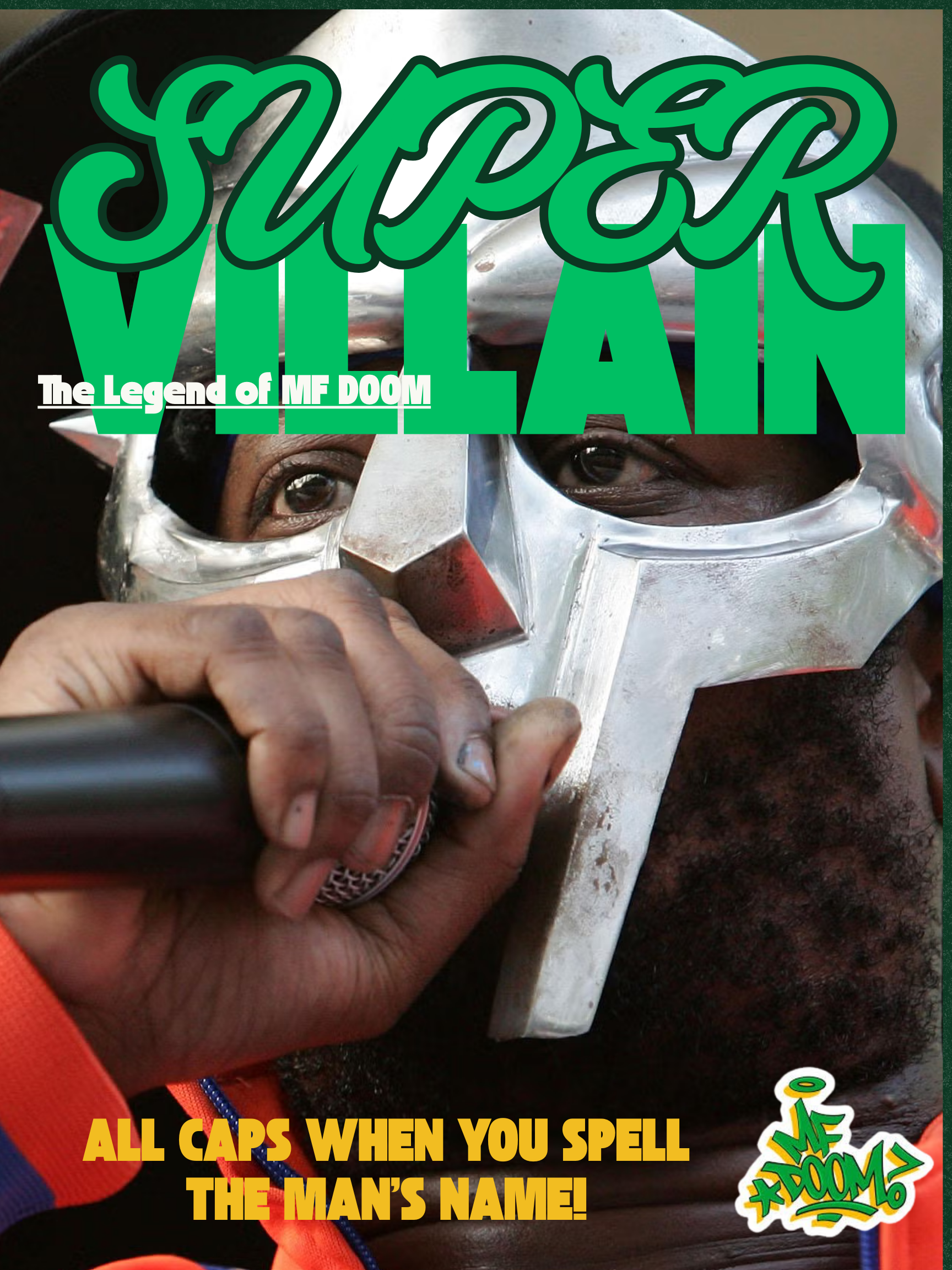
Graphic featuring MF DOOM and some of his lyrics (The Puma Prensa / Luke Trudeau
By Luke Trudeau
On December 31, 2020, the world of hip-hop was shocked and devastated upon learning about the death of rapper Daniel Dumile, better known as MF DOOM, two months earlier in October, with meager detail accompanying the abrupt announcement. As an artist who thrived in the shadows, Dumile’s backstory was an amalgamation of myth and real-life tragedy. Barely anybody even knew what he looked like, performing much of his career behind a metal mask, a concept that was exploited to such a degree that he would sometimes even resort to sending out masked impostors to perform shows on his behalf. From his incredible lyricism to his talent as a producer, MF DOOM was and will always be one of the greatest rappers of all time.
The self-proclaimed “supervillain” of hip-hop first made his recorded debut in 1989 at only eighteen years old, delivering the final verse on Third Bass’ classic anthem “The Gas Face”. Born in London, Dumile relocated with his family to Long Island, New York sometime in the 1970s. He would eventually become one third of the New York rap trio KMD, performing under the pseudonym Zev Love X, alongside his brother, DJ Subroc. Their debut in 1991 with the studio album Mr. Hood would be what signalled the trio as worthy descendants of rap’s golden age – combining witty wordplay with relentless sampling similar to the Native Tongues posse, with steely political undertones especially evident in their satirical, anti-racist single, “Who Me?”
KMD’s second album was a darker, denser project. It juggled samples from Pharaoh Sanders and African-American nationalist lyrics, but their record label Elektra objected to it because of its stark title, Black Bastards, and its controversial album cover that displayed a racist “sambo” caricature getting hung by its neck. Rejecting the album entirely, Elektra fired Dumile from the label with a $25,000 payoff and full ownership of the master tapes. But by that time, KMD were done for – shortly before Black Bastards’ completion, DJ Subroc was hit by a car and killed, and Zev Love X disappeared from the hip-hop scene completely.
Dumile might have been down, but he wasn’t out, and he was ready to come back for more. After six years of living in obscurity, licking his wounds and developing a different, individualistic voice, he resurfaced in 1999, assuming his final form – MF DOOM. During his earliest appearances at Nuyorican Poets’ Cafe, a Lower East Side bohemian hangout, DOOM performed while covering his face with a homemade mask made out of a pair of stockings, but this would quickly be replaced with his trademark metal mask, fashioned after one of his favorite comic book characters, the Fantastic Four’s archnemesis Doctor Doom. In the Marvel Comics, the scoundrel sported a fake countenance to obscure the disfigurement that ultimately led to his villainy. DOOM, however, wore his tragic origin story on his sleeve, as shown on the title track to his 1999 debut album, Operation Doomsday, where the supervillain signals his dedication by stating: “On Doomsday, ever since the womb/ ‘Till I’m back where my brother went, that’s what my tomb will say…”.
Sampling everything from Sade to superhero cartoons to Steely Dan, Operation Doomsday was an album characterized by crooked, fascinatingly disoriented beats, while Dumile’s brand new alter ego spoke with a deeper, raspy cadence, with offbeat rhyme schemes that were dismally comical and threatening. Having arrived in a hip-hop underground that was redefined by names like the Wu-Tang Clan and Company Flow, Operation Doomsday proved that the time had come for the former Zev Love X. Emanating acclaim from critics and fellow artists, Dumile entered a conscientious period, self-releasing CDs of instrumentals known as the Special Herbs series that showcased a fearless creation, cutting soundtracks from Godzilla movies into Hermann-esque hellscapes, and even developing new aliases like Viktor Vaughn, who appears as the lead voice on the LP Vaudeville Villain and its follow-up VV2, and King Geedorah, whose kaiju-themed concept album Take Me To Your Leader, is one of Dumile’s most interesting albums.
In 2004, his collaboration with Los Angeles producer and hip-hop soulmate Madlib delivered DOOM’s first commercial success as the musical duo Madvillain. Their sole album, Madvillainy, released in March 2004, was fuelled mainly by Thai food, marijuana, mushrooms, and plenty of booze, and featured the masked rapper rhyming over exceptionally-stoned beats lifted from the Mothers of Invention, Sun Ra, and 1950s Tex Avery cartoons, leaving hip-hop conventions demolished in their wake. Dumile immediately rose to the occasion, with imaginitive, compact lyricism and flow that was commanding, defiant, and delightfully ridiculous at times, spitting unshaken melodies like “tripping off the beat, kinda, dripping off the meat grinder” over a misty Hawaiian guitar and proclaiming himself as “the worst-hated god who perpetrated odd favors” on the song “Meat Grinder.”
Indeed, this dopey masterpiece of an album is probably the best thing either Madlib or DOOM have ever recorded. Riding high off of his success under the name Quasimodo, Madlib’s productions favored his spirits for bumpy, eccentric, and abstract funk music, but he’d discovered a perfect contrast who could deliver the weight and darkness he couldn’t obtain in the form of Dumile. If songs like “America’s Most Blunted” were in danger of stumbling into stoner comedy, then Dumile could pull both of them into a more captivating, inflammatory direction with his deep, rough voice and wordplay that staggered from mopey muttering to fragmented stabbing, along with lines that seemed informal and unserious, but upon closer inspection, proved to be tightly assembled and complex. His groggy chants and sinister grumbling lent glistening gloom to the song “Rainbows” and deftly occupied the ballad of misfit treason on “Fancy Clown,” featuring an old friend in Viktor Vaughn.
In a genre of music where ego meant everything, Dumile was able to remain as casual as he pleased but still managed to control the scene as he broke rules and meters. His lyrics were full of dark comedy and stoner-friendly cultural references, but the mind that constructed them was incredibly clever, stacking up multiple rhymes like flapjacks, and clearly fond of metafictional intrigue. As shown in the understated arrogance on the song “Beef Rapp” from his November 2004 album Mm..Food, Dumile disparaged the effort he put into his creations – “I wrote this note around New Year’s/Off a couple shots and a few beers, but who cares?/Enough about me, it’s about the beats” – right before cramming in some pure bombast – “A rhyming cannibal who’s dressed to kill, it’s cynical/Whether is it animal, vegetable, or mineral/It’s a miracle how he get so lyrical/And proceed to move the crowd like an old negro spiritual” – which only serves as flawless evidence of the very abilities he praises himself for having.
Another example is the track “That’s That,” where he manages to squeeze so many internal rhymes into only a few lines that it almost seems as if he’s doing it for a bet. But the rhyme collision of “Already woke, spared a joke, barely spoke, rarely smoke/Stared at folks when properly provoked, mirror broke” stands as the best conjuration of this Bobcat Goldthwait-esque hip-hop misfit character. The fact that he can deliver lines like these so modestly only makes his bold and – for lack of a better word – whimsical rhyme schemes that much more valiant.
Madvillainy marked Dumile’s first introduction into the Billboard Top 200, even though a long-promised sophomore album never transpired, as Madlib insisted that the ball was firmly in the court of DOOM. The masked villain would instead cut into deeper collaborative albums with artists like Danger Mouse, Jneiro Janel, Bishop Nehru, and Czarface. His final solo project was the March 2009 album Born Like This, a darker, more serious album that covered topics like the apocalypse and societal breakdown in a raw, almost disturbing manner, drawing inspiration from the likes of American poet and novelist Charles Bukowski and saw DOOM teaming up with names like Raekwon of the Wu Tang Clan and Ghostface Killah.
In addition to this, DOOM also had the pleasure of racking up guest appearances for artists like Gorillaz, the Avalanches, and BadBadNotGood, along with rising stars like Your Old Droog and Wilma Archer, and even started working on an EP with Flying Lotus in 2019 that was unfortunately discontinued. In every appearance he made, his voice was always recognizable – that type of headstrong, unique genius in the same vein as Sparks and Mingus, who always made sure to use his minute in the spotlight to steal the show, but never acted like he was trying very hard, which only made his music more effective. There truly will never be another rapper like MF DOOM.
Just remember all caps when you spell the man’s name.