
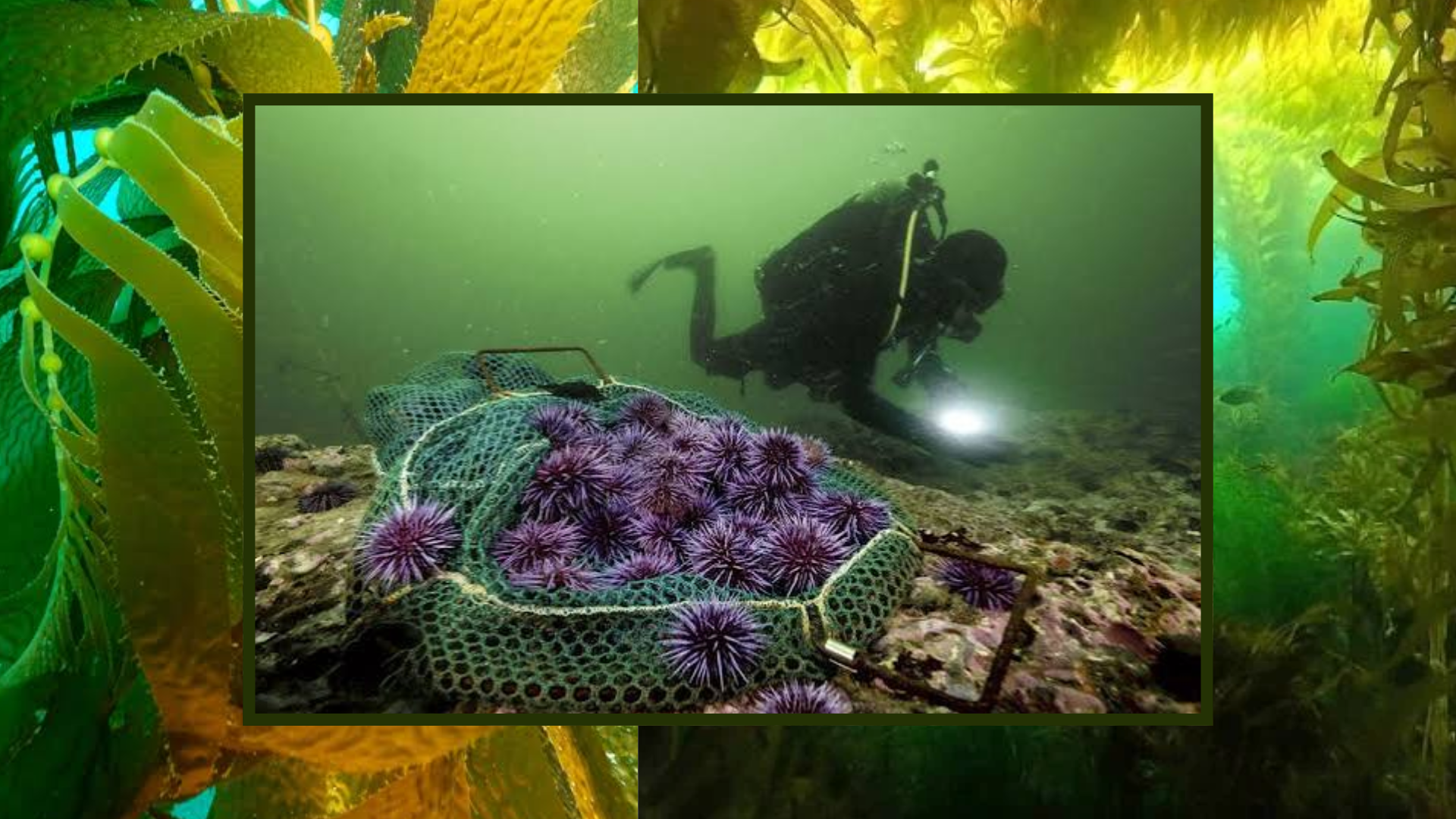
Images of California kelp forests with a volunteer urchin collector in the middle. (Eva Cruz / The Puma Prensa)
By Eva Cruz, Staff Writer
What is deforestation? What comes to mind when asked that question?
You might think of the Amazon Rainforest in Brazil and Bolivia or the Congo Basin. These problems are talked about every day, in major news sources or simply in your household when you use too many sheets of printer paper.
But what about the lesser-known issues, the ones below the surface?
Underwater deforestation is the loss or destruction of marine forest ecosystems. California is facing one of the worst underwater deforestation events in history. Since 2013, parts of California’s North Coast have lost 95% of their bull kelp canopy due to marine heatwaves, sunflower sea star die-offs, urchin population explosions, and cascading ecosystem changes.
In 2014, California’s coast began experiencing a massive marine heatwave known as “the Blob.” This heatwave persisted through 2016 and overlapped with a strong El Niño event in 2015 to 2016. Together, these events caused unusually warm ocean temperatures and reduced nutrient availability, creating difficult conditions for kelp forests. Although “the Blob” eventually dissipated, other marine heatwaves have continued to threaten California’s coast. Now, in 2026, another developing El Niño is raising concerns about whether similar conditions could return. El Niño can weaken the upwelling of cold, nutrient-rich water that kelp depends on to grow, adding further stress to forests already struggling to recover. While El Niño and marine heatwaves are different phenomena, their effects can overlap, making it especially important to monitor California’s vulnerable kelp ecosystems.
When oceans heat up, it causes ocean stratification, or the “Layer Cake” effect. The ocean is naturally layered with cold, nutrient-rich water at the bottom and lighter, warmer, water at the top. Under normal conditions, winter winds and ocean currents are able to mix these layers, bringing the nutrients of bottom layers closer to the surface where the sun can activate them. During marine heatwaves, the top layer of water becomes excessively warm and buoyant, creating an impenetrable barrier that prevents vertical mixing. The inability to mix the ocean layers leaves nutrients trapped deep in the ocean and causes the surface to be fundamentally starved.
The loss of sunflower sea stars is another large part of the issue. Starting in 2013, sea star wasting disease caused widespread declines in sunflower sea star populations. These sea stars are important predators of purple sea urchins whose population feeds on kelp. With fewer predators keeping their numbers in check, urchin populations have expanded and consumed more of the remaining kelp. The problem became especially severe when the urchins continued feeding even as their food source dwindled down. In some locations, the seafloor transformed into what scientists call an “urchin barren,” where urchins can persist on the reef even after kelp is gone.
Another missing predator has shaped the North Coast ecosystem: the sea otter. Sea otters eat purple sea urchins, helping prevent the urchins from overgrazing kelp. However, from 1785 to 1849, sea otters were driven from the Sonoma and Mendocino coasts by the historical fur trade.
Jean-Michel Nhat Hudson, a volunteer with the Purple Urchin Removal Project (PURP) and sophomore at MCHS, said he was surprised to learn how much the local ecosystem’s balance depends on sunflower sea stars. “Sunflower sea stars are the urchin’s main predator,” he said, “but with them absent from the ecosystem right now, urchins are overpopulated.” He also noted that, despite the common assumption that sea otters will eat urchins wherever they occur, they may not eat the nutrient poor urchins found in barrens.
These combined forces have allowed for urchin populations to grow by over 10,000 percent in the past decade.
Hudson also emphasized the importance of kelp forests as a source of oxygen. “Another reason is the oxygen the plant provides, which is a huge amount, especially compared to trees,” he said. Through photosynthesis, kelp absorbs carbon dioxide and releases oxygen into the surrounding water. During periods of intense photosynthesis, oxygen levels can rise above the amount normally expected in seawater at equilibrium with the atmosphere, a condition known as oxygen supersaturation.
Kelp forests also play a big role in carbon sequestration, the process of capturing carbon dioxide and storing the carbon over time. As kelp grows, it takes in carbon dioxide and incorporates it into its tissues. Some of this carbon enters the marine food web when kelp is eaten or breaks down, while some can be transported into the deeper waters or buried in ocean sediments, where it may remain stored for longer periods.
Together, oxygen production and carbon sequestration show how kelp forests influence more than just the animals that depend on them. They also contribute to the movement of carbon through coastal ecosystems and help shape the chemistry of ocean waters. When kelp forests disappear, the ecosystem loses important habitat and food sources, along with some of the natural processes that connect marine life to the global carbon cycle.
The effects of the loss of kelp are both ecological and economic. Kelp forests provide habitat for fish, invertebrates, sea birds, and marine mammals, creating a complex ecosystem in which many species depend on one another. When the kelp disappears, animals lose food sources and shelter, and the broader food web changes. Coastal communities are affected financially as well. The recreational red abalone fishery in Northern California closed in 2018, and the commercial red sea urchin fishery suffered major losses.
Beyond these ecological and economic consequences, the decline of red abalone and red sea urchins has also affected the Kashia Band of Pomo Indians of Stewarts Point Rancheria. These marine resources have long held cultural and food-gathering significance for the Kashia people. As kelp forests decline and access to these resources becomes more difficult, efforts to restore marine ecosystems are also connected to preserving cultural traditions and maintaining relationships with the coast that have endured for generations.
Despite the scale of collapse, restoration projects are testing ways to help kelp return. One method is manual urchin removal, known as culling. Trained divers remove purple urchins from selected areas, reducing the amount of grazing pressure on young kelp. At Caspar Cove in Mendocino County, the Watermen’s Alliance has led recreational urchin-removal efforts, with Reef Check staff and volunteers monitoring the site. The project is designed to test whether reducing urchin numbers can help kelp regrow and to gather evidence that could inform future restoration efforts.
However, removing urchins is not a guaranteed fix. If warm conditions persist or too few kelp plants remain to reproduce, the forest may still struggle to return. Restoration teams therefore combine urchin removal with monitoring and, where appropriate, efforts to introduce young kelp. Scientists track changes in kelp growth and urchin numbers to determine whether the intervention is working. Continuous monitoring is especially important after active removal stops, because a site that improves temporarily may not necessarily sustain a healthy forest in the long term.
PURP, or the Purple Urchin Removal Project, is a community led volunteer program working at Stillwater Cove. Founded in 2023, the project brings together recreational divers who remove purple sea urchins by hand to reduce grazing pressure on struggling bull kelp. With support from organizations like Seatrees, volunteers receive equipment and assistance with diving costs, making participation more accessible. Removed urchins can be used for food or composted, turning an ecological problem into a resource.
While PURP focuses specifically on removing excessive urchins, researchers with the Greater Farallones Association are also working to restore kelp directly. In July 2026, the organization reported placing 199 juvenile bull kelp on restoration structures at Stillwater Cove to test whether young plants could establish themselves more successfully. Scientists continue monitoring their sites because recovery depends on much more than removing grazers. Ocean temperatures, nutrient availability, and weather conditions all influence whether kelp survives long-term.
For Sonoma County residents, the collapse is not a distant environmental issue. The forests off the North Coast support marine life, fisheries and coastal communities, making their recovery important beyond the shoreline. Local projects also create opportunities for residents to contribute directly. Even people who are not certified divers can still help by supporting outreach efforts, assisting with community events, or volunteering with partner organizations that educate the public about kelp restoration. Every conversation about the issue helps more people understand that underwater forests deserve the same attention as forests on land. “Diving is considered the most ‘direct’ impact,” Hudson said, “but people on the shore are still required to keep the project going. People to help others out of the water, to sort the urchins from bycatch, and to help with other small tasks are still very important to keeping this project going.”
The work happening at Stillwater Cove proves that restoration is not limited to laboratories or government agencies. Scientists, non-profit organizations, and volunteers each address different parts of the same challenge. PURP reduces grazing pressure, researchers monitor recovery, and restoration teams test new ways to re-establish bull kelp. None of these approaches are a complete solution alone, but together they create better opportunities for the ecosystem to recover. As researchers continue studying changing ocean conditions, community involvement remains one of the most visible examples of conservation in action. Whether someone volunteers underwater, shares what they learn with peers, or simply pays attention to the health of the coast, each action helps keep the conversation alive while scientists work toward long-term solutions for California’s underwater forests.
“It is a part of a larger global ecosystem connecting land and sea,” Hudson said, “if this part falls, not only does California wildlife face consequences from lack of animals in the ocean, but the whole world will face problems.”