
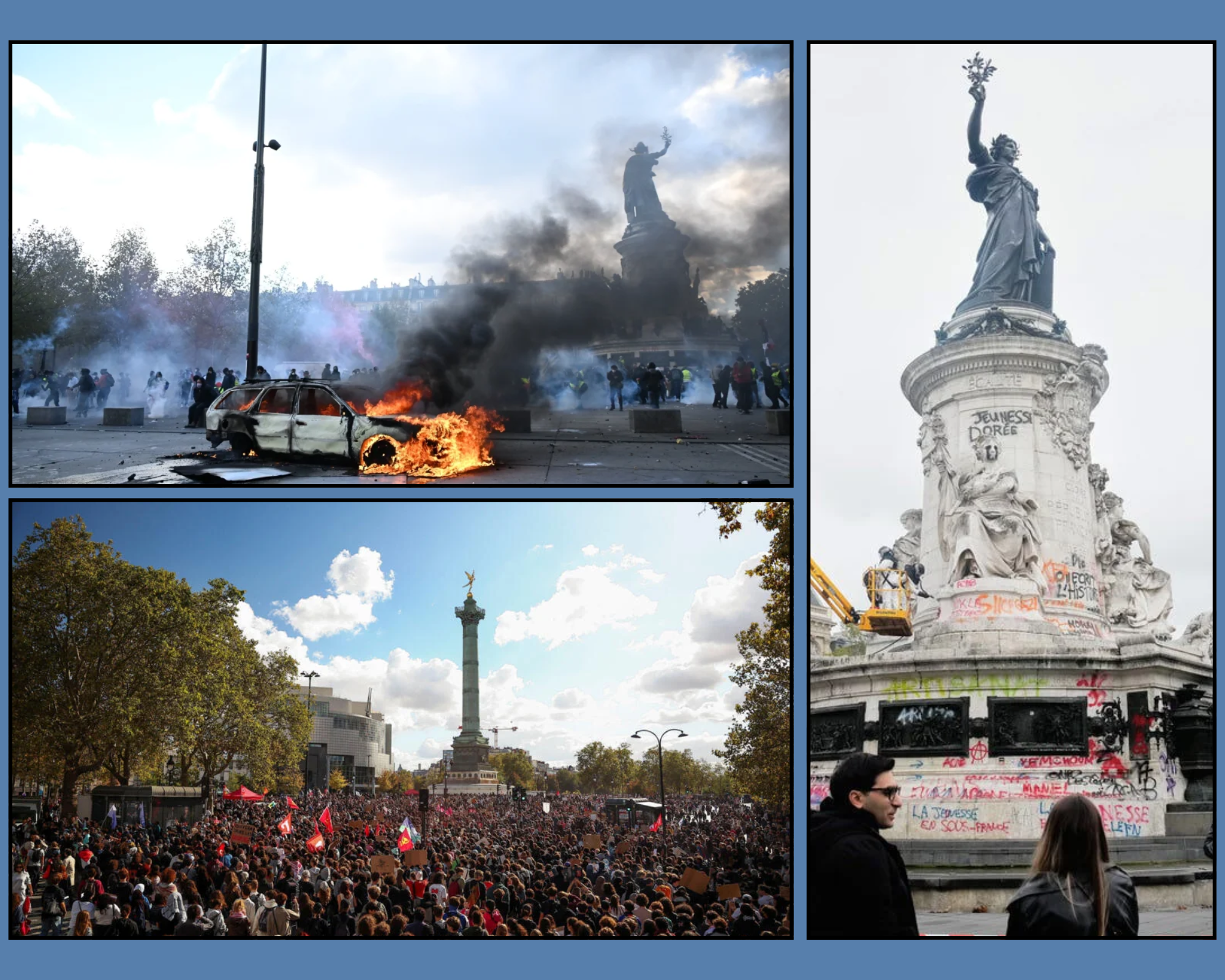
A collage illustrating the french student protests (Ava Cotton / The Puma Prensa)
By Ava Cotton, Staff Writer
What started as a demonstration in the Créteil Academy in Paris’ suburbs has rapidly evolved into nationwide movements with hundreds of thousands of students taking to the streets to demand quality education.
These current protests began on September 21— merely days after a teachers strike against a lack of resources and staff. These first waves of student protestors admitted to feeling neglected by the Ministry of National Education, which led to small, local protests.
However, the movement soon spiraled into a national issue.
Parents, high school unions, and teachers have all joined this fight in helping this new generation protest.
France’s lycée-secondary school-students have organized school blockades and demonstrations fighting for education reforms. Students have been reporting classroom sizes exceeding thirty people, which make it difficult for everyone to receive the attention they deserve. Students have also reported poor building conditions with toilets in the prefabs lacking water or containing cockroaches and rats.
There has also been teacher and staff shortages. As one Paris student, Madelena, told BBC, “Sometimes our teachers are absent for several weeks without being replaced.” France has experienced a steady increase of almost 250,000 in student enrollment while the country has struggled to keep up to pace with teacher recruitment.
The protests have been largely peaceful, however there have been few extreme instances where students have used arson, vandalism, and riots as part of their revolt. Students have engaged with vandalizing and burning schools which has led to over one hundred high schools being damaged. Additionally, trash cans, school desks, and chairs have been set on fire.
Hundreds of people have been injured as the police responded to the protests. Tear gas has been released in Paris and Marseille. Water cannons have been used in Rennes, while police stun grenades have been suspended due to a 15-year-old losing a hand in an incident involving them.
Over 6,000 arrests have been made according to the Interior Ministry, and numerous classes have been suspended.
These protests have also come in a time of intense political unrest as the French are getting ready to vote next year.
French citizens have been unhappy with their current president, Emmanuel Macron, who promised to reinvigorate the French economy almost a decade ago.
Decisions he made, such as cutting taxes for the rich and raising the retirement age from 62 to 64, made people protest out of dissatisfaction.
The far-left has been accused by the French government of stirring unrest for political gain as their presidential candidate, Jean-Luc Mélenchon, encourages supporters to attend and aid protesters.
When talking about the current protests, Mélonchon has often referenced France's May 1968 student protests.
In this nationwide movement, ten million students and workers initiated nationwide protests and strikes which nearly broke the government. It was a time of civic unrest which changed French politics, cultural life, and labor relations. The protests were initiated by radical students who expressed dissatisfaction over overfilled classrooms and unresponsive faculty which greatly mirror reasons for France's current protests.
These protests have also put a blinding spotlight on France's growing financial struggles.
For years, France has been overspending with a generous welfare and low pension system. The country is past its limit of spending in the European Union (EU). This overspending will soon be affecting the other countries in the EU.
The damage the students' protest has inflicted, in only the greater Paris region alone, is over 7 million euros—or 7.84 million U.S. dollars—according to CNN.
With the country already at its limits of overspending in the EU, people worry France may lack the funds to repair the damage.
As these protests evolved, the world is reminded how deeply ingrained protest is in French culture. From the 1229 University of Paris faculty strikes to the May 1968 student protests, France has had its fair share of fighting for their rights.
Raised in a culture of revolution, young Gen Z protesters believe it is their democratic duty to revolt against corrupt systems. The current France protests are just one part of ongoing, global Gen Z movements.
In India, people are protesting about electoral accountability; in Chile, the topic of their movement is proposed education spending cuts from their president; and in Spain, young activists are joining the fight to demand housing affordability.
Young activists have been leading the cause of new reforms as they refuse to live in a world where the government fails them.