
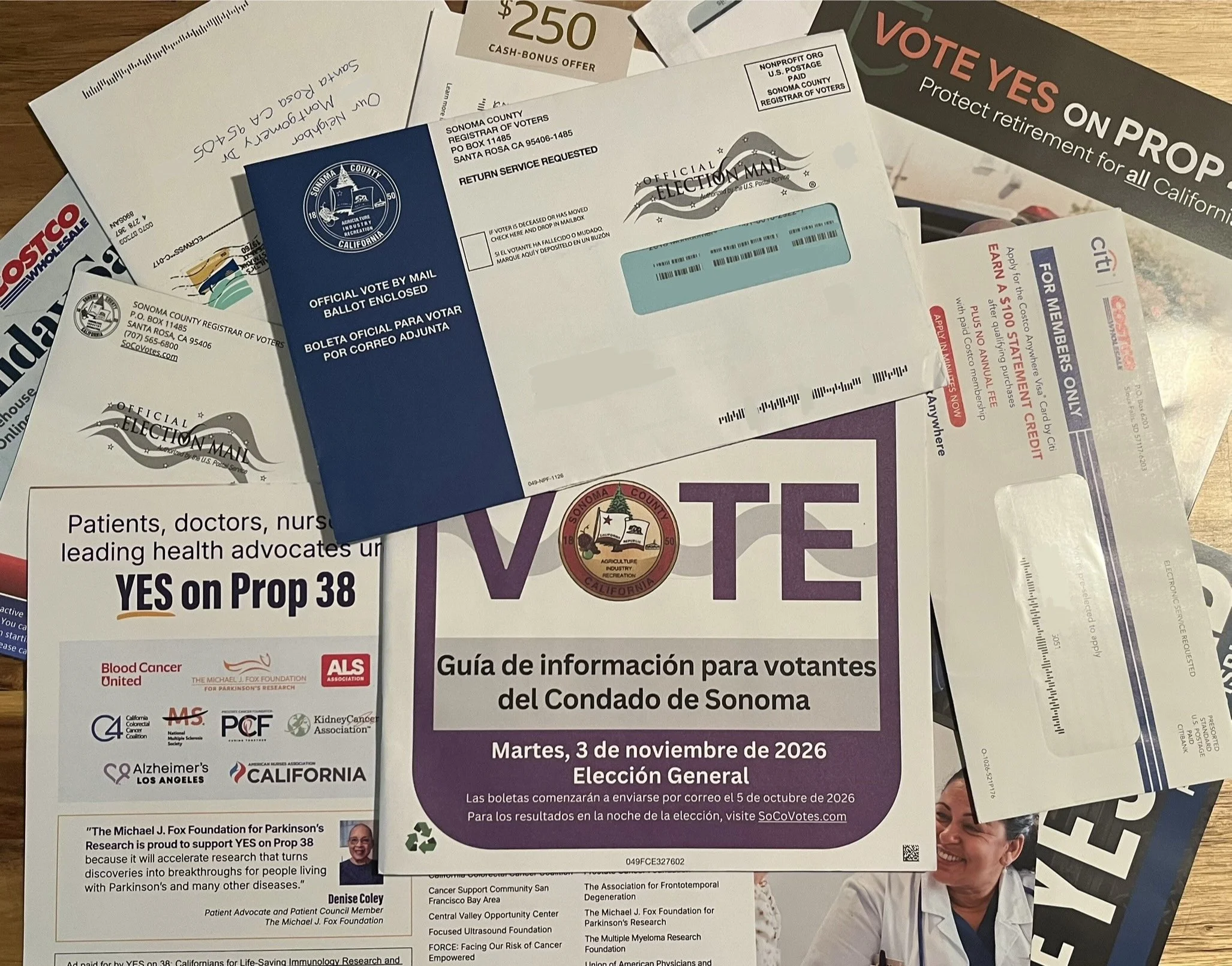
A pile of mail including a mail-in-ballot and numerous campaign flyers and pamphlets (Ruby Costa / The Puma Prensa)
By Ruby Costa, Co-Executive Editor
Whenever the conversation of voting is brought up, it's almost always guaranteed that the argument claiming “your vote doesn’t matter” will be one of the hottest topics of debate. That will then expand into the idea that our elections are rigged, our government is corrupt, or that Democracy as a whole is a scam.
True or not, the prevalence of these ideas is enough to prove that Americans, as a whole, are not too keen about political participation. In fact, in 2024, only 63.9% of eligible voters actually cast a ballot (Ballotpedia). California was about a percent below the national average at 62.1% (Ballotpedia). America as a whole consistently ranks near the bottom of lists about voter turnout in Democratic countries, and it doesn’t exactly have a good track record when it comes to the fair elections.
So, knowing this, is it fair to say that an individual vote does not matter in an election? Answering “yes” is only a self-fuffilling prophecy.
To answer this question, multiple levels of government must be called into question. Local governments consist of mayors, city councils, and, on ballots, measures and propositions that focus specifically on the county or city that you live in. In most local elections, claiming that an individual’s vote does not matter is simply not true. On a small scale—the sort of scale that democracy, as a general idea, functions best at—each and every vote could be the one to tip the results in either direction, and your vote will be felt in each issue that you chose to participate in.
The same can be said for elections in certain smaller states, though in larger states—and ones with historically stagnant political beliefs—such as Democratic Massachusetts, the waters start to muddy. Nationwide elections, such as the quadrennial presidential election, are the ones that come under the most fire due to the not-so-straightforward voting process.
In truth, the way a president is elected is not reliant on the popular vote. The Electoral College—a process including 538 electors that represent the majority vote of their state—is the important aspect of deciding a winner, and is outlined in the Constitution, having stood the test of time for more than two centuries. In most cases, the electors, proportionate in number to their states population, are required by law to vote the same as their state did, and in theory, that should ensure a fair, direct election regardless.
However, there have been five separate elections where the candidate that won the vote of the electoral college did not win the popular vote— John Quincy Adams in 1824, Rutherford B. Hayes in 1876, Benjamin Harrison in 1888, George W. Bush in the year 2000, and Donald Trump in 2016. These instances alone are enough to convince many that the way individual citizens vote is not important in the outcome of an election. If the state you reside in always votes for the Democratic candidate, or always votes for the Republican, then it is almost guaranteed that the electoral votes will align with that party, and the population of residents that vote in opposition will have little effect on the outcome of the election. Even in swing states—those that swung from the 2020 election to the 2024 election including “Arizona, Georgia, Michigan, Nevada, Pennsylvania, and Wisconsin”—it can feel hopeless to cast your vote if polls have already predicted the winner with any level of certainty (USA Facts).
So, then, what is the point of voting at all? Why should you take time out of your busy schedule to participate in our Democracy if you don’t feel that our Democracy is accurately reflecting the wishes of the people?
Simply put, whether or not the election is rigged does not matter. Whether or not your minority vote may sway the electors of your state does not matter. Whether or not you agree with our current system, in any regard, does not matter.
You can have as many qualms with the American government and voting process as you’d like, but the fact is, your vote still does matter. Change cannot be expected—more fair elections, more power to the people, more safeguards against abuse of power—if the people wanting the change are not willing to fight for it. If you believe that your vote does not matter, then the only way to make it matter is to continue to vote.
It's not as counterintuitive as it sounds.
There are many ways that the American government can be reformed. A fairly popular first step would be to abolish the electoral college—favored by “63%” of Americans, according to Pew Research Center—and rely on popular vote alone to elect the president. In this case, each individual vote would become equal and more important, and maybe Americans would be more greatly convinced that their vote matters. But how do we get there? We vote.
We vote in politicians that have our best interests in mind, ones that support the same policies we favor and that we trust to carry them out. We vote on propositions and ballot measures that will positively affect our community, curb the power of the wealthy elite, and stop corruption in offices of power. We campaign, protest, and use our freedoms to create change instead of sitting complacently in the system that we believe is flawed. If it truly is flawed, and if we truly do care, there is so much more we can do than complain about our vote.
Vote Now:
You can start making a change this November 3, 2026, in California's midterm elections. Preregister or register to vote here, pre-register at 16. vote at 18, and check out what's on the ballot here: Qualified Statewide Ballot Measures.