
The Melting Himalayas: 2026 Nepal Floods
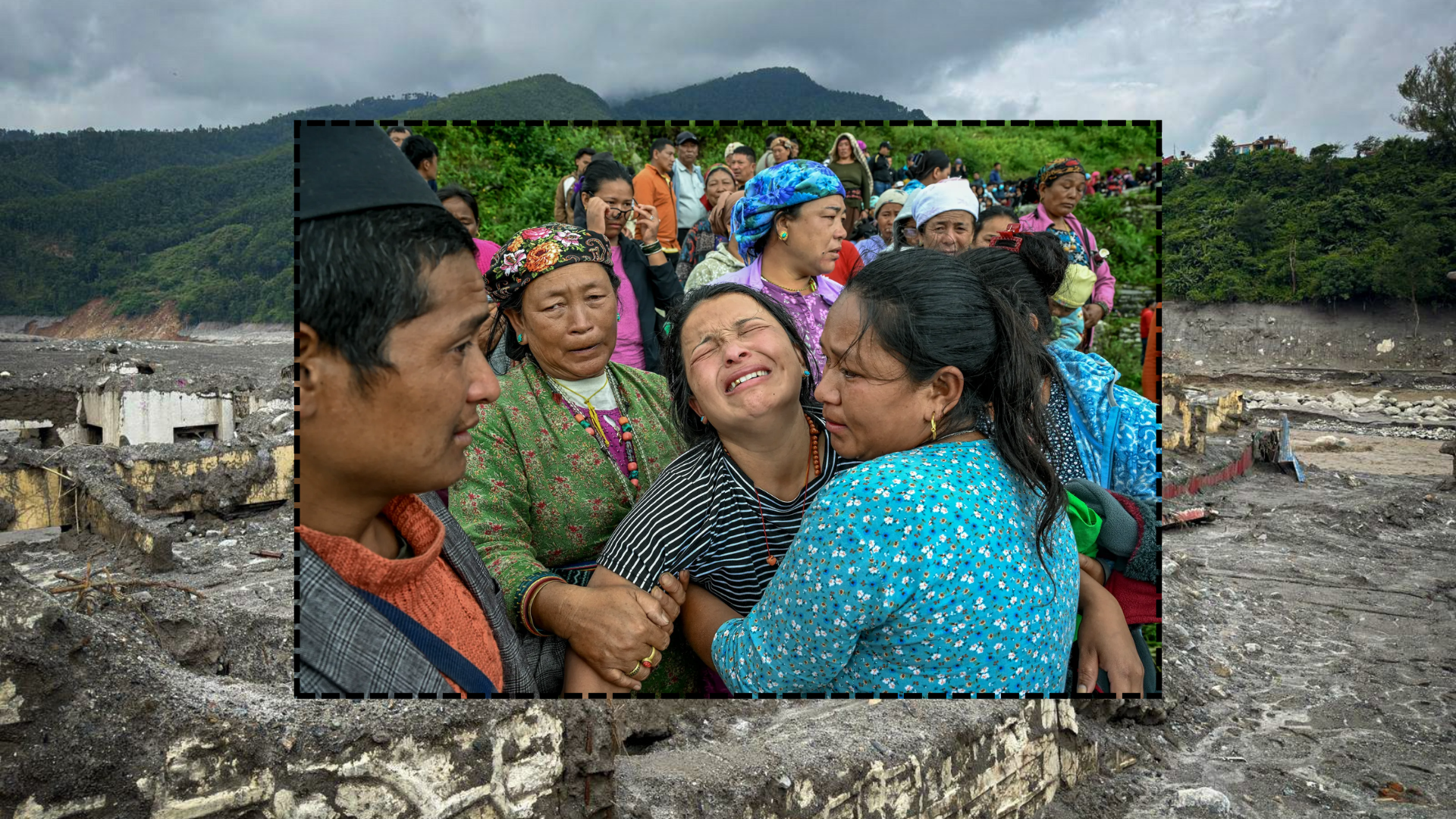
A Nepalese woman mourns over the amount of losses caused by the 2026 Nepal Flood in the Rasuwa district. (Courtesy of Atul Loke / The New York Times)
By Caeden Chee, Staff Writer
On August 26, 2026, Nepal faced one of the darkest hours of its history. The nation was met with a seismic event, registering 5.2 on the Richter scale, near its border with China’s Tibet region caused by a glacial collapse at 10:52 a.m. CST according to the USGS.
The event was initially reported as an earthquake, but was later reclassified as a glacial collapse, estimated to be around 2,000 feet wide, according to an analysis using satellite imagery.
The glacial and rock debris which led to the build up of river water in the Lhende Khola River, and shattered ice from the collapse eventually reached speeds of 150 to 193 kilometers per hour (approximately 93 to 120 miles per hour), raising water levels by as much as 9 meters.
The huge amounts of water, approximately over 1 million cubic meters, had pressure able to break through dams and infrastructure, ravaging communities in Nepal’s Rasuwa, Nuwakot, Dhading, Gorkha and Tanahun districts, as well as parts of Tibet in China.
Reported deaths of more than 1,300 people and the declaration of over 4,000 people missing have been confirmed by Nepalese officials and professional news outlets like The Hindu. However, the extent of the damage has caused quite a number of bodies to be maimed beyond identification, leading officials to publish photos of severed body parts of victims in hopes for the urgent public to discern any noticeable features of missing family and friends.
Other effects of the flood also include around $2.5 billion in property and infrastructure damage, the displacement of tens of thousands of residents along the affected valleys, the destruction of public infrastructure like roads, which makes it difficult for rescue operations to proceed. For the current government of Nepal following the 2025 “Gen-Z uprising” revolution in Nepal, this disaster sets a test for how they proceed with larger obstacles.
The current administration, under Prime Minister Balen Shah, has mobilized the army, police and medical rescuers to deal with the overwhelming situation. However the damage to roads as well as a lack of specialized equipment has hindered the extent of the operations, causing public doubt about the limit of experience that the new government has dealing with a disaster of this scale.
So how is climate change intertwined with the disaster?
Rising global temperatures have been destabilizing the Himalayan region’s glaciers and high-altitude rocks: With global greenhouse emissions warming the mountain region 50% faster than the global mean, at least a third of the ice has been lost in the past 30 years.
The country constitutes less than 0.1% of total global emissions, getting most of its energy from renewable sources, but it is the target for the biggest impacts of climate change in the world. This being said, Nepal is now considered as one of the earliest victims of severe climate change.
Shisir Khanal, Nepal’s foreign minister, recalls the incident, “This feels like a tsunami that was coming from the Himalayas,” according to his account with The Guardian. This call for climate justice in Nepal comes from bigger climate contributors like China and India who also control parts of the Himalayas.
Nepal’s ministry of finance and ministry of environment have also written a letter to the United Nations regarding a request for $20 million in damages from the 2022 UN’s “Lost and Damage Fund” from the Paris Climate Agreement back in 2015.
Climate change is undoubtedly a major factor in the modern world, and with the current administration pulling the US out of the Paris Climate Agreement back in January earlier this year, we could face harsher difficulties within the local environment.
The city of Santa Rosa has also implemented climate action plans that call for a reduction of greenhouse gas emissions with the 2020 Resolution NO. RES 2020-002 and a current, updated plan: General Plan 2050 which focuses sustainability, equity, and resilience as core components regulating land use.
Along with the existing climate plans, the city also hopes the residents proceed with actions that reduce the amount of emissions of greenhouse gases, as well as itself working with agencies that produce renewable energy sources like Sonoma Clean Power (SCP).
However even with these plans of fighting against climate change, the local area has not been spared by the effects of climate change.
The county has faced multiple severe droughts, terrorizing fires and ever increasing temperatures annually since 2013. Most notably the Tubbs Fire in 2017 which destroyed over 3,000 residential units, costing over $9 billion dollars in damages.
These increased changes in greenhouse gas emissions come mostly from transportation and energy used in buildings according to the RCPA.
This means that while Sonoma County is not at risk of a disaster on a scale as the 2026 Nepal Floods, it may be heading in that direction if we don’t advocate harder to become at least carbon neutral.
Because climate change is undoubtedly a global crisis, we as humanity must learn the weight of our actions not just on ourselves, but on the surrounding environments that we reside and share with other species on Earth.
Climate change is set to cause possibly more worst disasters in the future, not only affecting the developing-countries, but also the ones most responsible for it. At one point in the future, the last human will finally learn that you cannot eat money.