
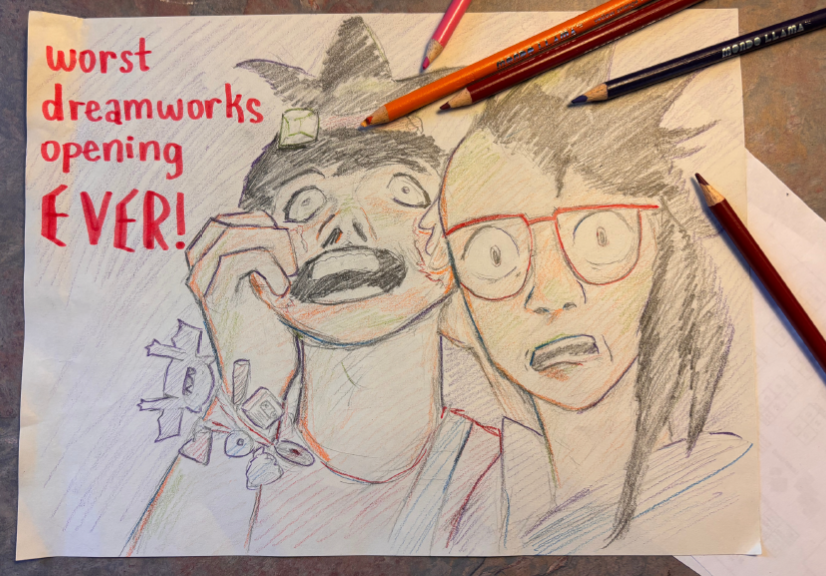
Illustration thumbnail of Forgotten Island characters (Esmond Hoang / The Puma Prensa)
By Esmond Hoang, Senior Staff Writer
Dreamworks’ newest movie, Forgotten Island, created by industry-defining veterans, was one of their lowest opening weekends, and this failure is a symptom of a larger problem. A creative and capitalist one.
Have you noticed how studios like Disney and Warner Bros constantly create remakes or sequels or spinoffs? Financially, it makes sense, as these franchises already have established audiences. This strategy can be a great way of giving more life into old franchises. However, these franchises all need to start from somewhere and studios don’t want to take that risk anymore. They would rather create sequels for movies with already widely celebrated endings or make uninspired live action remakes, which are mostly computer animated anyways. Over the last few years, there were only a few original movies grossed enough to reach the top ten domestically of their year.
Notably, some of the biggest failures recently are from huge franchises like DC and numerous live action remakes. The audiences have started to become sick of repeatability and unoriginal movies. Meanwhile studios are allergic to believing in them, especially the animated ones. Those movies are the first to be canceled or cut for tax benefits. Imagine working on one of those movies, every frame has been though hundreds of other artists before you, and then it gets cut, so the parent company can pay less on taxes. Ironically, films like Coyote vs. Acme, Nimona, and one of the biggest movies of 2025, Kpop Demon Hunters, were all sold off projects that gained a huge following. Those movies were able to retain their core vision, but some aren’t as lucky. Recently Disney’s animated films— Wish and Elio—had their core concepts removed to be marketable, like removing personal experiences and queer themes. This led to generic movies and monetary failures that barely broke even of their production budget.
So, are films like Forgotten Island bad? According to Rotten Tomatoes, it had a ninety-five percent score, which means that audiences are enjoying the story. The movie was inspired by numerous Filipino artists and their personal lives. So, then, why isn't it succeeding?
Some people might blame the audiences because they didn’t support the movie. After so many unappealing experiences, most people are wary, especially since it was barely marketed. The movie’s core is about the fear of losing your friend after graduating, which is something that should resonate with high school students, and yet none of my friends or peers ever saw anything about the movie. That should tell you how well the movie was marketed for its intended audience. Does anyone remember films like Wish, Lightyear, and Ruby Gillman: Teenage Kraken. If you're wondering what random movies these are, they’re from Disney, Pixar, and Dreamworks, and are all failures from a few years ago. Maybe the reason is because we’re too old or at least feel too old. As each generation becomes more acclimated with the internet, they expose themselves to explicit ideas and that makes them grow up faster. But this can’t be the reason, as, historically, some of the most popular animations like Wall-E and How To Train Your Dragon appeal to all ages while conveying serious themes. Ironically, companies believed that it would create less marketable movies.
So is there no hope for movies?
Well, according to the US Bureau of Labor Statistics data, at least 200,000 artists have lost their employment in the US over the past four years, making the future of the industry bleak. The rise of AI is the perfect match with this because it will create even more artists to lose employment and it is also soulless. Some of the biggest hits recently were Toy Story 5 and Kung Fu Panda 4, which shows studios that continuations for franchises considered dead is profitable. This mindset will stifle a young artist’s dream and is antithetical to creativity.
Animated or not, creativity still shines through. The independent films, Backrooms and Iron Lung, despite being based on an existing property, were able to add their own originality, and it paid off on them being massive hits. My hope extends to animation as well. Animation is a showcase of human effort and deliberate storytelling, and the most recent example is the stop-motion passion project that took way over a decade, Wildwood. Their studio values human creativity and creations despite rarely making a profit. Antithetically to them is generative AI, which cheapens human labor and is exactly what corporations want. However, the director of Wildwood, Travis Knight, describes AI as something that has “never felt loss or love or pain, and that’s something that people can feel and that’s something you feel in something that was made by people.” That’s why he believes stop motion and animation as a whole is valuable, despite how labor intensive it is. Whether corporations believe this, only time will tell. Meanwhile, if you see an unfamiliar animation, maybe check it out.