
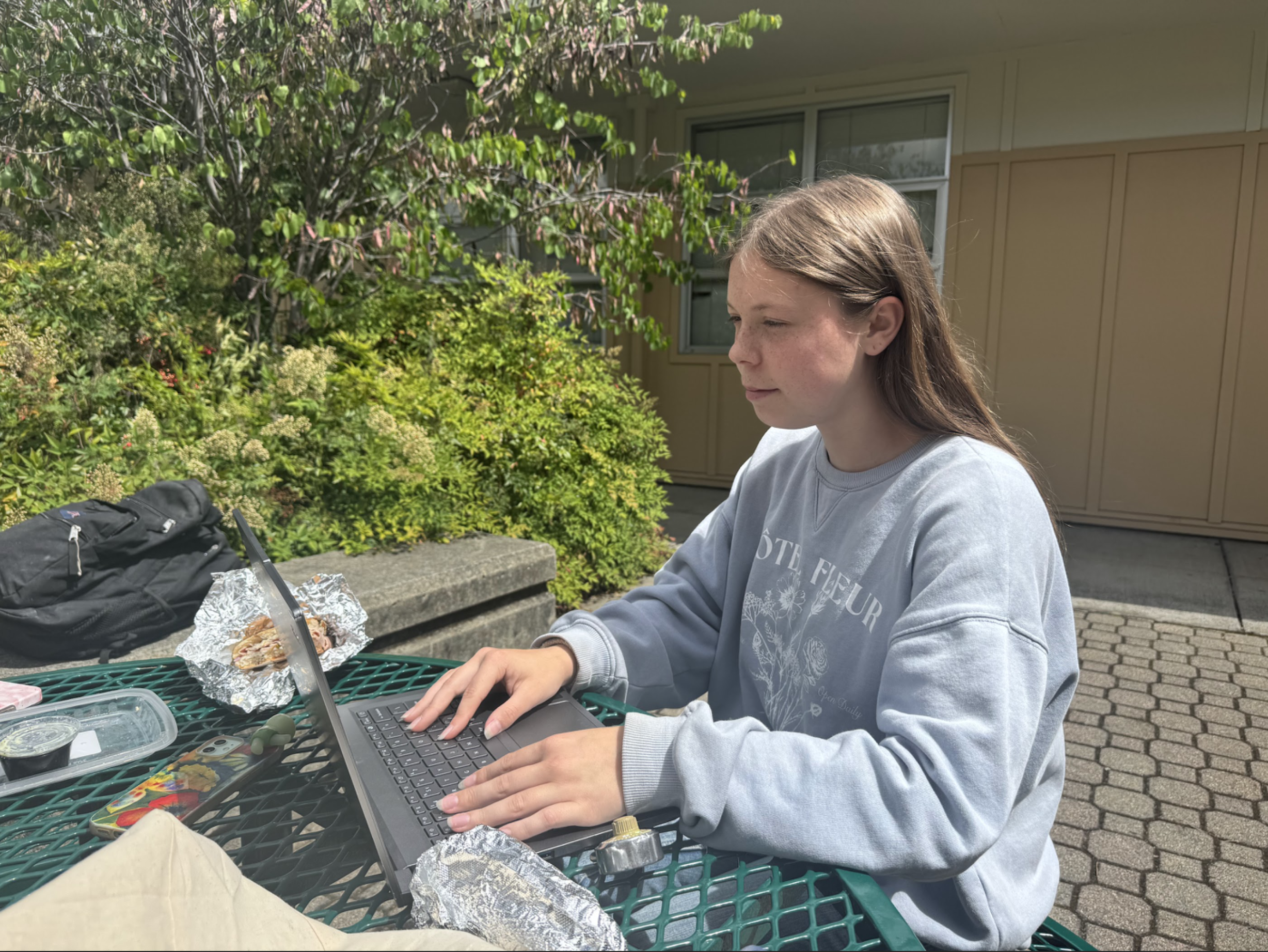
Nell Krombholz working on a Chromebook (Isa Dajalos / The Puma Prensa)
By Isa Dajalos, Staff Writer
It’s officially spring. Flowers are blooming, the grass is greener than ever, and temperatures are right in that sweet spot everyone loves. As the school year comes to an end, a lot of students are beginning to prepare for heavy-weighted finals and AP exams. However, the experience for seniors is a bit different with normal decisions for most colleges scheduled to release before April 1. The past few weeks at the senior tables and senior classrooms have been full of constantly refreshed college portals and fingers crossed, followed by excited screams and even tears. This is a stressful time for many students at Maria Carrillo High School that tensely await the next four years, but one senior in particular is not fazed by this nerve-racking period: Nell Krombholz.
Instead, Krombholz consistently has their head crammed between a textbook and laptop, intently studying for the IMAT, or International Medical Admissions Test, this coming September. The IMAT is an exam held for English-taught medical schools in Italy that tests on biology, chemistry, physics, mathematics, as well as a section on logical reasoning. The system for entering medical school in Italy differs vastly from the American system, or any other country for that matter. Here in the states, becoming a doctor requires a bachelor’s degree and medical school which takes at least eight years to complete. In Italy, this is cut down to at least six years to complete: two or three years of pre-clinical studying, then three to four years of clinical studying, and a required thesis. Other than being a shorter timeline, college in Italy is far more affordable than in the United States, though this is not accounting for the similar years of residency required in both countries. For these reasons and the promised adventure of a new city, Krombholz found that Italy was the right fit for her: “I’m excited to learn a new language, but I'm also gonna experience such a different way of life. Like different environments, seasons, and also different people–and since it's an international school, there's gonna be people from all over the world.”
Landing a spot in Italian medical school is no simple task. To enter the medical field, tens of thousands of students take the 100 minute, 60 question IMAT. Based on a student’s score they are assigned to one of 16 public universities, with higher scores ensuring placement in the more prestigious schools. Generally, a safe score to ensure placement at any of the 16 universities is at least 50 points.
When asked about feeling prepared for the exam, Krombholz said “taking the AP versions of all those topics has definitely prepared me.” She reflected that having committed herself to each class in the past with the guidance of supportive teachers has made the process “less like studying or learning new things.” Rather, they say it is more so “just reviewing” topics that they had previously learned at Carrillo. More times than not, Krombholz can be found jotting down notes in a thick three-subject notebook with just an iced coffee for company at the Peet’s Coffee on Mendocino or local Land and Water. Such hours-long study sessions have practically become a ritual in this year leading up to the long awaited IMAT. But to be completely transparent, Krombholz’ studying habits are more on the extreme end. Their class load the past four years includes 11 AP classes, four dual-enrollment classes at Santa Rosa Junior College, and all honors courses available to freshmen. Clearly, she’s worked hard to get the most out of what MCHS has to offer; however, this isn’t the only place Krombholz excels.
Without downplaying her academic dedication and prowess, it is worth noting that like all other students she has a life outside of the classroom, too. For Krombholz, life off campus means hours at Santa Rosa Gymnastics and pole vaulting for the MCHS track team.
Sports take up the second largest part of life for Krombholz—who not only has regular gymnastics practices three days a week, but also teaches classes to “the littles” every Saturday, and does varsity pole vaulting three times a week. Early this April, Krombholz took a trip down to Palo Alto for the Stanford Invitational after vaulting 10 feet this season. While vaulting is a rewarding new addition to Krombholz’ routine, gymnastics has been a part of their life for the past 12 years. “I can’t remember a time when gymnastics wasn’t in my life,” she reminisced. Wrapping up this final competing season is obviously bittersweet, not unlike the several other chapters coming to and end for seniors.
With the mountain of changes that seem to be ensuing as high school wraps up, it can feel overwhelming to keep moving forward. For most seniors, the transition to life after high school means moving out of your parents’ house, away to a new city or state, and leaving your friends behind. Keeping these typical rites of passage in mind, the anxiety-inducing and exciting qualities alike, and cranking them up a few notches gives a sense of where Krombholz is headed. Krombholz is not just leaving the only town they have known behind, but moving across the globe. And while it is a huge jump into a new life, Krombholz remains optimistic about being thrust into a new culture.