
AP exam advice
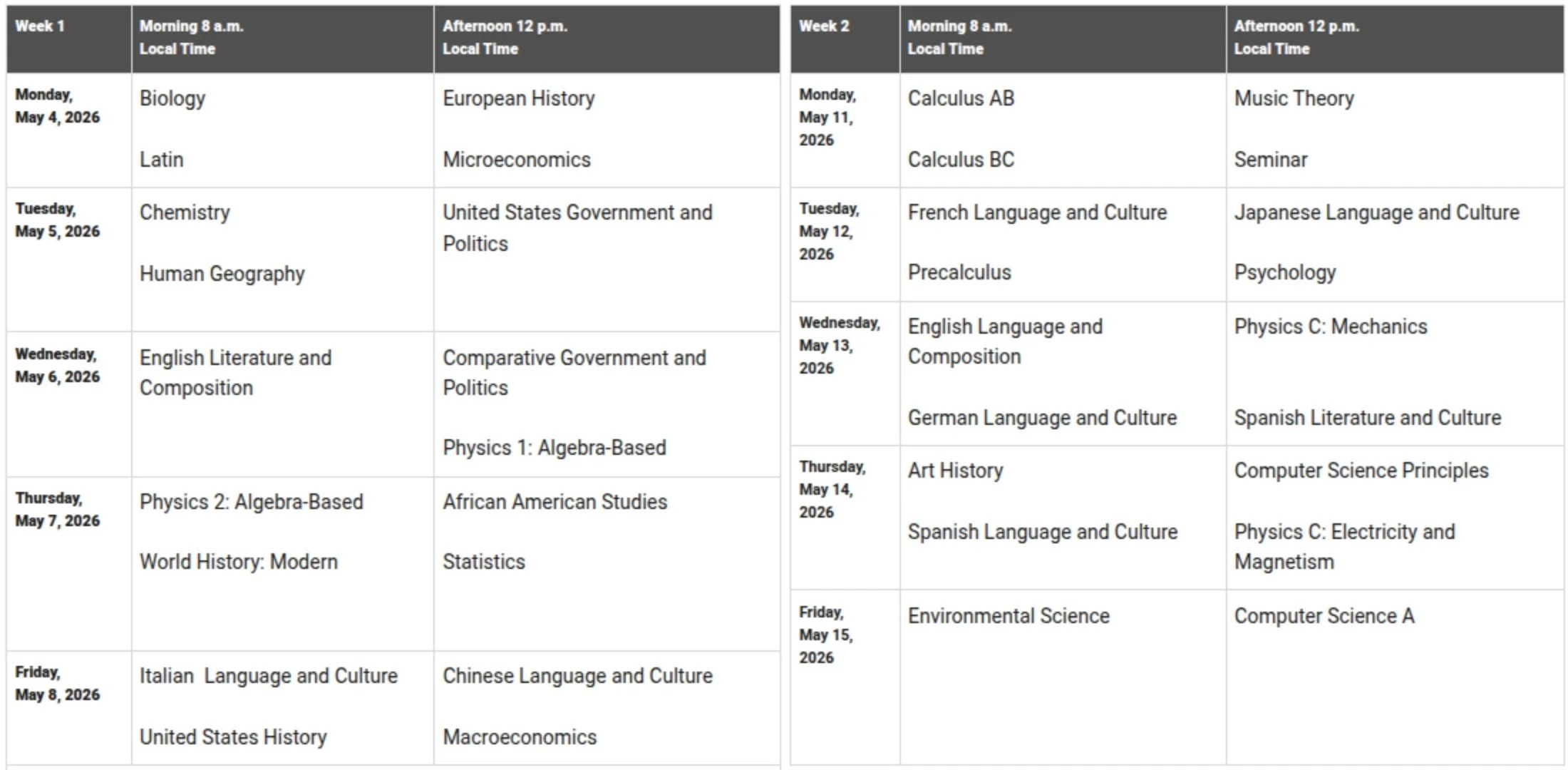
Graphic of the 2026 AP testing schedule from the College Board (Ruby Costa / The Puma Prensa)
By Ruby Costa, Co-Executive Editor
AP season is stress inducing. With less than a week before the first round of AP students will file into the Maria Carrillo High School library for testing, the most crucial last minute step is to make sure you are fully prepared.
Aside from the content you have hopefully studied, there are a few key pieces of information you’ll need to know before your test.
Location:
AP tests are proctored in the school library. You should be standing in front of the library at least fifteen minutes before your test, whether it is in the morning or afternoon time slot, and have all your materials. You cannot access anything in your backpack, locker, or another classroom during the test.
Materials:
Bring:
It could be useful to bring a watch (not a smartwatch) or a small egg timer because the clocks on the wall are not visible from all seats in the library
Your school ID, either a physical copy or Minga on your phone
For AP tests that require calculators, make sure the calculator that you bring is approved for your specific exam (some allow graphing calculators while some limit you to a scientific calculator). The testing program Bluebook (see the section “Testing Program” for more information) comes with a built in Desmos calculator for some exams
Bring a pencil or pen. If your exam is completely digital, it should not matter what sort of pencil or pen this is, as it will only be used if needed on scratch paper. If you have a hybrid exam with written sections, the pencils should be No.2 and the pens should have either black or dark blue ink
A device with Bluebook installed (this could be your school issued chromebook or a personal laptop, if available) and a charger, if needed. Portable batteries/chargers and computer mouses are permitted, but not required
A water bottle and snack for your break between part I and part II of the AP test
*AP Physics requires a ruler or straightedge
Prohibited:
Other electronic devices or watches/timers that make a noise (that cannot be turned off)
Electronic writing instruments (stylus, Apple pencil, etc.)
Extra school supplies such as books, notebooks, highlighters, compasses, protractors, white-out, dictionaries, colored pencils, scratch paper (paper will be provided by the proctor for applicable exams), clipboards, or privacy screens
Clothing or shoes that contain information related to the tested subject
Headcoverings or hats (unless for medical or religious reasons, as long as they do not obstruct the eyes or ears)
Earplugs or headphones
Some additional items may be allowed depending on individual student accommodations. If this is the case, you will receive a letter saying so, and need to bring it with you into the testing site.
Testing Program
This year, all AP tests are digital—though some contain non-digital sections—so you will need the application Bluebook installed on your computer. It should be pre-installed on your school chromebook, but it is still recommended to try opening the application and ensure it works before your AP test. As far as a personal device, you will need to install this application yourself.
Each AP test has a slightly different format, but doing practice tests on AP Classroom and asking your teacher questions can help prepare you.
Timeframe:
AP tests are two to three hours long, on average. You can have one of two time slots for your AP test: 8:00 AM or 12:00 PM. As you need to get there at least fifteen minutes early, and because thirty minutes is recommended by many teachers, remember these two times as 7:30 AM and 11:30 AM instead.
If you have the morning slot, you’ll likely be finished during your third or fourth period. You can return to class, but many students go home early. For an afternoon slot, your test will probably end very close to dismissal. Many students skip first or second period for afternoon AP tests, either getting some extra sleep or cramming.
All AP tests include a mandatory 10 minute break, usually in the middle, where you step away from your testing materials and are advised to have a drink, eat a snack, and prepare yourself for the second section of your test. You are not allowed to discuss the AP exam during this break, though even if you did, you would not be able to go back and change your answers for part I.
When the allotted time for your test is over, your test will close regardless of how much progress you have made. Block out your time carefully! After the test is submitted, any scratch paper you used will be collected and you are allowed to leave. AP test scores are released in July, and you can access them through AP Classroom. If you don’t get the score you were hoping for, you can always hide it from the colleges you apply to, though doing this with too many AP scores can give a bad impression. Remember, three and four are not bad scores. You don’t need fives across the board to release your scores to a college.
Good luck!