
The 1000 Day Crisis– Sudan
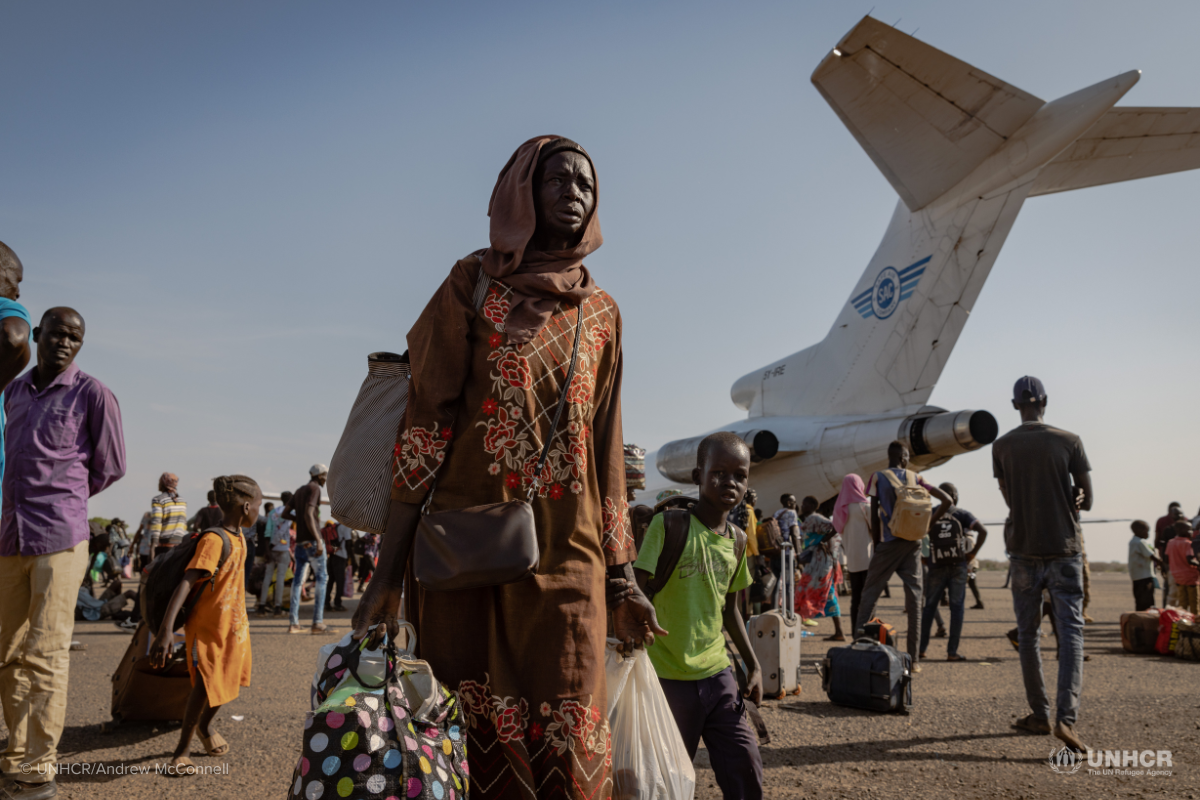
Beleaguered Sudanese refugees (The United Nations Refugee Agency / The Puma Prensa)
By Aiden Damasco, Staff Writer
The 21st Century has seen the introduction of devastating modern conflicts, such as the United States’ invasions of Iraq and Afghanistan, the Russian Invasion of Ukraine, and the Israeli-Palestinian Conflict.
These conflicts have been widely televised internationally, and thousands of lives have been lost due to the course of these wars. However, millions of unheard stories have gone unreported and untelevised in Africa.
The African continent, specifically the sub-Saharan region, has been plagued with issues since the 1980s and 90s, decades after many African colonies declared independence from their former colonizers, namely the United Kingdom and France.
This so-called “bleak period” was a time of little improvement for sub-Saharan Africa, with the average GDP (gross domestic product) per capita for the region fluctuating rather than experiencing significant growth. In a study done by Rebecca Simson, a lecturer at Oxford University, the average GDP per capita worldwide in 2020 was three times higher than it had been in 1960.
“Historical legacies of colonialism, governance challenges, weak institutions and corruption…have contributed to instability across the continent,” said Kuje Ayuba, a Chancellor at Bingham University in Lagos, Nigeria. Ayuba stated the borders for many African countries were created arbitrarily, “disregarding indigenous identities and historical affinities.” Due to the disregard for the indigenous and other various groups, much internal conflict within countries is experienced on the continent.
Sudan is one of the countries that suffers from these problems. A country located in sub-Saharan East Africa, it is shaped by Islamic and British influences from its periods under their rule and influence.
Under British colonial rule, “British colonial rulers treated the northern and southern regions as two separate entities,” said the United States Holocaust Memorial Museum. The northern side, which comprises the modern-day country of Sudan, had formerly been under Ottoman and Islamic influence, and due to both Ottoman and British influences, it experienced the most significant development.
Meanwhile, the southern side, untouched by the Ottomans and even the British, lacked the visible improvements the north did, mainly consisting of religious animists and people from various indigenous tribes, creating major disparities between the two areas.
The disregard for indigenous identities between the two areas would pose a major reason for the violent history of Sudan. In 1955, a year before their independence from the British in 1956, the southerners, now mostly Christian from their time under British influence, “had been promised and then denied the right to govern themselves,” said the USHMM. Due to the ethnic and religious divides between the two, hundreds of thousands of civilians would die in two civil wars, with millions more displaced. The Sudanese Armed Forces (SAF) of the north were infamous for targeting the southern civilians and various minority groups during these four decades.
In 1989, during the Second Sudanese Civil War, Sudanese Colonel Omar al-Bashir seized Sudanese power in a bloodless coup d'état. In a report by Al-Jazeera, “in 1993, al-Bashir abolished the [provisional government] and appointed himself president of Sudan, [retaining] military rule.” In addition, al-Bashir ordered the dissolution of all political parties, allowing only himself to run for president. Under his dictatorship, Islamic Sharia Law (the Islamic legal code derived from the Quran) was put into effect and was used to control Sudanese society.
Al-Bashir’s reign in Sudan came into international news on the onset of the Darfur Conflict in 2003. In February of that year, non-Arabian groups launched an attack on a Sudanese settlement in an act of rebellion against al-Bashir’s government, which had abused and oppressed the non-Arabian groups. Al-Bashir’s government met the resistance with violence, the conflict spanning seventeen years, ending with a stalemate in 2020. As cited by the Holocaust Museum Houston, the conflict in Darfur ended with “nearly 400,000 people…killed, women…systematically raped and millions of people [left] displaced as a result.”
During the War in Darfur, the Sudanese government armed nomadic Sudanese Arabs, known as the Janjaweed, to fight against the non-Arabians in a militia. These men used hit-and-run tactics to harass the non-Arabians and were one of the major military groups involved in the Darfur War. In 2013, al-Bashir ordered a significant portion of the Janjaweed to be incorporated into a new paramilitary force known as the Rapid Support Forces (RSF).
Al-Bashir’s wars were not the only thing that made him unpopular amongst the Sudanese people. As stated by the Yale Journal of International Affairs in 2013, “Sudan [was] the fourth most corrupt country in the world,” with human rights abuses prevalent. Furthermore, Yousif el-Mahdi, a Sudanese economist, estimated that “the real overall inflation rate [in Sudan] was closer to 65 percent.”
The instability in Sudan led to nationwide protests beginning in late 2018, lasting just shy of a year. The pro-democracy protesters incited widespread rioting and arson. Al-Bashir was overthrown in April of 2019 in a coup, ironically, the same way he received Sudanese power. Groups of generals, led by Lieutenant General Abdel Fattah al-Burhan, took power after the coup, forming a new provisional government called the Transitional Military Council (TMC), as well as becoming the leader of the Sudanese Armed Forces.
Later in August, the TMC and protesters agreed to a slow Sudanese transition into democracy, as “[al-Bashir's] regime was so deeply entrenched that it would take time to dismantle its political network,” said the BBC. The creation of the Transitional Sovereignty Council (TSC), the head of state of Sudan, was the first step, where both politicians and civilian leaders shared power. Originally led by Abdalla Hamdok, the TSC had unremarkable performance, with economic hardship, protests, and a lack of trust between the politicians and civilians, rendering the TSC weak.
The TMC’s lackluster tenure caused another coup, led by Burhan of the Sudanese Armed Forces, and Mohamed Hemedti “Hemedti” Dagalo, the leader of the Rapid Support Forces, against Hamdok in October 2021. After the overthrow of Hamdok, Burhan dissolved the TSC, derailing the democratization process. Despite Burhan’s reinstation of Hamdok months later, Hamdok resigned due to the unrest, leaving Burhan as the de facto leader of Sudan. Throughout 2022, Sudan remained under de facto military rule, with continuous protests and unrest from the civilians. The issues in the government were further complicated by the soldiers of the SAF and RSF, both armies having severe loyalty to their respective leaders.
In December of that year, Burhan attempted to continue the democratization process, but failed to integrate the RSF into the SAF as a regular army unit. Hemedti, fearful that he would lose power due to the integration of RSF, quickly deployed the RSF to key SAF military bases in April of 2023, ordering his soldiers to revolt against the SAF on April 15.
Since the onset of the war in 2023, the economy of the country has been in rapid decline. In a report by the International Food Policy Research Institute, by November of 2023, “the war had resulted in economic losses exceeding $26 billion…more than half the value of the country’s economy a year earlier.”
The collapse of the economy has made it astronomically difficult for the Sudanese population to remain in the country. In the same report, by July of 2025, “employment [fell] by 4.6 million jobs over the period of the conflict,” with “more than 7 million more people [being] pushed into poverty.”
The history of Sudanese instability has led Sudan to have the largest humanitarian aid crisis in the world, even before the outbreak of the 2023 war. According to the Council of Foreign Relations (CFR), before the start of the conflict, “16 million people [faced] severe food insecurity.” The situation in Sudan was further tense by the residence of 3.7 million internally displaced Sudanese civilians within the country. The country was also home to roughly 1.3 million Southern Sudanese refugees before the war.
Twenty-one million people are estimated to face starvation in 2026, according to UNICEF. Famines have been confirmed across the nation in Al Fasher and Kadguli, with an additional 20 areas at risk of complete famine. The risk of malnutrition and other diseases is widespread across the country. According to UNICEF, the northern area of Darfur, which had been free from the two-decade-long War in Darfur for less than three years before the 2023 war, is the epicenter of the malnutrition emergency.
The physical strain of the war has affected millions and continues to affect the mental state of the Sudanese. In a report by Ibrahim Nagmeldin Hassan published in The Lancet, 25% of older citizens in Khartoum, the capital of Sudan, are unable to receive medication, which, without the proper care, will lead to increased civilian casualties. The same report claimed that 40% of the older adults are showing signs of post-traumatic stress disorder, and with the lack of urgent healthcare, it is unlikely they will receive the mental help they need.
Children have been reported to be taking the biggest burden of any group. UNICEF reported that in January of 2026, “5 million children have been forced from their homes,” or about five thousand every day, with migration being frequent due to the risks of attacks and acts of violence from the military. Rape and other types of sexual violence are also reported, with UNICEF sharing “children as young as one are among survivors.”
“Children…are frightened, displaced and hungry,” said Edouard Beigbeder, the UNICEF Regional Director for the Middle East and North Africa. In Northern Darfur, 85 thousand children were treated from January to November of 2025, all with severe acute malnutrition. This equals roughly one child being treated for malnutrition every six minutes.
Not only has the war in Sudan affected the country and civilians, but the neighboring countries of Egypt, Chad, and South Sudan. The United Nations High Commissioner for Refugees reported that in January of 2026, 4.4 million Sudanese had fled the country since the beginning of the war to escape the extreme violence.
The influx of new refugees has left neighboring countries “struggling to cope with the increased demand on healthcare, education and other basic services,” said the United Nations. According to the United Nations Office for the Coordination of Humanitarian Affairs (UNOCHA), the influx of new refugees into their countries has overwhelmed health facilities.
“Medicines, supplies, and personnel are in short supply,” said the UN. The crisis in these neighboring countries is worsened by the fact that, before the 2023 war, nearly all of these countries were suffering from their own internal domestic crises, and with the new influx of immigrants, it makes it harder for the governments to resolve their own problems, placing the immigrants in temporary refugee camps. The UN has reported “large numbers of people [have sheltered] in overcrowded areas lacking access to water and sanitation, food, and the most basic services.”
The current war in Sudan has not only been at the forefront of the largest humanitarian crisis in history, but also for the genocide of thousands. In early 2025, the United States government determined that the Rapid Support Forces had been committing genocide in Darfur, launching sanctions on Hemedti. The Human Rights Watch (HRW) reported the RSF has been killing the non-Arab population in Darfur, as well as participating in the rape, looting, and torture of thousands of civilians across the country.
Through the accounts of survivors, both the Rapid Support Forces and Sudanese Armed Forces have been accused of the unlawful attack on “healthcare workers, local responders, and healthcare facilities,” all of which are crimes against humanity. In Khartoum, members of the RSF have been said to have “raped, gang raped, and forced into marriage countless women and girls,” said the HRW. An anonymous woman reported, “Since this war started, it is not safe anymore.”
As of January 2026, it appears there will be no end to the war in Sudan in the near future. A diplomatic group composed of the United States, Egypt, Saudi Arabia, and the UAE, colloquially known as “The Quad,” created a roadmap in September 2025 for the RSF and SAF to resolve the conflict peacefully.
However, neither the RSF nor the SAF refuses to stop the fighting until the opposing side is eradicated from the country. The RSF has not commented on the peace deal proposed by The Quad, instead continuing their Siege of El-Fasher, which fell a month later in October, resulting in the execution of sixty thousand civilians.
Meanwhile, in a visit to the city of Ankara, Turkiye in December of 2025, the Washington Institute reported Al-Burhan proclaiming the Sudanese government will “not accept a truce or a ceasefire so long as the [RSF] remains on any inch of the country.”
“For the children of Sudan, the world is 1,000 days late,” said Beigbeder. “Ending this conflict is a moral necessity. It cannot wait.”