
Ragebait and the death of complexity
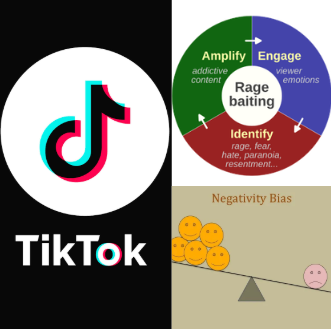
Graphic illustrating methods that TikTok uses to go viral (Ava Cotton / The Puma Prensa)
By Ava Cotton, Staff Writer
Social media is killing nuance.
Now, this statement may seem like an extreme claim, but the point is true. Social media has paved the way for millions of people all over the world to communicate with anyone, anywhere, any time. It connects people across borders, experiences, and backgrounds. However, social media also divides people.
Let's look at the history of these apps.
It is not surprising that we are addicted to social media. However, it is also important to uncover where that addiction comes from: us or the company.
The creators of TikTok originally capped videos at only 15 seconds, which meant content creators needed to quickly grab users attention in that small amount of time. Now, the videos are longer—capped at 10 minutes—but that original method still stands. Social media algorithms are built to keep people scrolling and they use addictive, fast paced content to do so. The ideal length for a viral video is 15-30 seconds according to Go Viral. So to go viral, creators need bold or attention grabbing words in the first few seconds. To do this, they may use a method called “rage-baiting”.
The idea of using rage to evoke engagement and spark virality is called “rage-baiting.” This tactic is used to tap into the audience's negativity bias— a cognitive bias that explains how human cognition is more affected by negative events rather than positive ones. This gives a reason to why we are so affected and attracted to the act of rage-baiting.
It also explains how frequently social media pushes out tragic events. Good events don’t get nearly as much attention because they are not as engaging. This warps people's perceptions of reality because TikTok doesn’t care as much for nuanced conversations, it cares for viral ones.
One example of this is when people start to claim the world is getting worse because of the abundance of tragic content online.
It’s not.
The world is so large and diverse that there are going to be bad things happening, but there are also so many good things happening at the same time.
Certain things like the cost of living, student loan debt, traffic, and air pollution are actively taking a turn for the worst. But to say that all these things getting worse is a reflection of the entire state of the world is erasing the reality and complexity of life.
People who think this way are excluding the fact that we now live in a world where there are declining crime rates and low rates of extreme global poverty. Or the fact that more people have access to decent health care. Or that education has never been more accessible.
If people were able to access more diverse and complex news that was outside of social media, they would view the world as a place where there is so much grey area. People have complex emotions that don’t always fit into a good or bad box. We are rarely stagnant in our growth.
A lot of the decisions people make aren’t entirely black and white.
For example, a homeless person steals food because they were starving. The act of stealing is inherently wrong, but this person is not evil for starving and needing a solution to that problem.
Multiple things can be true at once, because people and their actions are not black or white; we are gray.
However, social media perfectly creates an environment where we can forget about the nuance of life. The concept of echo chambers is the idea that the videos people are given reflect preexisting beliefs and ideas that they already have. Echo chambers erase the possibility of getting exposed to opinions that don’t directly affirm their own. Learning about different opinions and perspectives is essential to developing nuance because it exposes people to the idea that there is no inherent right or wrong opinion to everything.
TikTok isn’t a reflection of reality. It shows one side and prevents people from seeing the other. Nuance isn’t dying because we don’t know what’s going on in the world, it’s dying because we don’t take the time to break past the barriers of algorithms to see how much it’s hiding from us. As a society, we need to either get off social media to finally view the world from our own lenses instead of from people online—who are only using us for their own virality and success—or we need to deliberately seek out different kinds of people that don’t share the same ideas as us. Developing nuance is going to help us view the world as a place with good and bad things but also things that aren’t either.