
Untold secrets of college admissions: what’s behind the application?
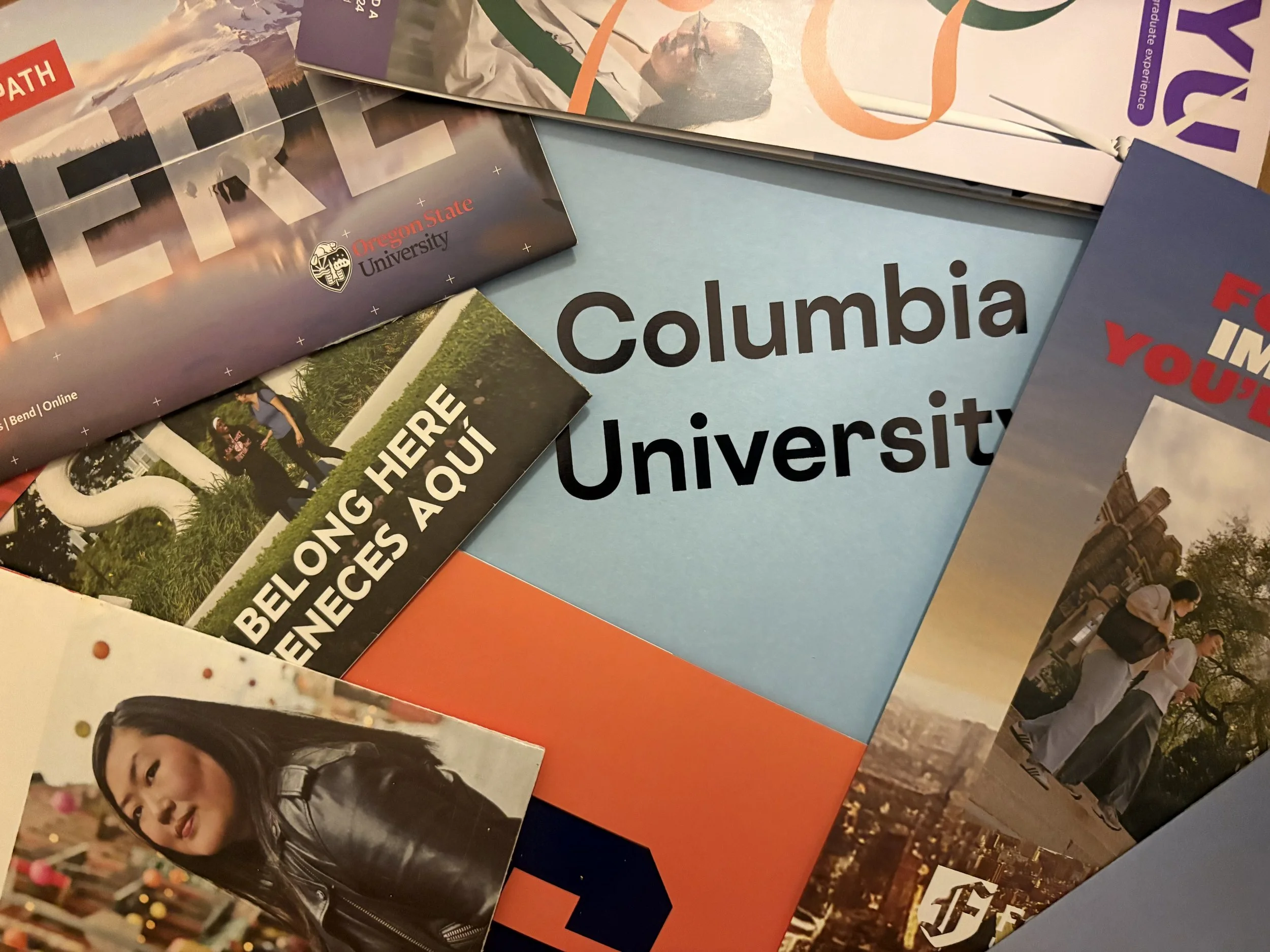
A collection of various college brochures (Lauren Chavez)
By Lauren Chavez, Co-Executive Editor
Many kids begin to feel the stress of college applications long before they reach their first day of senior year. Some are brought up in an environment in which everything they do seems to be for the purpose of propelling them closer and closer to a particular school. When they finally do reach senior year, most feel the weight of everything they once thought was so far away immediately. Whether it be staring at ten blank documents that are supposed to become personal essays, organizing every piece of information about themselves from the past seventeen years of life in a succinct, summarized way, or grappling with financial aid and scholarship opportunities, the process of figuring out where to spend the next four years can be extremely overwhelming and stressful. Add homework, tests, and projects for multiple classes and additional extracurricular work on top of that, and you’ve got a burnt out, exhausted senior, and possibly even a kid who hasn’t thought about anything but college since their first day of kindergarten.
However, have you ever stopped to think about why this process is so incredibly gruesome and seems to dominate so many childhoods and teen years, long before the issue of college applications actually comes to the forefront?
It’s clear that college admissions are incredibly flawed and directly contribute to the exact type of copy-and-paste, cookie cutter applications that they seem to warn against. Even if they don’t realize it, admissions offices hold students to a standard so impossible that their own methods are working against them.
Instead of joining clubs, sports, or other extracurricular activities because of an interest or a passion, many kids are conditioned to join simply because they’ll look good on a college application. In fact, this seems to be the most common problem plaguing our application systems today. When interest in a community or organization seems to sprout only from a desire to slap the name on a piece of paper hoping to impress a school, it begs the question, are kids really passionate about things anymore? Or do they just feel like they need to pretend to love something because they’ll receive another gold star on their chest? Instead of individually exploring interests and hobbies, kids instead settle for things they might not have much of an interest in, and what little time they have as a child and teenager is spent miserable.
Additionally, because most students applying to these top colleges have similar statistics, kids feel like there’s little they can do to make themselves stand out. This leads to an immense amount of burnout and feelings of self-doubt and failure, contributing to poor mental health and exhaustion, among other physical symptoms. It’s no question that school can be very mentally tiring for most students, but the college process in specific can be especially strenuous.. According to education company EAB, as of 2024, one-third of high school students going through the college application process say that the poor mental health they experience at the hands of the process contributes to their decision to opt out of college entirely. Forty-eight percent of students, almost half, indicated that “stress and anxiety overshadow their college search and planning” (EAB). This statistic is alarming considering just how many students apply to college every year, and translates bad for the schools as well; the staggering number of kids who feel such high amounts of anxiety and stress around college may cause distrust of the system.
Finally, it’s no secret that college is expensive. Most students applying to schools must apply for financial aid and rely on scholarships to afford their education, and even then, kids attending private schools or other institutions may still have to take out student loans, which in a lot of cases, can take many years to pay off. When looked at from a student standpoint, the idea that we must “sell ourselves” to colleges through our applications (list our accomplishments, display our best writing and attributes, etc.) doesn’t make much sense when we consider the fact that we are paying hefty amounts of money to be there. While many schools are highly competitive for good reason, there’s a high likelihood that expensive private schools would accept a student with no need for financial aid over one with that need, which raises the question of whether some schools care about their incoming students or just their money. Coinciding with this, legacy students add another level to this conversation. Many colleges may pick a student with family members who attended that school because there’s a high probability that the student will accept the offer, and because more students from one family at the school could possibly strengthen school spirit and influence the next generation of prospective students. However, legacy students often come from affluent families who most likely won’t need to use financial aid to cover tuition and will be able to pay in full, and admitting students with parents or grandparents who are alumni might encourage larger and more frequent donations from the family. Again, this raises the question of much of the work colleges do is really about the students and not the cash that possibly comes out of it?
As we seniors embark on college application season, it’s vital to remember that, while college and education is incredibly important, putting yourself first and remembering that which schools do or don’t accept you doesn’t define you as a person. Trust that you’ll end up where you belong, and the stress and hardships that it took to get there will all be worth it.