
The billion dollar problem…of billionaires
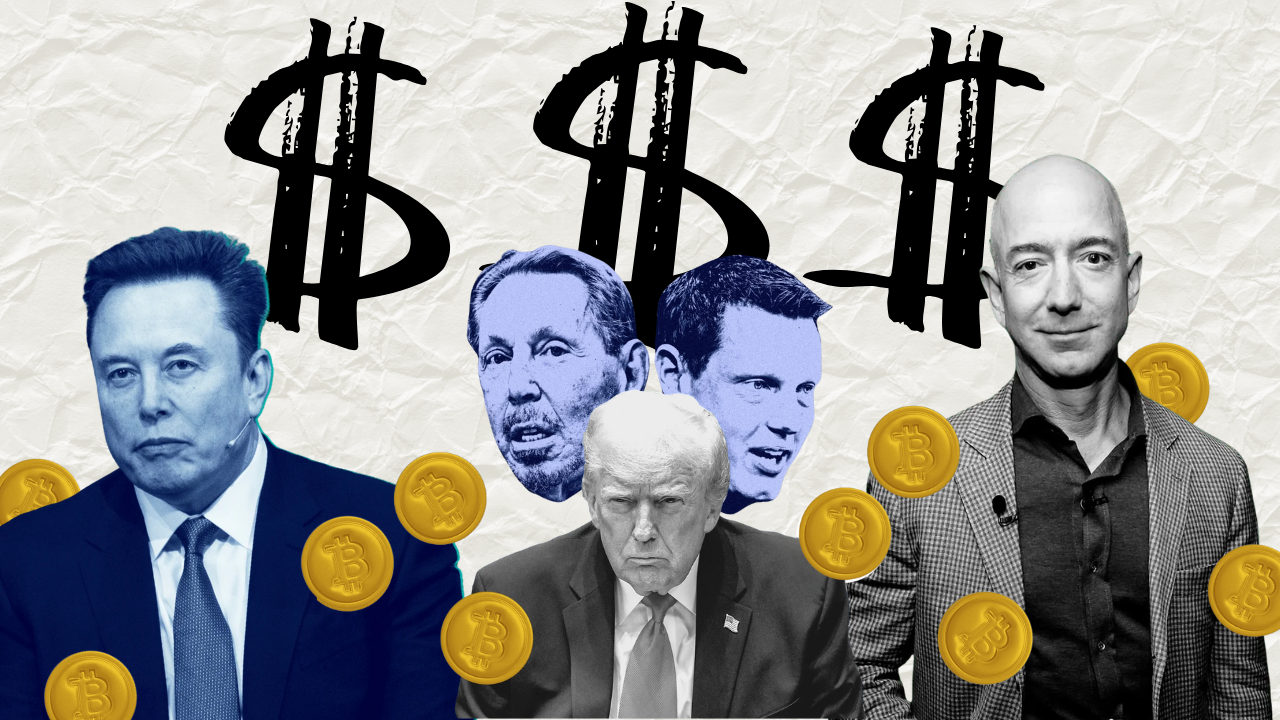
Graphic containing billionaires and big dollar signs (The Puma Prensa / Isa Dajalos)
By Isa Dajalos, Staff Writer
The founder of Amazon shuts down the entire city of Venice to throw his 50 million dollar wedding celebration, meanwhile his employees are some of the lowest paid delivery drivers and warehouse workers in the world. Our very own U.S. President, who is our country’s first billionaire president, builds a ballroom decked out in gold at the White House while simultaneously cutting over $500 billion in Medicare. And the owner of Tesla, X (formerly Twitter), and SpaceX is about to become the first ever trillionaire while wealth inequality reaches historical heights.
What timeline are we living in? And where exactly are these immensely wealthy people coming from? Oxfam America identified three main sources of billionaire wealth as “inheritance, cronyism and corruption or monopoly power” in their report “Takers not Makers.” So, let us break down these three sources of wealth for the 1% and how it impacts the majority of the working class and impoverished.
Inheritance
Firstly, inheritances from wealthy family members are not taxed. The accumulation of wealth from ancestors that were true “pioneers” or business moguls seems to have recently caught up with the current rate of emerging business startups. In the year 2023, the number of billionaires rising to the title through inheritance surpassed that of those earning the title through entrepreneurship, according to UBS (a multinational investment bank based in Switzerland).
Consider President Donald J. Trump, who was born into generations of real estate owners. Although Trump’s status as a trust fund baby has never been up for question, it was made a topic of interest when former Vice President Kamala Harris used it as a jab during an infamous debate between the two. Harris pointed out Trump’s privilege of being handed “$400 million on a silver platter,” however, this was likely outshined by Trump’s zinger of “they’re eating the dogs, they’re eating the cats” later that night.
If you’re questioning the accuracy of Harris’s claim, you are right to do so, as her statement was slightly inaccurate but in no way an exaggeration. Over his lifetime, Trump received nearly half a billion dollars from his father, as reported by New York Times in 2018. He may not have inherited exactly a billion dollars, but he had a million dollars under his own name by the age of 8, as well as the status of his father’s already established business, and he went on to become the first ever billionaire president in America. So, if you ever wonder how a president could possibly be so out of touch with the needs of the typical American, this is probably a part of it.
Monopoly Power
We all know the board game and the elation of buying up the most properties while collecting everyone’s money. On the flipside, we all also know the drudgery of paying up to the biggest owner on the board and handing over your rightfully earned properties to make rent. In real life, the situations for “winners” and “losers” are much more extreme than a quick round in jail. A glance at the list of the world’s richest individuals and several “winners” of monopoly in real life–corporate CEOs and owners of hundreds of consolidated companies–present themselves.
Take a look at Jeff Bezos, the founder and largest shareholder of Amazon. His company has come far from where it started as an online bookstore; today, Amazon is synonymous with Alexa, Kindle, Prime Video, and Whole Foods grocery delivery services. Now worth around two and half trillion dollars, the expansion of services by a huge brand like Amazon has beaten out countless small businesses, directing more money into Bezos’ already full pockets and away from local businesses that operate and support communities.
Looking at things solely from an economic perspective, ultra wealthy individuals, like Bezos, that “simply invest that money in the stock market, real estate or other opportunities” instead of “back [into] the circular flow, can be harmful to the economy,” commented AP Government and Economics teacher Scott Wallach. On the contrary, billionaires could “potentially be positive” for the economy if they were to “use their money to create businesses that hire large amounts of people for high paying jobs and donate much of it to organizations that improve society.
But Bezos’ business practices in particular are what makes the breadth of Amazon’s success so problematic. In trying to give the company the benefit of the doubt, one could argue that Amazon has created thousands of jobs, however, it’s a hard case to argue when numerous reports including one by the National Employment Law Project (NELP) and one by Institute for Local Self-Reliance (ILSR) both found that Amazon perpetuates job losses and underpays their warehouse employees compared to counterparts in the same field. So not only is Bezos’ billion dollar company eating up small businesses and respective job opportunities, but it is also creating a work environment where being underpaid is the norm, which is not an ideal that our capitalist society needs reinforced anymore.
Cronyism
If you are anything like me, you might have scratched your head at that word, but essentially, cronyism is when people in power give jobs to their friends without regard for their qualifications. In simple terms, it’s favoritism amongst the rich and powerful. For me, the first thing that comes to mind is Trump appointing RFK Jr. as the Secretary of Health despite his lack of any background in public health, as well as being an avid anti-vaccine supporter.
Crony Capitalism is the term for this trend in the business sphere and it exists across the globe. Probably most interesting is the business revolving around the ownership of TikTok. For years now, TikTok has been under threat of being banned in the U.S. due to its parent company being based out of Beijing, China. I hate to bring him up so much, but Trump is the main player in all of this drama as he was the one initially pushing for the banning of the app in 2020. Later in 2025, Trump worked behind the scenes to have a large stake of TikTok’s ownership handed over to Larry Ellison, a centibillionaire friend and owner of Oracle. And in the end Trump somehow spun solving an issue he created as a win over the Biden Administration.
Ellison is the second richest person in the world and has been monopolizing the media for years. Oracle is his 600 billion dollar tech company that offers data management and cloud computing services on a massive scale. Thousands of companies utilize Oracle’s services; name any big brand and they are likely found on Oracle’s website under their customer successes page. Earlier this year, Ellison helped his son David Ellison buy Paramount Pictures and CBS along with it, and almost bought Warner Brothers but was outbid by Netflix. Most alarmingly, Ellison signed a 300 billion dollar deal with OpenAI to provide Oracle’s data services, meaning that one of the biggest data collection companies in the world is now working with the most popular AI chatbot. If the alarm bells weren’t ringing before, the Ellison family would break the bell. They check all the boxes of inheritance: Larry passing the wealth to David, monopoly: buying major media sources like Paramount, CBS, and TikTok, and cronyism: Trump and Ellison buddying up to take over American TikTok.
・・・
Now that it is clear what each of the major ways billionaires acquire their money are, let’s explore the consequences of such immense collections of wealth. First and foremost, with money comes power, whether that be business wise, media wise, or politically. Everyone loves power, especially billionaires, so naturally the first thing on their agendas is maintaining and expanding their own scope of power. The megarich seem to have found a few tactics to increase their assets that aren’t so secret, nor ethical, but hey, good on them for working the system–right?
Self-Serving “Charity”
Singer Billie Eilish made headlines recently when she won Wall Street Journal’s “Music Innovator Award” and announced an 11.5 million dollar donation to charity. However, it was not her own donation that she called attention to; rather, she pointed out that there were several people in the audience much wealthier than herself that could use their money for good. She voiced a question many have asked: “If you’re a billionaire, why are you a billionaire?” and said “if you have money, it would be great to use it for good things, maybe give it to some people that need it."
Eilish’s comment might have been directed at Mark Zuckerberg or George Lucas, specifically, who were both in attendance, but it's a reminder to all the billionaires out there that they are capable of helping others on a scale that nobody else can. Unfortunately, most mega wealthy people do not reach out to support people or causes in need. In fact, several seek out loopholes and dodge required minimum donations.
Elon Musk is a prime example of a billionaire funneling money into his own bank account under the guise of charity as a means of avoiding taxes. Musk created his Musk Foundation in 2002, and over the years has “donated” large shares to this foundation in order to save upwards of 2 billion dollars in taxes. It may be the move of a crook, but who says billionaires need to donate to charity? Well, actually, the law does: the IRS requires all private foundations make charitable expenditures that are 5% or more of the value of its endowment. But these donations can be spent on a wide variety of things which can be worked around to funnel money back to the donor. Even with all his billions of dollars, Musk has failed to reach this 5% minimum donation several years over and even has an unpaid board of directors, that includes himself, for the Musk Foundation. That means that no one besides himself is getting a profit. For perspective, if he spent the minimum 5% this year, he would still have around 470 billion dollars. Instead, he continues donating into his own “charitable” investment accounts to avoid paying back his share of earnings to the government.
Avoiding Taxes
While many of the methods to tax avoidance are not technically illegal, the line between avoiding and evading taxes is murky to begin with. This line becomes all the more muddled with the ultra wealthy hiring tax lawyers to find every backdoor and loophole possible to hold onto their money. For some reason, billionaires seem to pinch pennies like the rest of us when it comes to taxes, but don’t mind spending massive, superfluous sums of money on city-wide wedding celebrations or Great Gatsby themed parties in Mar-a-lago. Currently in America, the top tax bracket sits at a rate of 37% or “about 20% lower than most European nations” and “currently at the lowest since the Great Depression,” says Wallach.
In spite of these record low top tax rates, ultrarich billionaires are not even paying up this amount. A 2021 report by ProPublica revealed that people like Musk and Bezos often pay only a fraction of their income tax rates. Using data from the IRS, ProPublica reporters were able to uncover the true tax rates of a few of the richest people in the country. Bezos’ true tax rate–the amount of income taxes he actually paid despite his tax bracket–was recorded at 0.98% that year and Musk was recorded at 3.27%, a remarkably lower amount than the 37% they were due. Over the years, Bezos has kept his true tax returns close to 1% by offsetting his earnings with “losses from side investments and various deductions, like interest expenses on debts and the vague catchall category of ‘other expenses,’” according to ProPublica.
Another common method of tax avoidance is the use of offshore accounts and trusts. In 2021, the Pandora Papers revealed hundreds of billionaires’ offshore business affairs in countries like Switzerland and the Cayman Islands. Known as “tax havens,” the extremely wealthy and their companies place their assets into accounts and subsidiaries in these areas to circumvent higher tax rates.These tax dollars would amount to billions of dollars flowing back into the upkeep of the country and would support hundreds of public services for people in need, but the greed of billionaires–people who have never relied on social welfare–keeps that money stowed away in investment bank accounts and stock shares.
・・・
The Divide
The current richest Americans are about one million times richer than the median American. This disparity increases for the biggest billionaires like Elon Musk–the richest person in the world right now–with a net worth of 500 billion dollars, according to Forbes. In comparison to the median household income of $83,730, according to the United States Census Bureau, Musk made about 2 million times more wealth than the median American in 2024 alone after his net worth grew by roughly two-hundred billion dollars.
While the scale of wealth and power that billionaires like Musk have acquired might feel like a far-away problem or a hopeless cause to the normal person, there are still ways to mitigate their growing power. If at any point while reading this article you felt your values were at odds with the antics of these super billionaires that thrive off corruption and tax schemes, consider keeping that in mind when using the services of such large corporations. Demand more transparency from corporations and, if possible, seek out more transparent and ethical businesses. Obviously, it’s hard to avoid brands with as big a scope as Amazon or Oracle, but staying thoughtful about where you spend is a practice that can help keep money in your bank accounts and out of billionaires’ pockets.