
How Coachella has morphed into everything it wasn’t supposed to be
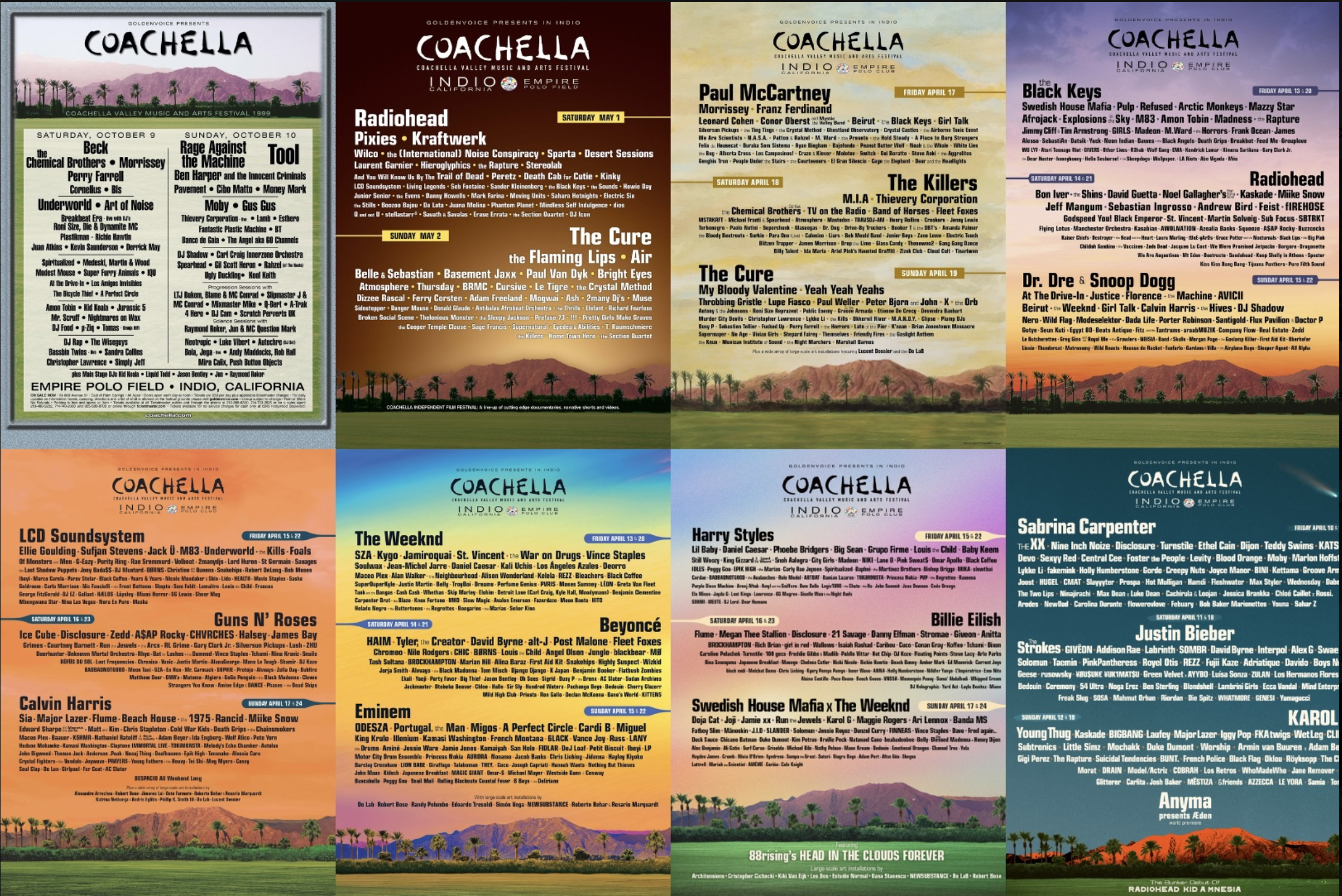
Coachella lineup posters over the years (Lauren Chavez / The Puma Prensa)
By Lauren Chavez, Features Editor
Every April, creators and audiences alike start to feel the anticipation of the biggest music festival of the year: Coachella. Held in the dusty desert climate of Indio, California — near Palm Springs — the festival has become iconic for its in-demand headliners and signature atmosphere and decorations, but most importantly, in more recent years, the massive influx of influencers. It began simply as a place where alternative music lovers from around the country could meet, be with people who shared their tastes, and enjoy the tunes without worrying about fashion or popularity. So, how did this dance party in the desert go from something so relaxed to an event catered to people who can drop thousands of dollars, can plan for years in advance, and are trained in social media and content creation?
Coincidentally, Coachella didn’t start off as the “influencer Olympics,” like many refer to it as online. In fact, when it first opened its gates in October of 1999, the goal was to create an environment that was the complete opposite of Woodstock, which was the country’s Coachella before Coachella existed. Woodstock was home to the world’s biggest artists and was primarily mainstream music. It became an event that was highly commercialized and chaotic, especially Woodstock ‘99, which had turned violent due to riots and left the festival industry with a bad taste in its mouth. Paul Tollett, who founded Coachella, wanted to create something that was calmer and less commercialized, focusing on alternative music and a subdued environment that would appeal to those looking for something more genre-diverse than Woodstock.
The festival was supposed to focus purely on the music and create a space for those who were interested in indie music, and this idea of “anti-mainstream” manifested itself into the festival's aesthetic as well. Local art installations were used instead of popular corporate brands, and because the event was supposed to be as accessible and comfortable as possible, it offered free parking and water stations throughout the grounds. The festival actually flopped monetarily its first year, losing $850,000, with its first headliners being Beck, Rage Against the Machine, and Tool.
As the festival grew, so did the headliners. 2001 brought Oasis, the Foo Fighters, and The Strokes to the desert, 2003 introduced the Beastie Boys and the Red Hot Chili Peppers, and bigger and bigger names began to fill the Coachella banner every year. Paul McCartney, Jay-Z, Kanye West, Beyonce, Calvin Harris, Harry Styles, Lady Gaga, Radiohead, all became names cemented in Coachella history forever. Part of the reason why the artists grew in popularity was because the creator of the festival realized that the indie, alternative idea he had originally had wasn’t selling the way he wanted to. People would pay more attention to the festival if they were shown names they knew and listened to.
Even still, Coachella carried on with the chill, laidback vibe it was created to evoke. Social media began to gain more traction and become more of a foundation for the generation attending Coachella, and although creators began to catch on to it and its growth as an iconic part of pop culture was apparent, the main objective was still to simply enjoy the music and have fun with friends. Many recall the festivals held in the 2010s as the peak, not only because of the headliners but because of the atmosphere and vibe.
Things seemed to get out of hand as TikTok took control around 2019, although the festival was closed for two years because of the Covid-19 pandemic. As the world of influencers began to grow more and more saturated with those who cared more about the money than the joy of creating and sharing it with a large audience, Coachella’s demographic began to change.
Suddenly, it seemed as though people were attending the festival for the sole purpose of filming a vlog and making content that they knew people would watch, instead of to enjoy the music, wear fun clothes, spend time with loved ones, and have fun. It’s identity began to reframe, morphing into aforementioned “Influencer Olympics” it’s known as today, with key players being people like James Charles (who continues to post yearly get-ready-with-me’s, outfit videos, and vlogs, and refers to himself as the king of Coachella), the Kardashian-Jenners, the Biebers, and Vanessa Hudgens. Although celebrities still attend in droves, influencers have taken the festival over, often preparing their outfits and makeup looks for the next year as soon as they get home.
The issue is, because of this massive influx in influencer attendance, it’s become increasingly more difficult for average, everyday people to attend Coachella. This has become an issue that is impossible to ignore in recent years, as prices just continue to skyrocket and the cost of even just one day at the festival is too much for the average person to handle. Tickets themselves start at around $550, but most go for much more than that. And, of course, finding accommodations is unavoidable. Many ordinary people attending Coachella choose to car camp on the premises, which seems much less expensive than renting an Air BnB or getting a hotel, but when the costs of the equipment needed to car camp are added up, it may seem more reasonable to just splurge on a hotel. Car camping is dusty, hot, and if you’re someone who values privacy and comfort, it might not be the best option. Of course, you have to factor in the cost of travel, outfits, food, and transportation, which usually lands the average person at around $1,500-$5,000 for the weekend.
Of course, if you’re spending this much money, time, and resources on your trip, you’d want to have a great experience. However, there seem to be problems cropping up in terms of the experience of Coachella in recent years. Complaints about non-energetic crowds, rude behavior, sicknesses, poor festival conditions, and issues with ticket levels have plagued social media over the past few years. Even James Charles, the mega makeup influencer who has attended the festival since 2018, has had numerous complaints about changes the festival has made, namely its convergence of the VIP and General Admission sections, which has led to unsafe conditions and a worse experience than what is promised with VIP tickets. This year specifically, there were many festival-goers who took to social media to share how sick they had gotten from pizza served at the festival, as well as how bad-quality the outdoor showers for those car camping were, many of which didn’t even lock or have water that would turn on.
Moreover, people are continually shocked at the amount of money influencers are willing to spend on Coachella. This year, influencer Sophie Rain went viral for spending $200,000 on her three day trip, sparking the conversation about who the festival really caters to and how inaccessible it’s becoming to those who want to attend with average people who don’t make massive amounts of money. As the festival continues to glean attention every year, it will be interesting to see how it responds to these concerns, and whether it’s willing to open its doors to more revenue or if it has truly become a habitat for the rich and the rich only.