
Valentine’s Day: for the love for consumerism
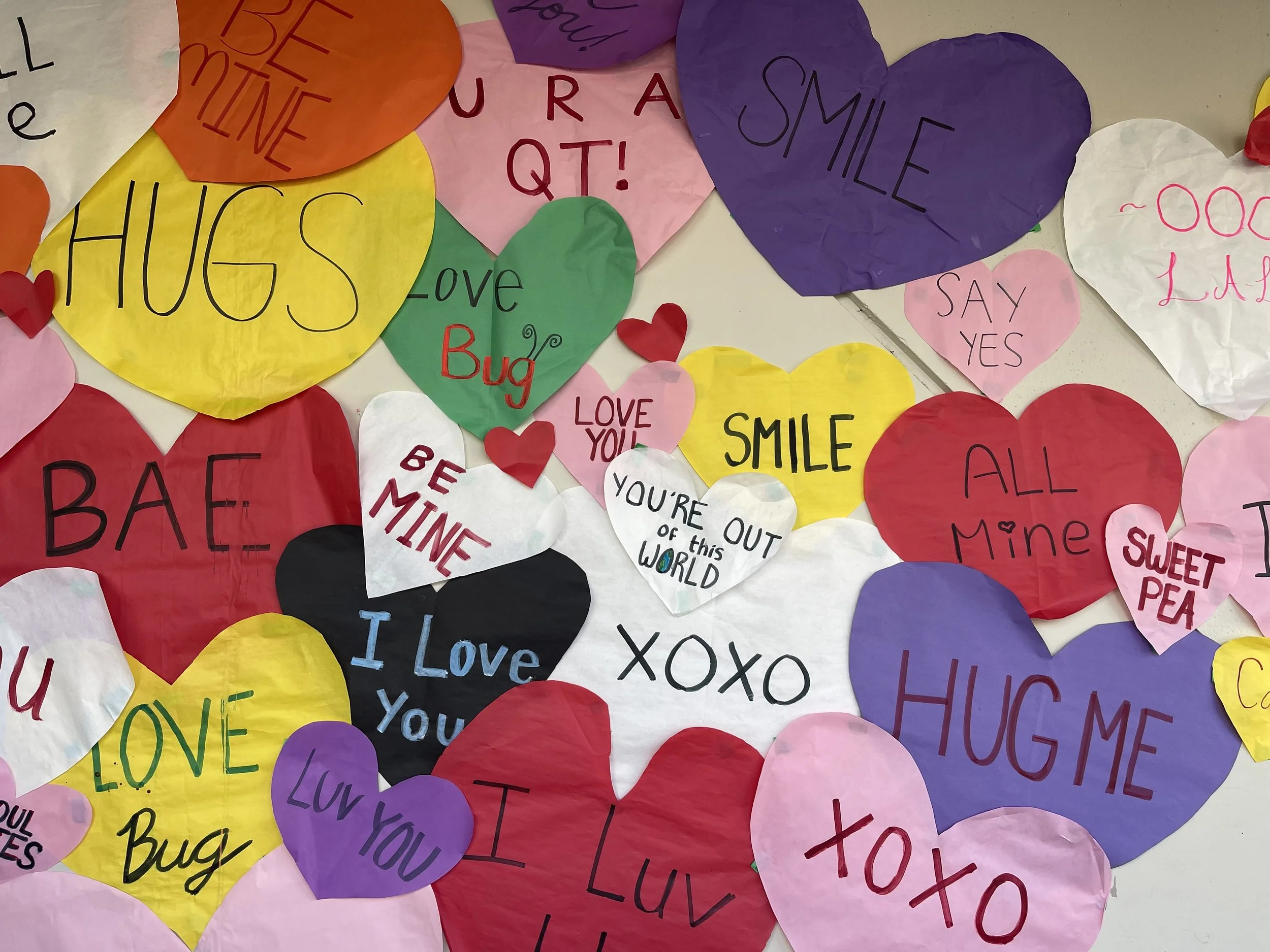
Paper candy hearts created by the student body(Nora Sitton / The Puma Prensa)
By Nora Sitton, Staff Writer, Aiden Damasco, Staff Writer
Perhaps you have thought about giving a special someone you like a box of chocolates or a card on Valentine’s Day, or maybe even going as far to confess your feelings to them. Whatever the case may be, Valentine’s Day is a widely recognized symbol of love and affection across the western world.
The namesake of the holiday, Saint Valentine, was a Roman clergyman in the third century named Valentinus. During the third century, the Roman Empire was highly unstable, having experienced the Crisis of the third century, one of the most important periods in history. In addition, the constant invasions by barbarian tribes and Easterners and the hyperinflation of Roman currency heavily weakened the Empire internally.
As a Christian in the third century, Valentinus and the Christian populace were heavily persecuted by the Romans, who in many cases would torture and execute them if they refused to give up their faith, as they were seen as problematic against the Greco-Roman religion. After being caught and given the chance to denounce his faith by Quintillus Gothicus, the short-lived Roman Emperor, Valentinus refused to do so. He was then executed and martyred on the 14th of February, with his remains buried on the Via Flaminia, a Roman road in Italy.
After his death, he was venerated by other Christians, and by the eighth century, his martyrdom was widely celebrated across Christendom. Coincidentally, Valentinus’ death happened during the Roman festival of Lupercalia, a pagan festival of women’s fertility. During the Middle Ages, Valentinus’ death and elements of Lupercalia became intertwined in medieval chronicles, with the two events being simultaneous with love by the fourteenth and fifteenth centuries.
Today, Valentine’s Day is meant to focus solely on the love aspect of its origin, but it has been morphed into something completely different.
What was once a celebration of love, tradition, and culture has been monopolized by corporations all over the United States. According to Fox Business, U.S. companies profit between $25.8 billion and $27.5 billion annually from Valentine’s. But to acknowledge the sources of their revenue, we have to observe how much is spent.
It is stated that this holiday is driven by over 170 million participants, and that the average consumer spends nearly 200 dollars on Valentine’s day each year. Within this spending, the top groups are jewelry, contributing $6 billion, dining out, contributing $5-6 billion, flowers, contributing $2 billion, and candy, contributing $2 billion. At the root of the expenditure we ask ourselves, why does everyone spend so much on this single day of the year?
To put it simply, on Valentine's, the day to celebrate love, people want to express their care for one another through gift giving and acts of service. Although, there is one thing that’s very important to consider before spending $200 dollars out of pocket. When did Valentine’s become the only time we could express love for each other? Suddenly, it doesn’t matter how well you have treated someone over the expansion of an entire year, and it has been funneled down to what you buy them on one day.
There are many opportunities as to what you can offer for your loved ones: homemade cards, letters, crafts, baking, or picking fresh flowers. Or even at the simplest of options: exchanging kind sentiments to let someone know how much they mean to you. With the upcoming Valentine’s Day, consider the many ways you can express love for the people around you, regardless of the typical expectation to purchase temporary items.
Objects are temporary, but love is eternal.