
The northern lights have a rich history–and now they’re glinting over Santa Rosa
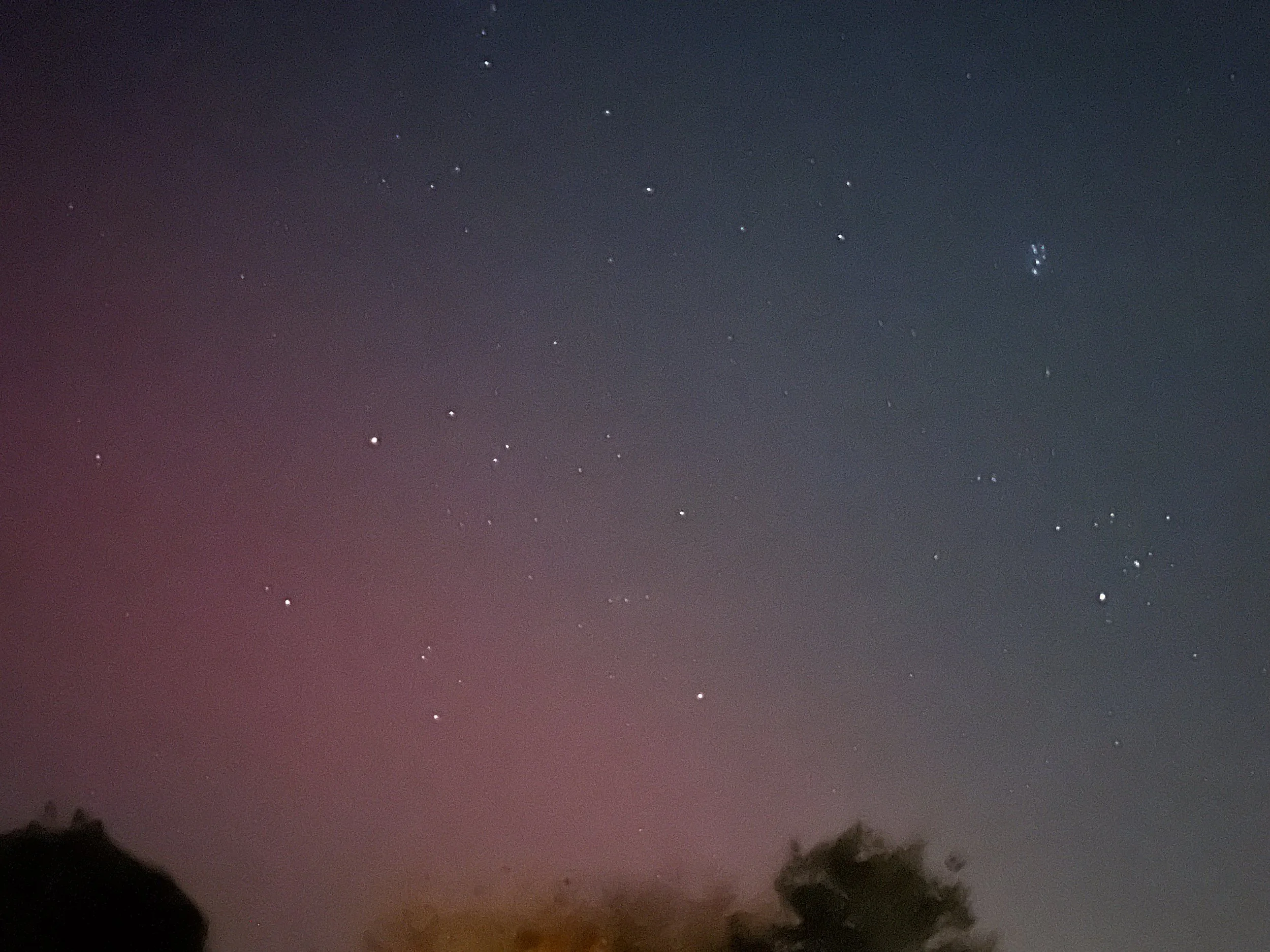
The night sky on November 11 (Alana Moscoso-Mendoza/The Puma Prensa)
By Alana Moscoso-Mendoza, Opinion Editor
The northern lights, otherwise known as the aurora borealis, are historically associated with celestial chariots, a war between dragons, dancing gods, or even the spirits of dead humans. These mystical, fascinating ribbons of glowing light have a long history, rich in folktales and ancient stories. And now, in Santa Rosa, nestled in our warm, beachy state of California, this phenomenon, most commonly appearing over the coldest countries on the planet, has visited our skies—on numerous occasions, too.
The most recent sighting of the northern lights occurred on November 11. They were distinctly magenta, with a purple glow emanating off of the edges of the lights. In the most intense points, they blazed a vivid pink, differing from their common green tones. The differentiation of colors between the northern lights is determined by altitude, and since Santa Rosa is situated in a valley with a low altitude, residents witnessed rare pinks and purples.
Higher altitudes will see green lights, and much rarer than that, red lights. The science behind being able to see these lights is fascinating; solar storms on the Sun’s surface emit large amounts of electrically charged particles, which can sometimes travel as far as Earth’s magnetic field. These particles then collide with molecules in the atmosphere and heat them up in a process known as “excitation.” According to Royal Museums Greenwich, “‘it’s very much like heating a gas and making it glow.’”
Because these particles most commonly travel to the north and south poles, where magnetic activity is strongest, it's uncommon for the northern lights to be seen in areas such as Santa Rosa. However, the explanation is simple; a very, very powerful solar storm–the most powerful of the entire year–caused electrically charged particles to travel farther than they normally would, meaning the northern lights were able to make a captivating appearance over our city just last month.
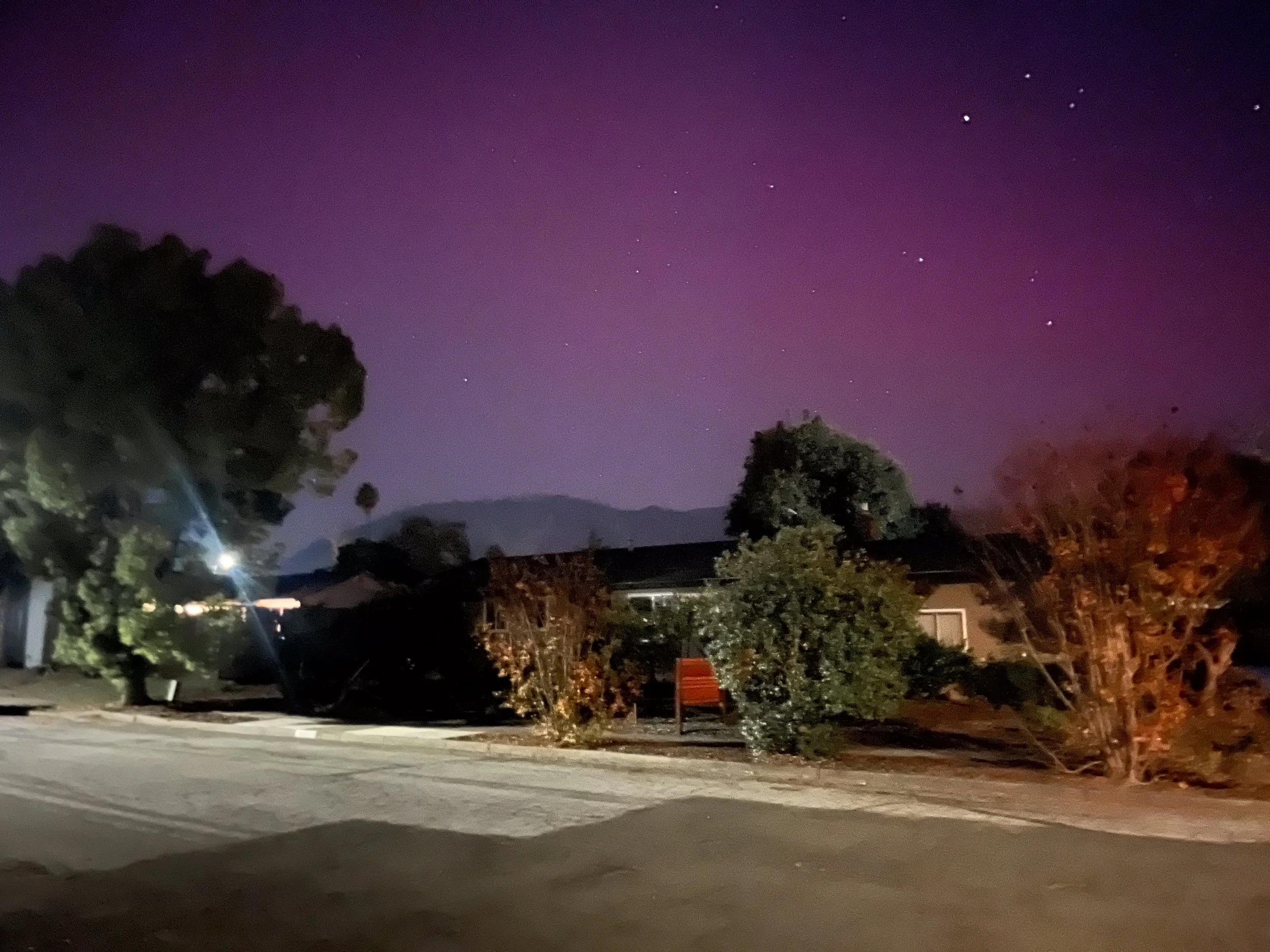
The November 11 aurora borealis sighting over Santa Rosa (Alana Moscoso-Mendoza/The Puma Prensa)
Again, these sightings are rare for us, but they aren’t impossible. All it takes is a strong solar storm, and you’ll see those gorgeous dancing lights. Luckily for us, the sun is currently at its solar maximum. Essentially, the sun operates on an 11-year cycle, and the solar maximum is when the sun is at peak activity. That, in turn, means more northern lights sightings. While we’ve been lucky enough to see two appearances of the northern lights just this year, that being in May and November, we may be even luckier and witness more in the coming years.
Of course, humans don’t have an innate ability to detect when there’s a solar storm; fortunately for us, there are special aurora borealis forecast websites that can predict when they’ll occur. Websites like NOAA’s Space Weather Prediction and University of Alaska Fairbanks’ Aurora Forecast can give you information about upcoming aurora borealis sightings. There are also apps that function the same. These sources predict northern lights sightings by measuring the Kp index, which measures geomagnetic activity in Earth’s atmosphere. The Kp index is a scale from 0-9, and any level from Kp5 and upwards represents high levels of activity, which indicates a higher chance of aurora borealis sightings.
As enchanting as northern lights sightings are, they become even more alluring when recognizing the historic folktales associated with them. Each area of the world has their own stories tied to the aurora borealis. The Aurora Zone states that many Inuit tribes thought the aurora borealis was the spirits of dead humans kicking around a walrus skull as a game.
Over in Washington State, the Makah tribe believed that the lights were fires from the north, lit by a tribe of dwarves who used them to boil whale blubber. And in Finland, the northern lights were believed to be caused by the firefox, a Finnish mythological creature, whose tail emits bright sparks from sprinting across the snow, thus forming the aurora borealis.
However, not every community believed the northern lights were as fantastical as firefoxes and dragon wars. The Great Plains tribes in North America thought the northern lights were reflections of fires under giant cooking pots meant to boil the enemies of northern tribes, according to Hurtigruten. And in Wisconsin, the Fox tribes feared that the aurora borealis were their slain enemies’ spirits, rising once more to take revenge. If that wasn’t terrifying enough, this was seen as an omen for war for these tribes.
The stories are endless, and the ones above are only a select few of the countless, imaginative tales that humans hundreds, even thousands, of years ago created. The aurora borealis can serve as a reminder of those tales and those historical bouts of creativity. The northern lights are a showcase of both fascinating science and history that we can actually witness above our skies.
The aurora borealis is a fantastic phenomenon, and it's incredible that we’ve been lucky enough to witness them in our city—and sometime in the future, we may witness them yet again.