The ultimate guide to finals week
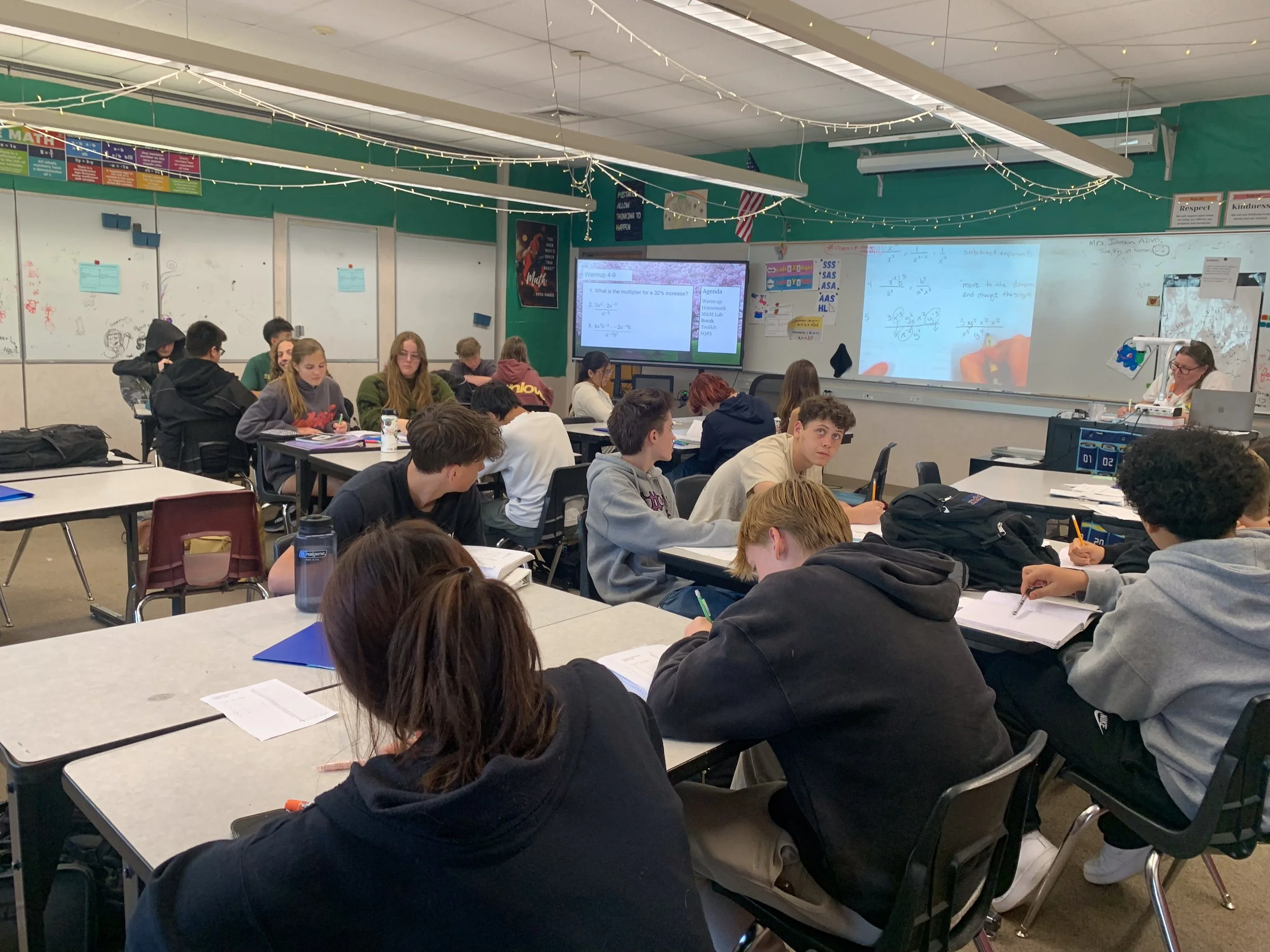
Students taking notes in a math classroom (Brianna Rubio / The Puma Prensa)
By Ruby Costa, Co-Executive Editor
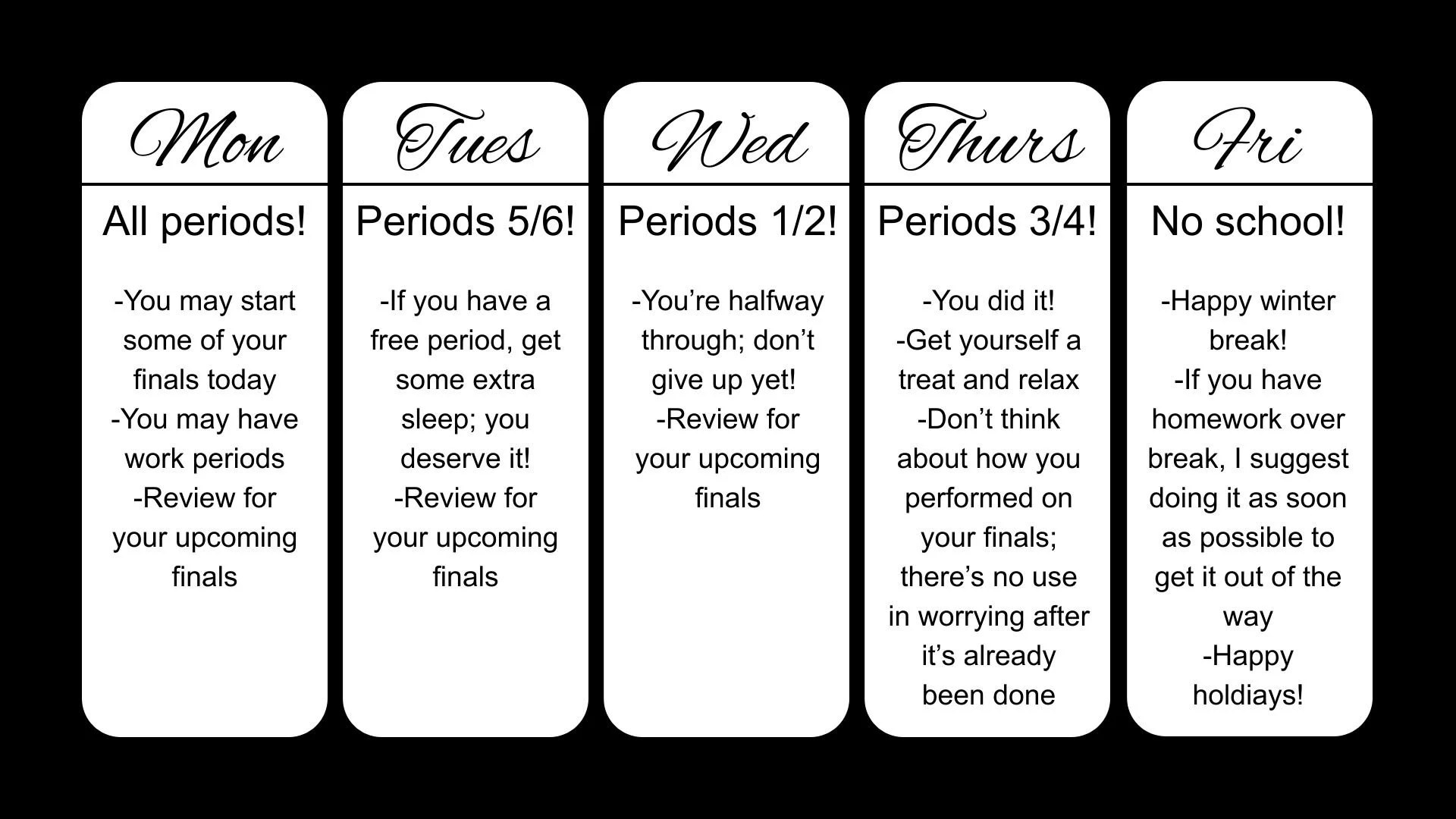
Whether you’re a freshman still getting into the swing of things or a senior who just wants to graduate already, the words “finals week” probably strike fear into your heart. Finals week brings a plethora of unpleasant hurdles; aside from the intimidating exams themselves, the schedule of finals week is odd enough to throw anyone off, and it's hard to get into the holiday spirit when you have to get through your finals first.
No matter how many times you’ve done it, finals week will always bring dread, but it's not completely hopeless if you have the right mindset and follow the right tips. This guide to finals week will help with everything from studying to your sleep schedule so you can take your exams with an inch more of sanity; think of it as my Christmas gift to you.
Warm-up:
You can’t go into finals week blind. Preparation should start weeks before your actual exams. Make sure you know what the final in each of your classes will be, and start studying as soon as you can (refer to the section “Studying” for my tips and tricks). Don’t leave things to the last minute, and though it may seem like common sense, don’t ever go into an exam without knowing what exactly will be on it.
A great way to prepare leading up to finals is to make a study schedule or plan hang-outs with your friends to study together. At the very least, make sure you have some time blocked out for studying, rather than just having to cram it into any random free time you have here or there. If you have other commitments like sports, clubs, volunteering, or work, try to keep a calendar with any days you’ll be busy so you can visualize what time you’ll have left for preparation. Any time is better than nothing.
Studying:
1.) By Subject
English: You’ll likely have an in-class essay, multiple choice questions, or a presentation, though some English classes, like sophomore Honors Ethnic Studies English, have specialized finals, like the Mary Shelley’s Frankenstein mock trials. If you mainly need to tackle terms–vocabulary, literary terms, logical fallacies, appeals, etc.–then flashcards are the most practical studying strategy. It's also important, as Maria Carrillo English teacher Maddie Doyle emphasized, to “consider the format” of your test. She “always encourages students to study the usage of vocabulary more than definitions” because that's likely going to be more beneficial for a test, and it's also more practical for the future.
If you’re gearing up to write an essay, then go over any past essay feedback you’ve received from your teacher or peers, and maybe do some practice essay prompts on your own time. The best way to get better at writing is practice. Doyle suggests group studying as well, though it's important to be serious and not get off task. She believes studying with your peers can be extremely beneficial, if done right, because “in education, there's something called the zone of approximal development.” This is the science behind how you are probably going to learn better from someone who is only slightly ahead of you than from someone who is much farther ahead of you. In other words, reviewing with your peers, who are likely on the same level as you, is actually more beneficial than only referring to what you have gone over with your teacher.
For a speech or presentation, see the presentation section in the assessment type category. Overall, presentations and speeches rely on memorization, sophistication, and having a good volume and speaking speed to keep your audience engaged.
History: Studying for a history final is about equal parts memorization and drawing connections. For your history final, you are likely to either have a multiple choice test, essay (likely a research paper for academic classes and a DBQ, LEQ, or SAQ for APs), or cumulative project, like a presentation or poster. For a project, my best advice is to follow the directions as closely as you can and always use reliable resources. A test or essay is usually more difficult to prepare for, and I would recommend making flashcards, summary sheets of important terms, timelines with important dates, or doing practice essay questions to prepare.
AP United States History teacher Jerry Deakins recommends, no matter the strategy, to only “focus on your unknowns–the things you struggle with,” and to not “waste your time reviewing something if you already understand [it].” Memorization is only half the battle, though; understanding the context for terms and their connections is crucial to write a well-rounded essay or answer certain multiple choice questions. “Make interconnections to create links” in your mind, Deakins suggests, and once you think you’ve got it down, try to quiz yourself or your friends to see how well you’ve mastered the material.
Science: Studying for science finals is discipline specific. MCHS science teacher Leanne West suggests repetition for “sciences that involve more math, like physics and chemistry, to get comfortable navigating that content.” She feels that students “do best with just practice” and “seeing lots of different situations and just knowing how to navigate each different [one].” West suggests asking teachers if they have extra practice for them, or “another blank copy of [a] worksheet to redo it.” On the other hand, life sciences is “just about understanding the basics and how those kind of relate and tie into each other,” so West suggests making summary sheets. In order to understand the material at a deep level, she encourages her students to include “words, examples, visuals, [and] diagrams” on their summary sheets. Using the summary sheet as a study tool can be effective, and even in the making of a summary sheet you're actually studying. This is a great example of active studying rather than passive studying, like simply re-reading your notes.
Group studying can be very effective for science because West believes “if you're able to teach somebody then your knowledge on [a topic] should be pretty solid.” You can try working with your classmates, forming study groups, quizzing each other, and trying to teach each other. “Even if you [have] a friend who's not in that class,” West says, “you can try to teach them.” Practice active recall after you are done reviewing to make sure you have mastered these incredibly complex topics. Taking some notes from your class textbook or an online resource is a great way to top off your studying, smoothing the gaps in your knowledge and establishing strong contextual padding.
Math: Math finals are almost always multiple choice or open-ended tests. Studying for a math test is probably the most straightforward out of all subjects, and the best strategy is simply solving practice problems. Ask your teacher for extra copies of homework or classwork worksheets, or print off some worksheets online that cover the concepts you are going to be tested on. Practice all the different types of problems you will have on your test until you're confident in each skill. Make sure to check your answers as you go! If your biggest complication is memorizing equations or rules, check with your teacher to see if you can use a notecard on your final. If you're not allowed to, flashcards could be useful for math as well; if you're memorizing equations, make sure there are absolutely no mistakes, as even one wrong variable or sign can mess up your entire answer.
Electives: With the amount of unique electives that Carrillo offers, elective finals can appear in a wide variety of ways. For most students, their language learning class will likely be the elective they are most worried about for finals week. Senior Ayla Alexander, who is currently in French, suggests a mix of individual and group studying, as well as taking advantage of all the help your teacher can provide you, rather than just relying on google translate. She thinks “using friends and conversations" is a really practical way to prepare for a speaking exam, and for writing and reading, flashcards are optimal. Quizlet is a great free resource, though it is blocked on the school Chromebooks, so you’ll need a personal device. When getting tested on a language, fluency in both vocabulary and grammar is essential, so make sure not to neglect one or the other. Reviewing with a native or fluent speaker can be helpful as well, as they are more likely to catch small mistakes in your speech or writing.
2.) By Assessment Type
Test: Start every test by carefully reading the directions. Tests will often have a multiple choice section as well as a free response section, and I would recommend starting with the free response. Write in full academic sentences and be specific and clear; even if you aren’t 100% sure in your answers, great grammar and specific terms may be able to save you. Go into the multiple choice section with careful eyes; some questions, and the answers you chose for them, may help you with other questions down the road. Answer the easy questions first and circle the ones that you are stuck on. Come back to them at the end of the test, and if you really aren’t sure, pick the answer that seems the most reasonable, even if you aren’t sure it's true. The process of elimination (crossing out the options you know are wrong) can make even very complex questions more manageable. Pace yourself between questions– I suggest dividing the number of minutes you are allotted on your test by the number of questions you have (example: 65 minutes for 54 questions → 65/54=1.2 → 1.2 minutes per question). This way, you can see on average how long you should try to spend on each question.
Don’t let test anxiety make you second guess your answers. I personally don’t go back and check mine, because I know how indecisive I can get under stress, so if that seems like it might work out for you, give it a shot on a practice test and see if your score improves! Bring some snacks and a drink to keep your energy up while testing, and put your blinders on. Cheating will hurt everyone involved, and getting distracted won’t help you either!
Presentation: Depending on the person, a presentation for your final might seem like a blessing or a curse. For some, presenting comes easily, and all they have to worry about is practicing their parts a few times. For others, though, a combination of stage fright and a poor memory can turn presentations into a nightmare. To ace a presentation, you need to practice; practice so much it feels like you’ll dream about it. Take advantage of the times in your day where you have a task to do and might want something to fill the silence–while in the shower, doing chores, or walking home–and recite your presentation from memory. Ideally, you should get to a point before the day of your final where you don’t need flashcards or the words on the slide. The repetition might be tedious but it will pay off, and if you know you have the presentation memorized, you’ll likely be less nervous when you go up to present.
(Tip: when you present, put your flashcards in your pocket or hold them behind your back! It might seem counterintuitive, but if you hold them in a place you can easily see, you’ll probably be drawn to glance at them out of nerves even when you don’t need them. Keep them out of your line of sight–unless you absolutely need to check–and trust yourself).
Project: A project can either be fun and engaging respite from difficult finals or end up being just as tough as the tests and essays you are preparing for. It's key to remember three key aspects, either way: creativity, reliability, and organization. Be creative and come up with unique ideas for your project. Don’t forget to use only reliable resources, however, whether this is for research, images, or just background information. Keep these resources organized, and make sure you have one central idea to keep track of all the websites, documents, or images that you need. Projects often require multiple mediums and various parts, so it can be easy to lose track of a thing or two. Make sure your project is neat and organized in its layout as well, so it is easy for your teacher to view and grade. I suggest asking your teacher if they can show you any past student examples if you are stuck on how to approach and project. If you have a difficult time coming up with ideas, maybe draw inspiration from your other classes (many classes tie into each other, like English and History, so drawing connections there could help you in both subjects).
Self Care:
Taking care of yourself is just as important to test-taking as studying is. If you're tired, hungry, and dehydrated, there's very little chance you’ll be able to focus or take a test to your full potential even if you’ve studied for hours. There are some things you should avoid during finals season, and other things you should prioritize for yourself.
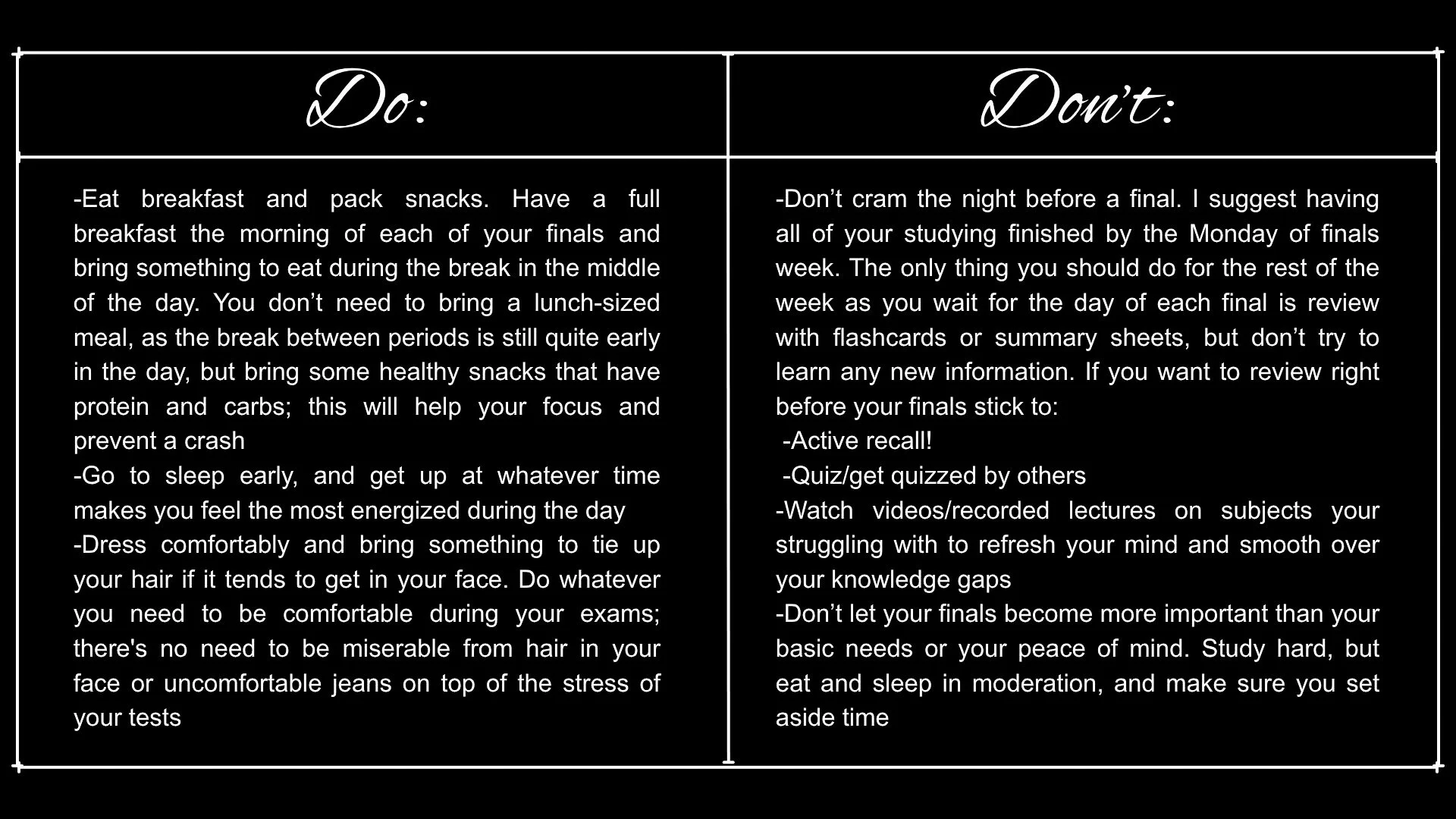
Pamper yourself a little the Sunday before finals week. Take a nice shower, do a facemask, watch your favorite show- anything you need to start the week with a positive attitude. Above all else, don’t let yourself be consumed by nothing but finals and school. Find a healthy balance and you’ll be rewarded by better performance on your assessments.
Good Luck:
Remember, your grades do not define you as a person. Familial and societal expectations can make it feel like they do, but one bad grade won't define your entire life. If you show consistent effort and work ethic, that tends to be more important in the long run than a pristine report card.
Just try your best and take care of yourself, and finals might not feel so scary. Happy finals week and happy holidays!