
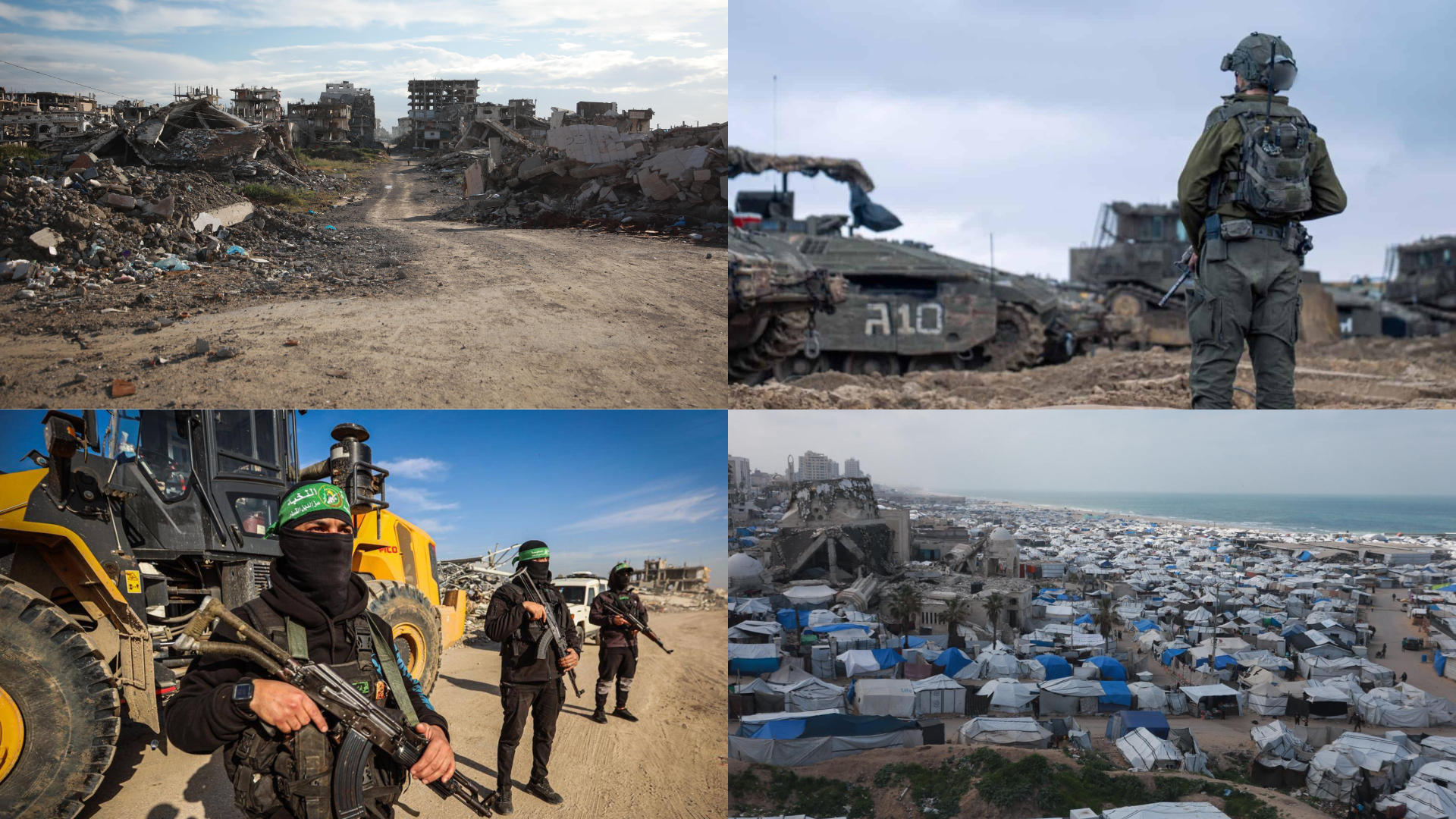
A collage of the war within the past year (Aiden Damasco / The Puma Prensa)
By Aiden Damasco, Features Editor & Web Developer, and Hugh Cochrane, Photo Editor
Where were you on October 7, 2023?
Most people remember the day, but for those who don’t remember, on October 7, Hamas and other Palestinian militant groups crossed from the Gaza Strip into southern Israel, killing over 1000 people and kidnapping an additional 250. Following the attacks, Israel launched a retaliatory military campaign into the Gaza Strip; according to the Israeli government, this was to dismantle Hamas and recover the captured Israeli hostages. This resulted in a large-scale war that has involved public outcry not just in Israel and Palestine, but internationally.
The original attack was three years ago.
In the years following, due to the conflict’s magnitude and the frequent instability within the region, much of Gaza has experienced widespread destruction and a severe humanitarian crisis, in Gaza especially.
As of October 20, 2026, the UNRWA also estimated that over 741,000 Palestinians had been killed in the fighting, with another 175,000 injured.
The UNRWA (United Nations Relief and Works Agency) estimated that, since the war’s beginning, twenty million Palestinians have had to make health-related hospital visits, and over 730,000 people in the Strip have been displaced, including 520,000 children.
Even with a ceasefire established in 2025, the violence has persisted. It is estimated that over 1,000 people have died in the time from the ceasefire’s start to now with an additional 5,000 injured.
Another major problem for people in the Strip is a lack of safe housing, the quality of which has consistently worsened over the last three years. The OCHA’s (United Nations’ Office for the Coordination of Humanitarian Affairs) most recent report has done estimates on the current state of housing and food production in Gaza. They have concluded that daily food production is down 12%. OCHA has also concluded that if aid could be sent into the Strip, they would only be able to help around 18% of families currently in Gaza.
So, why can’t the United Nations get enough resources into Gaza to help support the region that is currently in a Phase 5 famine? According to the IPC, a stage 5 famine is where at least 20% of households are lacking food and there are at least 2 non trauma related deaths per 10,000 people per day.
One reason could be a lack of funding.
The UN is simply unable to provide humanitarian aid on such a large scale while still providing aid to other parts of the world. The WFP (World Food Programme) currently supplies food to about 1.1 million people in the strip as of October 19– which is down from 1.6 million in September. Worse, ration sizes have been cut in half and cash assistance has dropped substantially. The funding is nearly half that at the same time in previous years, and the WFP “Urgently Requires 450 million to maintain critical operations in Gaza and the west bank” to this march. The UN has also cut the number of people receiving assistance in the West Bank from 400,000 to 200,000.
OCHA has also done research into the West Bank, where between October 1 and 15, violence had killed five and injured about 240 Palestinians. Israeli forces have also allegedly targeted olive harvests in the region according to OCHA and Reuters, marking a rise in violence on the West Bank of Palestine with a previous report listing 26 people killed since the start of the year.
One of the most notable attacks in recent years was the murder of Shireen Abu Akleh, an American-Palestinian journalist reporting for the news organization Al-Jezeera in the West Bank. She was shot and killed by an IDF soldier while wearing marked reporter gear, and during her funeral, violence erupted between mourners and the IDF.
An estimated 300 journalists have died in Gaza with an additional 400 journalists wounded. According to the UN, about 70 of these journalists have been killed as a “reprisal for their work.”
This makes it by far the deadliest conflict for journalists in history, with more journalists killed in the span of the war than in the entirety of WW1, WW2, Korea, and Vietnam combined. On top of the hundreds of journalists killed, the UN has estimated an additional 100 have been detained and have been allegedly brutally tortured and branded as terrorists. If these cases are indeed true, these would be war crimes under articles 32, 50, and 79 of the Geneva Convention.
On the third anniversary of the attacks, many protests occurred throughout the Bay Area. One notable protest was at UC Berkeley, where both pro-Israel and pro-Palestine supporters came to UC Berkeley’s Sproul Plaza and Sproul Hall, and both sides unfurled flags, set up stands, and hung up posters. Further demonstrations occurred at other campuses nationwide, including both UCLA and Columbia University.
Besides universities, many protestors have also brought their demonstrations to city halls and public spaces to call upon their local and federal officials to take stronger positions on the war. The war still leaves people divided. Pro-Israel supporters have called for increased support for Israel’s security in the Middle East. On the other hand, pro-Palestine supporters have continued to demand for an end to the warfare in Gaza and for officials to provide greater humanitarian aid for Palestinians.
Online and on social media, many have also raised concerns about the United States’ role in both funding and military assistance in the conflict, especially about the United States’ relationship with the Israeli government.
Internationally, recent responses to the conflict have been attempts to establish a strong ceasefire agreement between the two sides. In July 2026, the European Union’s delegates to the United Nations called upon Israel to allow unrestricted humanitarian access to the Gaza Strip, the reopening of border crossings, the protections of civilians, and to allow access for international media. The EU also called for the eventual withdrawal of Israeli forces from the Strip.
The next month, UN officials emphasized the importance of establishing a unified Palestinian government that could govern both Gaza and the West Bank. The UN also restated their support for the two-state solution between Israel and Palestine.
The delegate, Quenten Wiler, in his address to the UN listed a variety of concerns-–and solutions—across various international conflicts with a focus on the middle east. He called for “the permanent disarmament of Hamas” and for the “full withdrawal of Israeli forces.” He also spoke on the issues in the West Bank, urging “the government of Israel to reverse the expansion of settlements.”
Alongside the push for humanitarian aid and reforms, Wiler also spoke on general security concerns in the Middle East. They targeted issues such as terrorist attacks from groups like the Houthis and also called for deescalation of the conflict between the US and Iran.
With a ceasefire in name only, it may appear that the violence has stopped in the region; but this is far from the case. Even with attempts to stop the unnecessary bloodshed, only the test of time will reveal if these attempts will finally be put into action.