
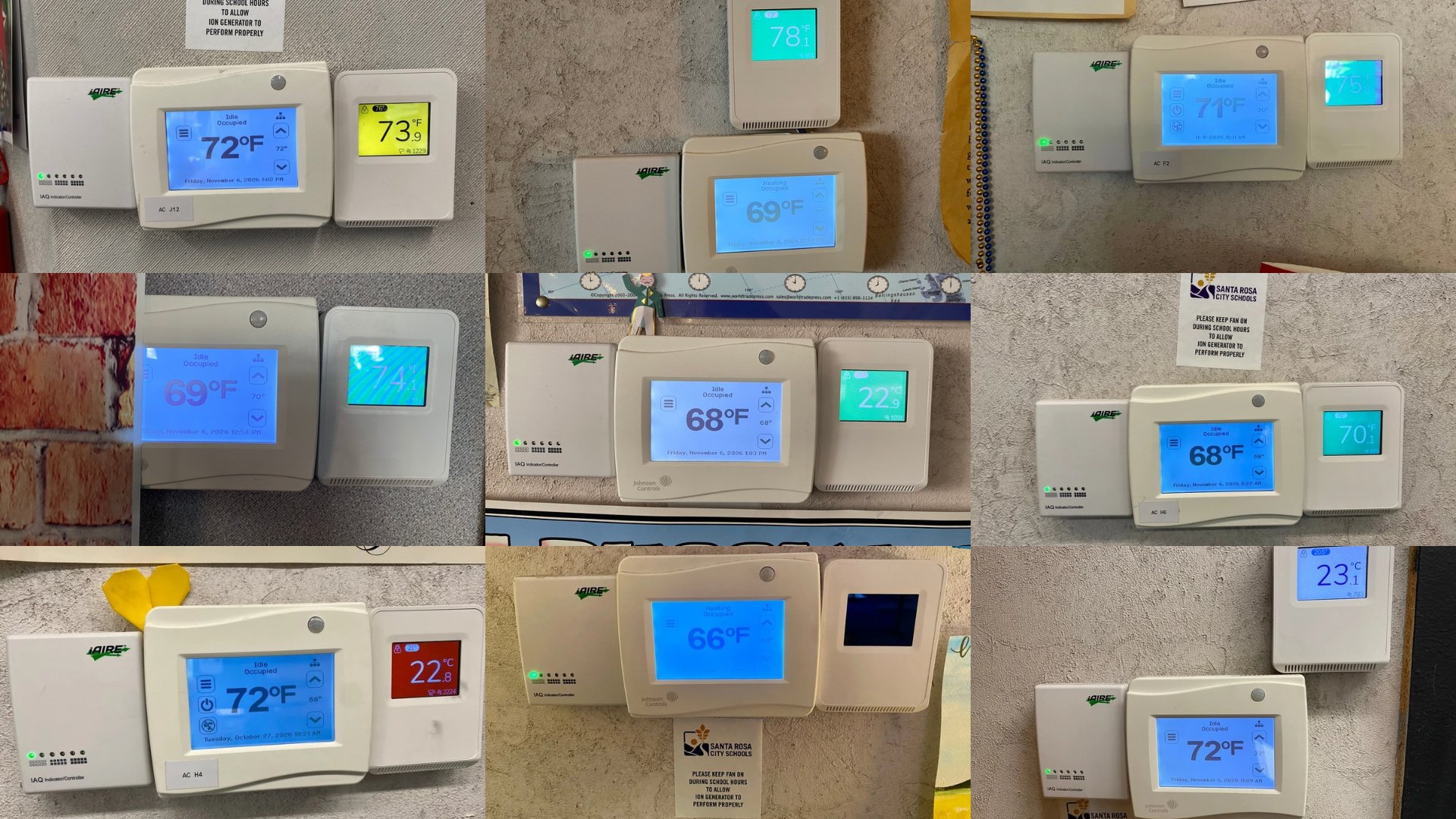
A collection of various classrooms' thermostats at Maria Carrillo High School (Ryan Win-Ruan / The Puma Prensa)
By Ryan Win-Ruan, Senior News Editor
All too often, students at Maria Carrillo High School have walked into a classroom and felt a drastic drop in temperature. Although the coldest rooms are all but figured out, a major question remains: why?
At MCHS, students note that the math and science buildings tend to be significantly warmer than other departmental buildings, sometimes four or five degrees Fahrenheit hotter than English and history classes on the same campus.
This is largely in part due to the wide variety of construction and placement methods featured across buildings: the coolest areas by far, MCHS’s English and history classrooms in buildings N and M are arranged into long, narrow structures, meaning that every room is exposed to the outside atmosphere. This linear construction, combined with thin interior walls and large windows, creates poorly-insulated classrooms which leak heat and sweeping drafts that carry out any remaining warmth. These features are maximized in classes on the corners of each building, with two perpendicular walls containing windows (as opposed to the singular windowed wall on most classes), thus inducing perpendicular ventilation, a vastly more effective form of natural circulation than single-opening ventilation, and creating better airflow to carry out warm air when both windows are open.
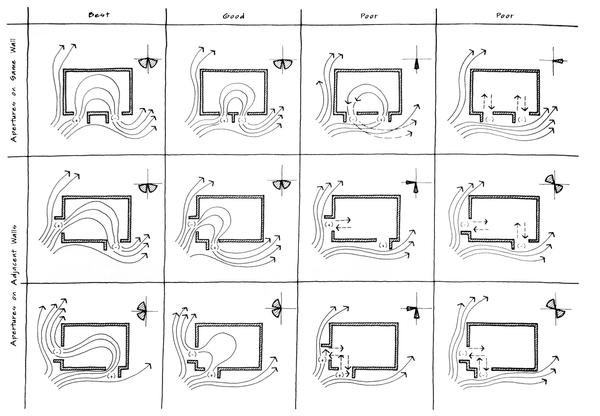
Meanwhile, the science department’s D building is built into a block-like structure, with thicker walls and fewer windows limiting ventilation and trapping heat more effectively. Compounding this are the centrally-located rooms, which, in the case of the science building, are the many labs and hallways between the outer classrooms, which trap warm air inside and allow for more consistent temperatures. Additionally, the higher ceilings of the science rooms and labs create taller spaces which aren’t directly in the path of airflow, further dampening the cooling effect of natural ventilation.
The math department’s E, F, and G buildings, by contrast, employ different tactics in order to retain heat. They, like the science buildings, are arranged in blocky structures with robust walls and limited windows. But this is where the similarities end. With their compact size and shorter ceilings, they should, by all accounts, be cooler than they are.
However, unlike other departments’ classrooms, their corners are covered with small display compartments rather than leading directly into another classroom, and thus minimize the perpendicular cross ventilation which other classes must tackle. Their central location also allows wind to break on other buildings near the school’s outer perimeter, and are thus protected from the harshest winds by the social studies departments to the east, the library/administrative offices to the west, the gyms to the north, and the foreign language buildings to the south.
However, some of the reasons for these inconsistent temperatures also lie outside of the school itself: there is no federal or state law restricting acceptable ranges of classroom temperature, and instead, the Occupational Safety and Health Administration (OSHA) has guidelines for workplaces and classrooms experiencing extreme temperatures. These guidelines, however, are not thoroughly enforced and only have power as recommendations, thus leaving control of K-12 school climates in the hands of smaller administrative bodies.
In the city of Santa Rosa, for example, classroom temperature and climate conditions are controlled by each individual school, though Santa Rosa School District’s Facilities, Maintenance, and Operations Department (FMOD) provides a standard preset point for each school’s HVAC units. For SRCS in particular, the exact temperatures are 68 Fo for cooling, and 72 Fo for heating, in line with the 68-76 Fo range which OSHA recommends.
According to Alejandro Escobar, the Custodial Manager of SRCS’s FMOD, the temperatures are an ideal midpoint between being “comfortable for students and extending [HVAC] unit lifetimes” in order to minimize maintenance. Despite the district’s hands-off approach, they employ a small team of technicians to maintain the schools’ HVAC systems, and call in contractors for larger issues.
But this form of management is not without issue. At MCHS, every classroom has a thermostat for temperature display and a CO2 detector (which also displays temperature), but these climate controls are often inaccurate, at times displaying different temperatures from one another, even when in the same room. Furthermore, as Escobar elaborates, “each building has its own HVAC unit, and larger offices have two to three of them,” thus leaving temperature up to individual departments to decide.
Despite the issues and inconsistencies, many students have come to regard the temperature variances as a defining feature of the school, and, upon questioning, friendly comments of “English classes are the coldest!” and “the Language rooms are freezing!” could be heard as students chimed into the conversation with their own experiences.