
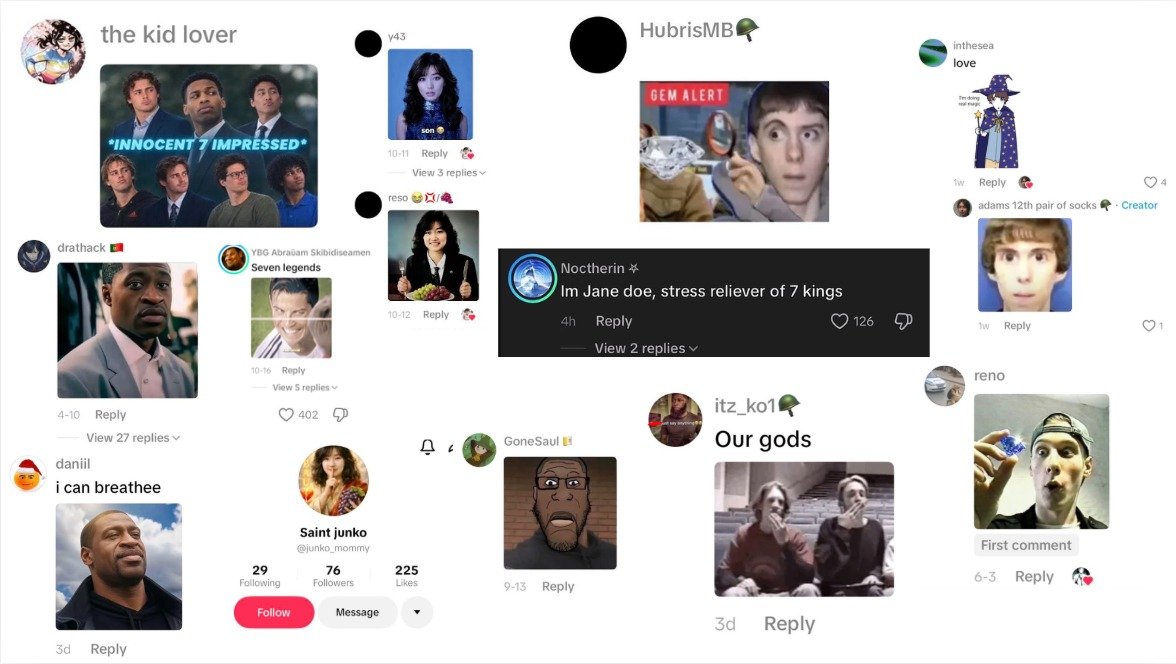
Screenshots taken from various comment pages on TikTok videos turned into a collage. (Caeden Chee / The Puma Prensa)
Caeden Chee, Staff Writer
With the expansion of connectivity and development of the modern internet, the spreading of ideas and opinions has become easier than ever. People across the globe are able to freely share their thoughts on various social media platforms like TikTok, Snapchat, Facebook, Youtube, or X (formerly Twitter).
Nowadays, most of the younger generation use social media as their standard form of receiving news and information on different events across the world. News outlets have been forced to create and operate accounts on such apps if they want to appeal to the ever-growing younger population.
However, because humanity is humanity, we have different views on various topics. We are driven by an incredible sense of hubris and mission to get others to follow our virtues, and with the use of the internet, anyone is able to spread misinformation and vehement judgements as much as they want under the guise of anonymity.
One of the internet’s major downsides is the “memeification” of victims, where users on the internet take a frivolous stance on a real and verifiable case in the world—murders, rape, assaults — and transform it into a lighthearted situation, making memes or jokes about the victims’ circumstance.
The recent Cornell 7 case is a perfect modern example of this ideology. A woman, only known as Jane Doe, stated that seven men from the Chi Phi Fraternity raped and sexually assaulted her for at least four hours. Some users on social media have come to defend the perpetrators, calling them the “Hero 7” or ridiculing the victim by stating her as the “true stress reliever” in reference to the men who used her for their own “relief.”
Humour is now used as a way for undermining the seriousness of the situation, and in turn, it normalizes the idea of rape culture and toxic sexuality for the younger generations. It also shames the victim for pushing back against the dominant narrative of the biases towards men while also re-traumatizing the victim as they have to relive their past and face further mockery from the gaze of others in the world.
Unfortunately, this isn’t only a recent theme, dating back to many decades like the 1980s being indifferent from ceaseless ridicule, as seen in the case of Junko Furuta.
Furuta, a 17-year-old high school student from Japan, was abducted on her way back from school and raped by four different male perpetrators for 44 days straight before being murdered and having her body stuffed into a concrete barrel; the perpetrators were aged 17-18 named Hiroshi Miyano, Jō Ogura, Shinji Minato and Yasushi Watanabe.
In recent years, users on various social media platforms, especially TikTok, have turned her into a symbol for the glorification of rape. Editing her face onto the latest mainstream memes, the internet has primarily transformed her into a sort of sadistic joke, rather than an actual victim of sexual assault, murder, and kidnapping. Many have also taken to holding her perpetrators as symbols of authority and male dominance, depicting them as righteous for “putting women in their place.”
Additionally, the glorification of killers is also reflected in numerous other cases internationally, even seen in America with the Sandy Hook Elementary Shooting.
Adam Lanza walked into Sandy Hook Elementary School on Dec. 15, 2012, shooting and successfully killing 26 people in the process, 20 of which were small children. Even with all of his horrific actions, he was not deemed as a “villian” in the eyes of a minority of people: the True Crime Community. Instead, they revered him akin to a “God.”
Lanza was also inspired by the 1999 Columbine High School Massacre; one of if not the most infamous school shooting incident in the world. Eric Harris and Dylan Klebold shot and killed 13 students at Columbine High School on April 20, 1999, which would go on to influence 70 other crimes in the future.
A small fandom for Harris and Klebold has also been formed on social media platforms, deeming themselves as the Columbiners.
Multiple drawings and edits have been made of them since the occurrence of the shooting, but it has been exponentially increased with the development of modern internet. Many creations fixated on their appearance and ideals. Because of this, small but disturbing communities have been formed and immortalized in fixation of these perpetrators and many other mass-murderers, infantilizing and justifying their actions.
The major factor in those who participate in these communities are their poor mental health. These communities encourage others, especially children, to imitate and follow the ideologies of these perpetrators, more often than not born from a lack of mental and physical stability.
Similarly, this can be found in the neo-nazi subculture of TikTok. They represent themselves with two lightning bolt emojis, symbolizing Hitler’s Schutzstaffel. The community holds zealous beliefs on upholding white supremacy and discrimination of those unlike them, and because of this, victims of racial or homophobic hate crimes are frequently mocked by them.
Perhaps the most famous example of this would be George Floyd’s murder back in 2020. His death was seen as a result of police violence and most significantly a case of racial discrimination in America, leading to the nationwide “BLACK LIVES MATTER” movement in the same year. Many users aligned with anti-Black ideologies came online to laugh and joke about Floyd’s final words, along with the protestors of the cause— they made stickers of Floyd’s face and painted the protestors as radical and too zealous in their beliefs.
Equivalently, the murder of Brianna Ghey mirrors the rampant anti-queer ideology found in such communities. Her identity as a transgender-woman was a leading cause for her death by Scarlette Jenkinson and Eddie Ratcliffe, who wondered if “[she] would scream like a girl or a man.”
This ultimately leads numerous people of minorities to suffer severe mental health risks, hating themselves just because of their race, sexuality, or gender. In a society that caters to a white heteronormative worldview, this could lead to detrimental effects on such people as they battle constant hate from cyber-bullying to real-life examples like lynching.
As a result of animosity and mental health instability, young victims resort to destructive coping mechanisms like self-harm, self-starvation, and in the worst cases, suicide.
The significance of this shows how nobody is excluded in mockery and shame in real life. Anyone can be a victim, whether they’re privileged within society or oppressed, and it could happen at any time as long as the internet exists.
Your wife, daughter, son, mother, or even you yourself could have your life cardinally transformed at any moment or second; fate and harm is not discriminatory to anyone or anything. Because of this, we as a society should learn how to be more empathetic, as well as having more basic respect and decency for any tragedy that happens across the globe.