
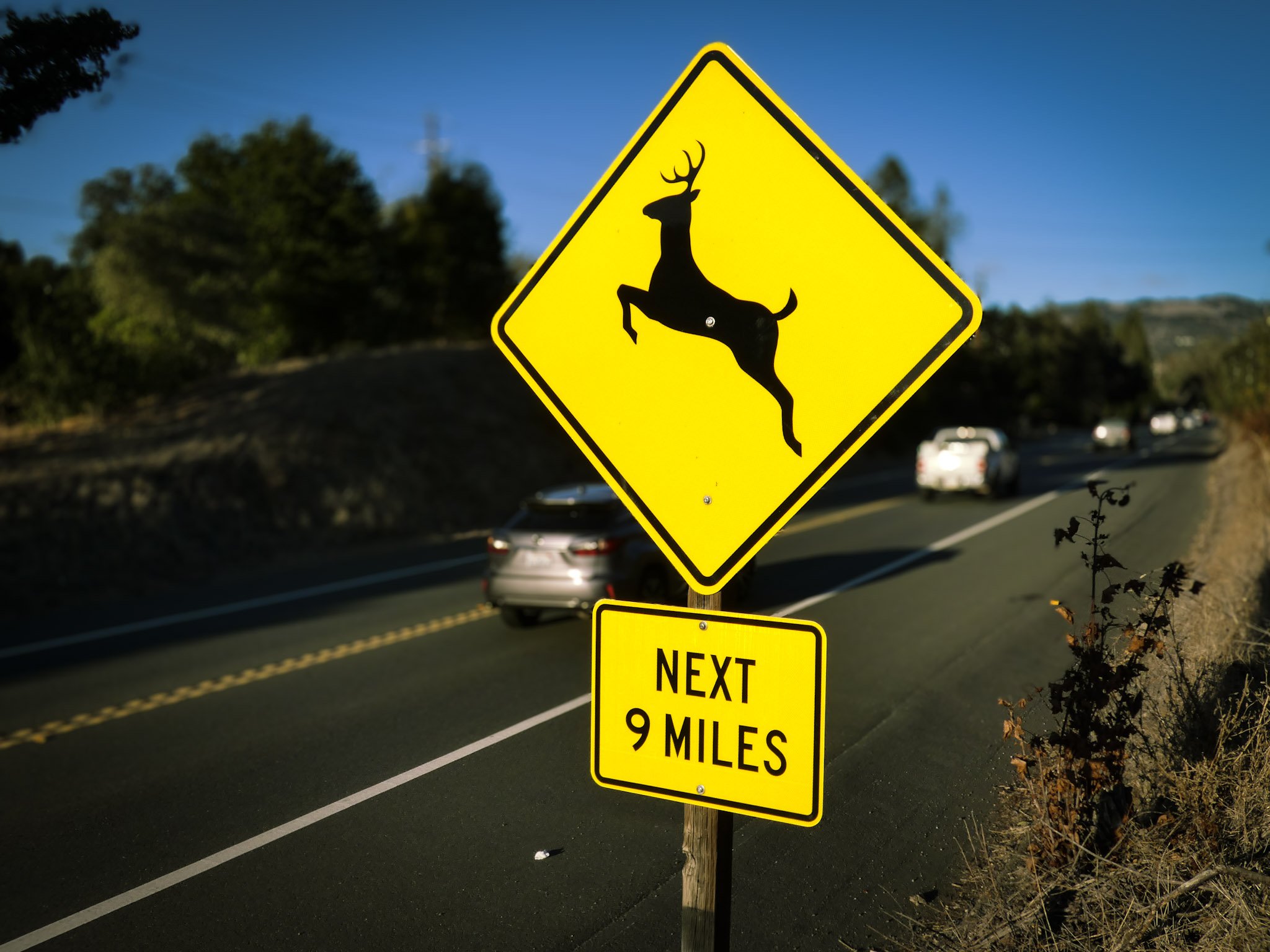
Deer crossing warning sign on Mark West Springs Road. (Lily Peltz / The Puma Prensa)
By Lily Peltz, Staff Writer
If you’ve ever driven certain roads in Santa Rosa, like Mark West Springs Road, Calistoga Road, and some stretches of Highway 12, you’ve probably noticed there’s almost always roadkill on them. Most often squirrels, skunks, deer, and birds.
Or maybe you haven’t noticed this problem at all.
But this isn’t really your fault. Roadkill just isn’t a topic that comes up often, so most people never think about it.
Animal safety is almost never talked about in conversations about driving, where it is arguably most important. In the entire 22 sections of the California Driver's Handbook, wildlife safety is brought up a grand total of two times. Once telling people to watch out for signage with pictures of animals, and to slow down if they see one on the road, and once saying that if they hit an animal they should call the humane society and not touch it. This is really not enough to actually imprint the idea into a new drivers’ head that they should take care not to hit wildlife.
Drivers Education courses, like DriversEd.com, discuss it more, but in a way that only focuses on the impact to a driver, not the safety of the animal. The site says this on animal collisions, “they cause deaths, injuries and expensive car damages.” They’re more focused on the fact that hitting an animal could cost you money than the fact that you just killed a living thing.
Other animal rights issues, like hunting and animal testing, have numerous laws and regulations placed on them, but the government seems to stop caring about animal safety once it comes to regulating their deaths on the road.
Another factor leading towards the lack of care for animals on the road is that the act of being in a car itself separates a person from reality. According to Accurate Auto Advice, being behind the wheel makes a person feel like they are less vulnerable, and can therefore act more recklessly. It also makes people less empathetic towards other drivers and pedestrians, as they feel physically separate from them.
This same psychology applies to encountering animals on the road. Unless you’re hitting something like a moose, you are not likely to be the one getting hurt when you hit an animal, which makes a collision feel less dramatic or important. But obviously, it’s important to the animal that ends up dying or being critically injured by the accident.
And honestly, is it a big deal to hit something as common as a squirrel? They aren’t endangered or even threatened; there’s nobody protecting squirrel rights or starting squirrel nonprofits. But why should that mean they deserve to die?
For most people, seeing an animal often can cause the experience to lose its wow factor, which in turn makes people lose sympathy, because they don’t think of the animal as special anymore. Just because an animal is common or “uninteresting” to you does not mean its life has any less value than an exotic animal. Animals shouldn’t have to be endangered for them to be worth not pointlessly killing.
Sometimes there is no reason for not caring about roadkill. Some people just genuinely lack empathy for living things that aren’t human. This view can manifest in the belief that it’s the animal’s own fault for walking onto the road, that they were stupid for trying to do something that could result in their death. This is an exceptionally cruel way to think. How apathetic do you have to be to suggest that an animal is stupid for trying to move around in its natural environment? An animal should not be punished because humans have destroyed its home.
This mentality is a symptom of a greater issue. We, humanity, have cut ourselves off from the rest of the natural world, building walls and houses and pavement and roads. We’ve tried as hard as we possibly can to establish that we are not animals; we like to see ourselves as so much smarter and more important than them, and therefore showing them empathy would place them on the same level as us, thus insulting our “superior intellects.”
But we are animals. To separate ourselves from every other species on Earth just because we evolved bigger brains is to ignore and diminish all the beauty and wonder existent throughout the animal kingdom. We should not try to pick out what we are best at, and hold it over their heads, saying we're above them, as if there aren’t countless things we couldn’t even dream of doing that other animals do as second nature.
It should not be so incredibly difficult to show them enough empathy to not hit them with our cars.
Empathy for all living things is a need, nowadays more than ever. Having kindness and respect not only for other people, but for the whole animal kingdom is one of the most powerful things you can do. We are not separated from the rest of the Earth; no matter how divided we’ve become, we are still animals. We still need the Earth just as much as they do. Do not forget this.
Let’s zoom back into our specific issue here; roadkill. If all of this has inspired you to care more, here are some possible next steps.
It’s important to remember that, like most animal rights issues, the main culprit is a bigger system, rather than an individual, but the burden to find solutions always seems to fall upon the individual anyway. The root cause of roadkill is that roads are being built through natural habitats, without regard for the damage it will do to the animals that now have to adapt around it. People continue prioritizing our convenience over the animals whose lives we are ruining, and so the real solution to this problem would be stopping the creation of roads through natural habitats. But with the rate of our expansion, it is extremely unlikely roads will stop being built, and it’s not like we can just get rid of the roads that already exist, so what can we do if the responsibility lands on us, the drivers?
One thing we can do is be educated on animal activity in certain areas. Learn which roads frequently have animal activity on them and be extra vigilant when driving them, and be aware of different animal migration patterns to know when it's more likely for animals to be moving through different areas. For example, it’s currently rutting season (deer mating season) meaning they will be moving around more in the daytime, so try to be careful around areas with deer populations.
You can also support bigger efforts. Join protests against the construction of roads though vulnerable habitats, back efforts to establish wildlife highways, and push local governments to try harder to protect wildlife.
The biggest thing I can say is to be mindful. It is genuinely that easy. Just make more of a conscious effort to avoid animals on the road. That doesn’t mean that you should risk getting into a crash, or putting yourself or others in danger to not hurt animals on the road, but it does mean that if you’re about to mow down a skunk, and you can steer away from it, do it.
If you just try to care a little harder, you could save a life. That matters, even, or maybe especially if that life is just a squirrel’s.