
From classical to charro: Matthew Bowker
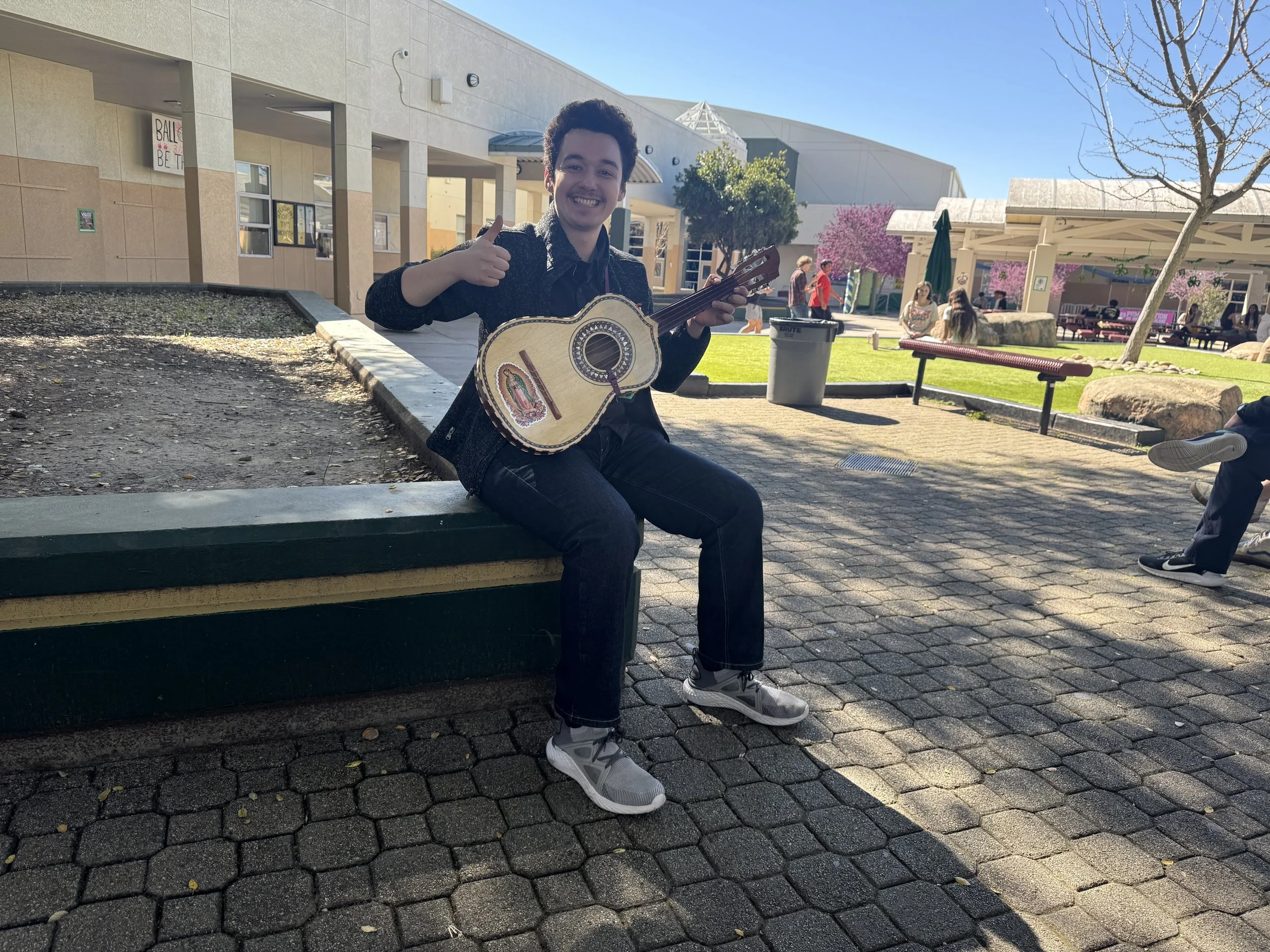
Photo of Mathew Bowker (Miguel Ramirez / The Puma Prensa)
By Miguel Angel Ramirez, staff writer
Around campus in the early morning, Mathew Bowker can be found waiting idly in the band room for his zero period class, sipping his coffee from an old Mexican Jarito style mug, as the mug his students got him from Disneyland (with the words Abuelita in big pink letters) broke the year before. Later in the day he moves on to his other classes, be it Mariachi, Orchestra, or Jazz Band. During lunch, he’ll pull out a vihuela with a decal of la Guadalupana and fine white wood accented with dark brown, and play along to whatever tune he finds, always chiming into a student's conversation and helping anyone who comes up to him. Later on, his day shifts to the Luther Burbank Center where he teaches the trumpets and all of the group practices.
His impact around the school and the Luther Burbank Center cannot be overstated, bringing new programs, groups, and ideas in the short time he has been teaching. He introduced the Mariachi program to Maria Carrillo High School, creating the first high school Mariachi in the Santa Rosa City Schools District. At the Luther Burbank Center, he became the director of the program he created, the all female Mariachi Rosas, the first all female youth Mariachi in Northern California, as well as taking the most advanced Mariachi of the program, Mariachi Cantares De Mi Tierra, to state competition and winning third in the state.
Bowker's interest, ideas, and passion in music have spread around Santa Rosa, and he has managed to make what was a fascination of music into a career of uplifting others. Bowker says that he “started playing music in school when it was part of my music integration, and I chose the saxophone and played it up into highschool.”
When asked why he chose Sonoma State University, Bowker replied: “I chose SSU because, growing up, we didn’t have a lot of money. My parents sat me down and told me we can afford to apply to two colleges. So I applied to Cal State East Bay, who offered me a full ride scholarship on the spot, but chose Sonoma State, which was closer to home … who after a year gave me a full ride scholarship.”
At Sonoma State University where he studied classical saxophone as his major as well as studying for music education. It was there in college where he also began to externalize a passion for Mariachi, which had been a growing love in the background of his life. When asked about how Bowker found his love for Mariachi, he said how “I always loved Mariachi growing up half Mexican half Portugues, it was always playing in the house or at parties.” But, he was “more of a Banda lover, and my] family didn’t like Banda at all.” The passion for Mariachi and Mexican culture as a whole continued to grow until after college when he furthered his journey into Mariachi by joining the Luther Burbank Center as a teacher.
Bowker “always loved Mariachi but never played it… being the only musician in my family.” Later on he was given an opportunity to play when the former Luther Burbank Mariachi director, “who [he] was friends with”, offered him a position working at summer camp teaching music. The first day he was there with his “little vihuela I got off of Craigslist, that was basically plywood” and seeing that sheer talent in the room, drove him further to better understanding and mastering the music. Later on former director said “I’m leaving the program” and asked Bowker “Would you like a position teaching mariachi?” Bowker jumped at the chance of being a director and gladly chose it furthering his journey into mariachi.
When asked how his first day as the mariachi director Bowker said that, “the first day as ‘big boss’, I will never forget it because the old director told the kids he was never coming back, with me in the room, within the first five minutes of class, and I had to take it from there”. Bowker detailed how he had to catch “the kids' interest again” as it was like starting from the beginning since their old director left. The two did things very differently making the shift a little jarring but over time as Bowker puts it “the kids became my kids and now were at a good spot” with them having more synergy and cohesion.
On the other side at Carrillo, Bowker began student teaching when he was still at Sonoma State. After almost being placed at Marin, Bowker began teaching at Carillo wanting to bring in new ideas
Bowker describes himself as “not the biggest fan of doing the same thing that has been done for music education, especially at the school level” wanting to bring change to the music found in
Carillo.
“I started there and the first thing that I was thinking was that we need to bring some diversity to the table. We have the players, have everything, we just need to do it”. Luckily, Bowker had a guitarron player Marta, being a senior at the time, who was enthusiastic about starting a mariachi at Carillo helping get the Maria Carillo mariachi off the ground; with her now being a Teacher at the LBC.
Through this Mariachi was able to start out as a club at carillo playing at different gigs and odd jobs eventually becoming a fully fledged class and solidifying its place as the first mariachi class in Santa Rosa City Schools.
Overall Bowker has had a profound impact on the community surrounding Sonoma County. With Mariachi Rosas he has made the first all female youth mariachi in Northern California allowing for more diversity and opportunities for others, Under his direction the Luther Bank Center’s mariachi has flourished and even placed third in state competition. At Maria Carillo Bowker has made connections with his students being both a teacher and friend to those around him, Making a mariachi were people who would have never taken a music class finally take the chance and opportunity to experience one, his impact once again cannot be understated as it is seen everywhere around Maria Carrillo
And as Bowker recommends “do music; it is the only, only thing that can work your entire brain and its what define us as human beings.”