
Jordan Henry: energy and drive in the classroom and out on the field
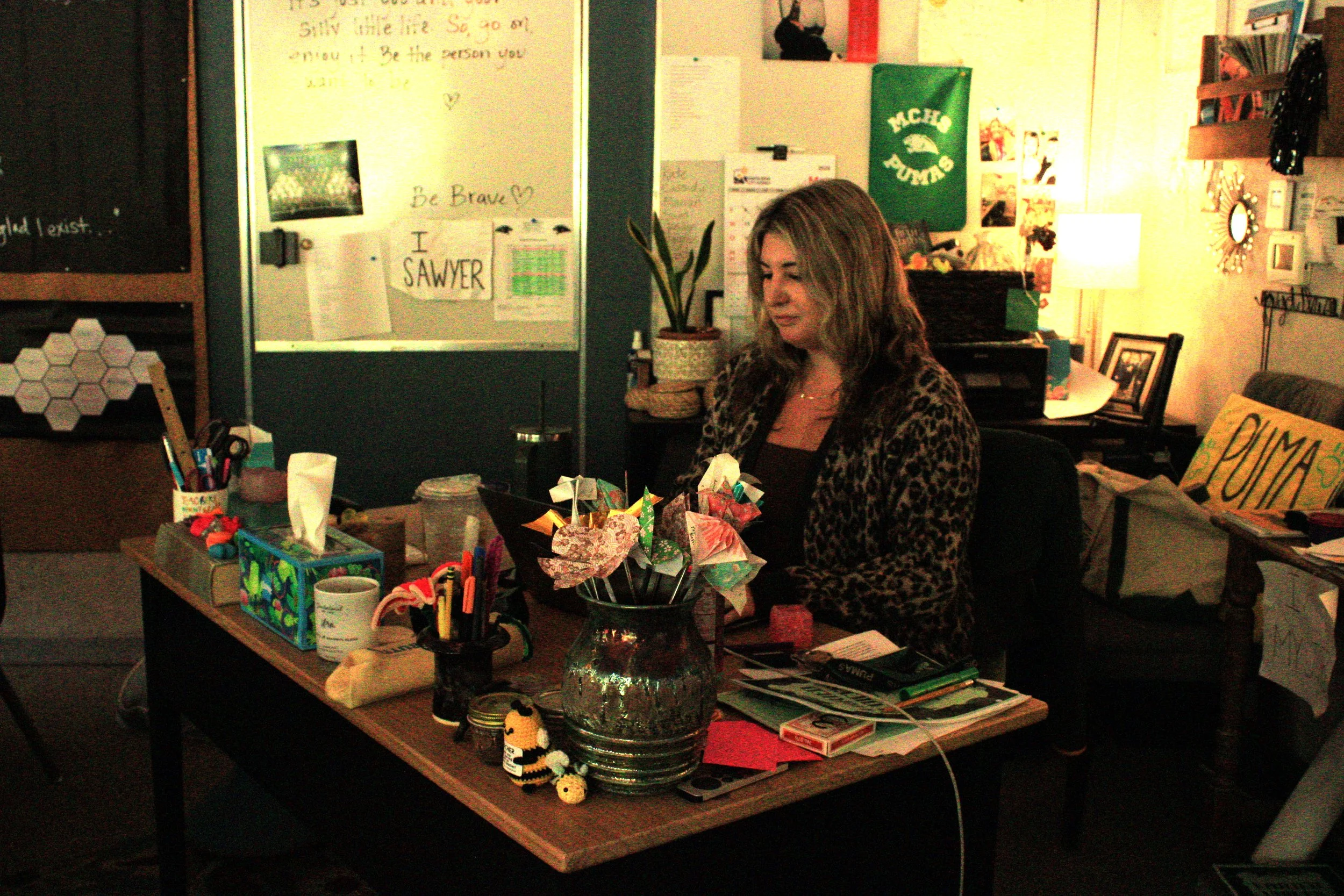
Photo of Jordan Henry working at her desk (Rheya Bushan / The Puma Prensa)
By Rheya Bushan, Features Editor
On most days at Maria Carrillo High School, AP Literature and Honors Sophomore English teacher Jordan Henry’s classroom does not follow the usual script. There is no long stretch of silence or predictable lecture. Instead, students talk, sometimes cautiously, confidently or all at once. Henry is usually in the middle of it, asking questions, pushing back, or taking the opposite side just to see where the conversation goes.
“I love discussion,” she added. “I like playing devil’s advocate and trying to teach students to actually say what they mean, and mean what they say.”
That approach shapes almost everything she does. Rather than focusing on getting the “right” answer, Henry is more interested in whether students are willing to speak, disagree, and think through ideas in real time.
In her career as a teacher here at Carrillo, a few books stand out. Mary Shelley’s Frankenstein is the one she enjoys the most because of how much discussion it generates. But the book she describes as most meaningful to teach is Song of Solomon by Toni Morrison.
“It’s rewarding.” She stands firm in this thinking. “It’s important.”
Her interest tends to lean towards books that create tension, stories that force students to deal with complicated or uncomfortable ideas. If she had more flexibility in the curriculum, she would add titles like 1984 or The Handmaid’s Tale, especially at the upperclassmen level.
“I’d like to teach more around censorship,” she said. “Something students can really get into and argue about.”
That last part matters. For Henry, a good book is not one that everyone agrees on, it is one that gets people talking.
This year, she added something unexpected to her schedule: coaching flag football. The decision was not part of some long-term plan. It came down to timing, curiosity and a willingness to try something different.
The district had just introduced the sport, and after years involved in basketball, she was ready for a change. Flag football felt like a reset. It filled in a gap she noticed looking back on her own experience.
“I didn’t have the opportunity to play when I was younger,” she said. “I wish I would have. It always looked fun.”
More than anything, it gave her the chance to be a beginner again.
“I just like learning. So it felt like a really good opportunity to try something new.”
That mindset carried over into a season that ended with unexpected recognition. Henry was named an National Football League (NFL) Coach of the Week by the San Francisco 49ers.
“I was shocked,” she recalled. “I didn’t think they’d even be paying attention to North Bay athletics, let alone a new team. However, we worked really hard. So it felt good to be recognized for that.”
Even after years of teaching, Henry does not really see herself as done with school. If anything, it’s the opposite.
“I miss being a student,” she said.
That feeling is part of what is driving her next step: studying abroad in Ireland, where she plans to focus on contemporary literature. It’s something she has been thinking about for a long time, but only recently started to feel realistic.
“I’ve always wanted to go to Ireland,” she added. “And combining that with continuing my education just made sense.”
The program will involve a major research project—essentially a 30,000 word dissertation—which she sees as a different kind of writing milestone.
At one point, she thought she might write a novel. That is less of a priority now, but she has not ruled out writing altogether.
“I could see myself trying to publish a short story or poetry,” she said.
Long term, she expects to stay in education in some form, even if the setting changes.
“I can’t imagine not coming back to Carrillo at first,” she said. “But eventually, I think I want to teach at the college level.”
In addition to teaching and coaching, Henry helps run Puma Peers. The program includes more than 50 students. “It can be a lot,” she lamented. “There are only two coordinators.”
But the group’s energy makes a difference.
“They’re the most motivated and involved students on campus,” she said. “So that helps a lot.”
Like most leadership programs, a lot of the work happens behind the scenes—organizing activities, and trying to keep things from feeling overly repetitive.
“Sometimes it’s just figuring out how to keep things fresh,” she said.