
Tiffany Jahnke: kindness in the classroom
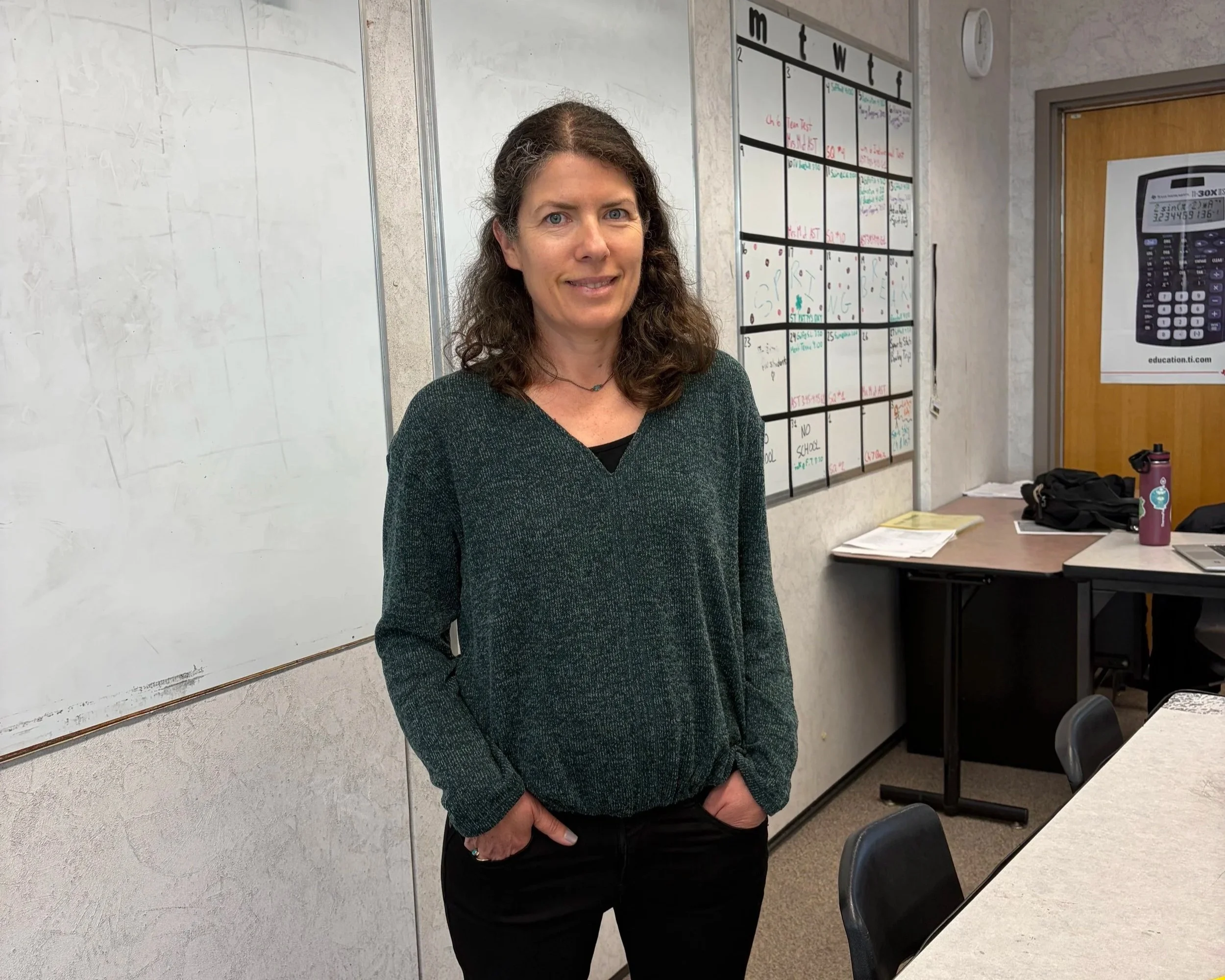
Tiffany Jahnke in her classroom (Keira Eicken, The Puma Prensa)
By Keira Eicken, Staff Writer
We have all heard, and perhaps preached, the slogan that “a teacher can make or break a student's passion,” but what about the times when we refuse to acknowledge the characteristics that create passions themselves?
More often than not, a student can name at least one teacher that they know. It might be the loudest or youngest educator that greets them in the hall whenever they pass, or it could be the teacher that didn’t round up their grade by one percent, an offense leaving them eternally crossed. But when discussing the community of academics, it is of the utmost importance we don’t forget the quiet kindness of educators behind the scenes.
Behind the scenes, instructors work to reform rules, create the timeline of someone's learning, and, most impressively, enhance their own understanding of topics just to master a field for students’ sake. Tiffany Jahnke is no different.
In 2000, Jahnke started her teaching career in Long Beach, California. The school had a balanced calendar schedule (year round), only shutting down during holidays and with a strict schedule of three months of school, one month of break. Jahnke says the schedule was “nice with the frequent breaks, but [she] ultimately missed having a summer.” She also made a point that a long break like summer can be beneficial to both teachers and students' mental load, yet there is not yet a good way to ensure students remember important topics. Her strong opinions on mental health and education being more equal shine through in how she treats students.
After expanding her experience with schools, Jahnke worked with deaf and hard of hearing preschool classes. These classes can include a sign language curriculum, a specialized education to fit different communication needs and even social emotional learning. Jahnke expresses a ton of interest in atypical learning, something many students seek out today. Her calm and unwavering demeanor can encourage students to ask questions and find their own way through problems.
Another compelling reason to get to know Jahnke is her unique attitude towards her job. You will often find her co-teaching with teachers like Mrs. Mancilla and Ms. Getty, both math classes being different from any special education class. In a study done by PhilPapers, an online psychology research group, six different teachers were interviewed on the basis of specialty in different subjects and their corresponding attitude. The research found that, overall, “teachers handling multiple subject areas encounter profound difficulties in preparation, instructional mastery, and pedagogical adaptation.” This, in turn, proved that “teacher's emotional state and optimism in the face of challenging work conditions can be correlated to their self-efficacy and work engagement.” Being able to stay mature and solution-oriented continues to be a stand out quality in people like Jahnke.
A part of her work she utilizes her skills in is overall special education, where teachers need to be prepared to teach all subjects while also aiming to reduce cognitive load. These classrooms are smaller and often have a different schedule than the school they reside at (e.g. starting later, different physical education, and transportation). Jahnke’s involvement with these classes can range from being on the floor and teaching to being part of different committees, one being the Special Ed Task Force. Involvement in different areas is important to Jahnke because she enjoys the community and being a part of “all four years of many students’ high school careers.”
Apart from her thorough experience in special education, as of 2026, Jahnke is not teaching any special education classes. She is co-teaching in three math classes with Mancilla, Getty, and Ms. K. Jahnke also shared that she enjoyed learning about the curriculum of Financial Math, a class that is most likely being cut from Maria Carrillo as of next year. Another part of Jahnke’s work that is being cut is co-teaching. While speaking about pay cuts, Jahnke added that around “one-third of the special education department [would most likely] be cut,” another area of her work being threatened. Jahnke expressed that, although it is always sad to lose any part of education, she believes the special education department is the most vital. Her concerns stem from the fact that many kids under this department not only need extra support in school environments, but that they also need extra motivation in the rest of their lives, especially after graduation. Jahnke stated “[her] goal is that every kid doesn't just graduate, but has a plan after.”
If you really want to understand the impact she has, you can usually find Jahnke at the study spot in advo, or after school, still helping students work through problems, answer questions, and showing that her dedication doesn’t stop when the school day ends, it carries on in the time she chooses to give just to see her students succeed.