
December and its universal festivity
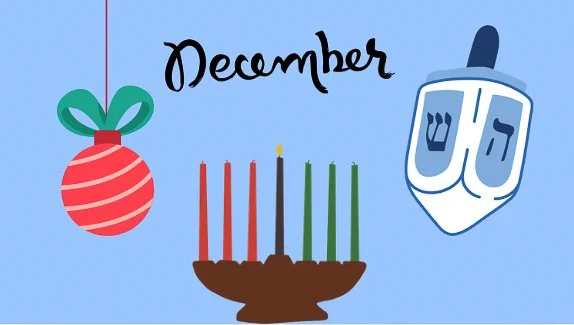
Graphic including elements of Kwanzaa, Christmas, and Hanuka (The Puma Prensa / Keira Eicken)
By Keira Eicken, Staff Writer
December is known for its bright tradition of lights on trees, hot cocoa, and leaving cookies out for Santa, but what else does the end of the year represent around the world?
Boxing Day: Boxing Day is on December 26 and is traditionally celebrated in the UK, Canada, Australia, and New Zealand. It originated from traditions of wealthy employers or house owners giving their servants a "Christmas box" of gifts or money, but for many, the day has evolved into a major shopping event similar to Black Friday in the United States. Boxing Day can also represent a peaceful day to pack up decorations after the chaos of Christmas. Millions of people around the world take part in these traditions.
Hanukkah: Hanukkah is a Jewish festival that celebrates the rededication of the Second Temple of Jerusalem by lighting candles on a menorah each day of the eight-day festival. A component of Hanukkah is the dreidel, a four-sided top that spins and falls, revealing one of the Hebrew letters. Children can look forward to gelt: chocolate coins wrapped in silver or gold foil to represent giving. Foods like latkes, potato pancakes, and donuts are made during this time, and many families cook fried food.
Kwanzaa: Kwanzaa is a seven-day celebration from December 26 to January 1 honoring African-American culture, unity, family, and gift giving. The holiday is not religious, but rather ceremonious and symbolic. Almost 30 million people globally celebrate Kwanzaa with the seven candles, and each part of the Pan-African flag–red (the struggle), black (the people), and green (the future)–representing the seven principles. The principles are unity, self-determination, collective work and responsibility, cooperative economics, purpose, creativity, and faith.
Winter Solstice: The Winter Solstice is marked by the shortest day and longest night of the year, symbolizing the beginning of winter. It usually falls on December 21 or 22. The solstice is a time of observation and celebration, as well as a time to express gratitude for nature and daylight. Festivals like the Chinese Dongzhi Festival and the Druidic Alban Arthan take place yearly concluding the solstice.
Las Posadas: Las Posadas refers to the Latin American tradition of reenacting and commemorating the journey of Mary and Joseph going to Bethlehem. It is nine days long, occurring from December 16 to 24, and includes food like tamales and pozole, as well as music and celebration. Many people take part in dressing up as Mary and Joseph, and hosts can open their homes for “lodging.” This holiday can range in complexity from full, realistic recreations to a simple dinner for some.
Yule: Yule is a Germanic holiday, incorporating winter solstice traditions but adding its own twists. It mainly celebrates the shortest day and longest night and gives thanks for the returning daylight. It spans from December 21 or 22 to January 1. Anyone can celebrate Yule, but it is most commonly celebrated by Pagan and Neopaganism communities. The yule log originated as a tree stump that was traditionally burned for multiple days along with a piece of the past year’s log to symbolize unity. Today, a yule log is a type of cake that is decorated to look like a realistic stump.
Saint Nicholas Day: Celebrated on December 6, St. Nicholas Day is a Christian holiday that celebrates St. Nicholas for bringing gifts. It began in Turkey where a bishop dedicated his life to giving to the poor. Traditionally, the day will consist of feasting and giving small gifts like chocolate and oranges to family. St Nicholas day is sometimes thought of as the holiday that Christmas is based off of, and St Nicholas has since evolved into Santa.
There is always a new perspective, place, or tradition that uniquely expresses holidays in a way you may be interested in.