

Is it lawful? (April Huang / The Puma Prensa)
By April Huang, Staff Writer
Warning: This article contains mentions of death and crime that may be triggering.
You may have heard of the death penalty, the capital punishment given to criminals convicted of crimes such as first degree murder, treason, espionage, and many more.
Recently, on October 7, 2026, Defense Secretary Pete Hegseth announced in a media interview that Nidal Hasan’s execution by firing squad would be publicly live-streamed.
Nidal Hasan was a military psychiatrist who on November 5, 2009, brought a handgun to a U.S. military base and opened fire. He killed 13 and wounded 30 more and was sentenced to death.
This announcement was extremely shocking and upsetting to the general public. Not only was this an outrageous statement in itself, but it also brought up an important question— what counts as going too far when it comes to justice?
Is it right to kill someone because of what they did? Are executioners morally right in executing prisoners? What gives them that right?
As a society, we must reconsider the use of the death penalty because the death penalty is unjust, flawed, and often not very effective at its intended purpose of punishing and deterring future crimes.
First, let's look at the purpose of capital punishment: to punish and deter criminals from committing crimes punishable by death.
However, that is where the punishment fails in itself. States that have legalized the death penalty do not have a lower crime rate than states that have not.
In fact, studies have found that states without the death penalty actually have a lower murder and homicide rate than states that do. Consequently, other forms of punishment such as life imprisonment have found to be more effective.
Additionally, support for the death penalty has reached a five decade low with less than 52% of Americans supporting the death penalty. Support for the death penalty has been dropping since 1980, when support reached an all-time high of 80%.
Second, the racial biases during sentencing are extremely skewed, and people of color are almost certainly punished more severely than their white counterparts.
A study published in the Santa Clara Law Review found that those who kill non-Latino whites are over three times more likely to be sentenced to die as those who kill African-Americans and that those who kill non-Latino whites are over four times more likely to be sentenced to die as those who kill Latinos.
This should speak for itself. The data clearly shows prejudice towards Latinos and African Americans during sentencing.
Another study by Stanford psychology professor Jennifer Eberhardt rated Black men on 'how black' they looked. In other words, having highly stereotypical features associated with black men. 57% of the men that were rated highly in stereotypical features were sentenced to death, while only 24% of the men rated low in stereotypical features had been sentenced to death. “Those strong distinctions signal that our perspectives, our criminal justice process and our institutions are influenced by primitive racial narratives that link people of African descent to darkness and evil,” she says.
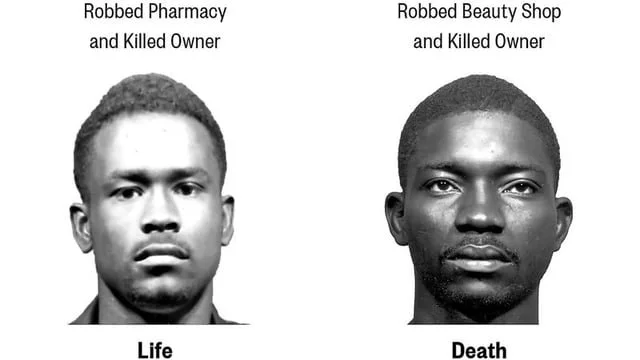
Oftentimes, a defendant's case or testimony is completely ignored due to the high volume of cases, and simply sentenced without further ado. Not only is this extremely unethical, but it is also unfair to the defendant who is stripped of their lives without a second glance.
A prominent example is Ker’Sean Ramey, a 41 year old man, was recently executed on September 26, 2026 for the fatal shooting of three people in 2005.
During his trial, his jury deliberated for less than 14 minutes before sentencing Ramey to death. 14 minutes is hardly enough to do anything, much less deliver the sentence that would influence the course of his life.
He was also represented by a part-time lawyer who did his lawyer job as a side hustle, and who did not have any capital trial experience.
The constitution guarantees all criminal defendants the right to a lawyer. However, it does not mean it is right to give a defendant a poorly equipped lawyer and expect them to be tried fairly.
Later, it was discovered that the Jackson County Criminal District Attorney Office was withholding documents that were potentially crucial to his case.
These constitutional violations were troubling and disheartening to Ramey, but he continued to appeal by filing appeals to the Texas Board of Pardons, the Texas Court of Criminal Appeals, and the Supreme Court of the United States, which were all denied.
In the end, Ramey was executed on September 26, 2026, after over 20 years on death row.
How far are we willing to go to punish criminals? Inevitably, innocent people will be harmed and will suffer the same consequences as the criminals do. The harsher you punish criminals, the harsher the innocents will be punished too.
Pushing the moral boundaries in justice will also push the moral boundaries of society.
Are you willing to punish or redeem?
Further reading:
“Just Mercy” by Bryan Stevenson